Understanding Crown Staples for Manufacturing
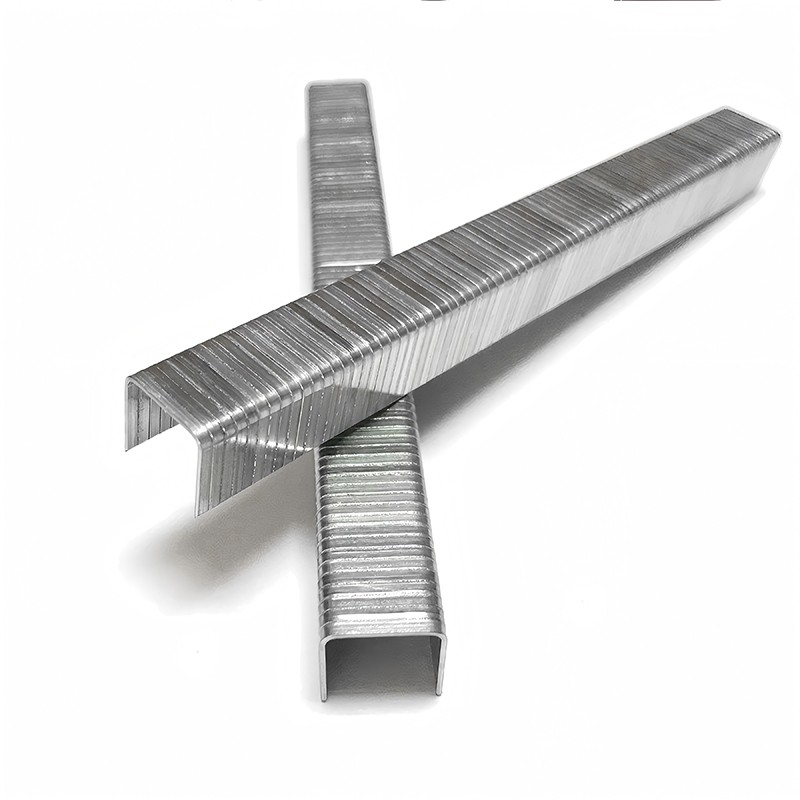
Crown staples are a category of fasteners characterized by a wide, flat crown that bridges the gap between two legs. Unlike narrow-crown staples used in office staplers, crown staples are engineered for industrial joining tasks where holding area and load distribution matter. They are commonly used in furniture frame assembly, bedding and upholstery construction, packaging crate fabrication, and light structural connections in wood and composite materials.
What Crown Staples Are and Where They Are Used
A crown staple consists of a crown (the horizontal bridge), two legs (the shanks), and a point geometry that determines penetration behavior. The crown width distributes clamping force across a broader surface, which helps reduce material tearing in softwoods and engineered wood. In manufacturing settings, crown staples appear in operations such as attaching webbing to frames, securing corrugated packaging, assembling pallets, and fastening thin panels where nails might split the material.
Key Specification Terms Buyers Should Know
Bulk buyers should be familiar with several specification terms. Crown width is the distance between the outer edges of the legs. Leg length determines penetration depth. Wire gauge describes the thickness of the wire used to form the staple, which influences holding power and the tool energy required. Shank type—smooth, ring, or screw—affects withdrawal resistance. Coating or finish, such as galvanized or resin-coated, influences corrosion resistance and friction during driving. Collation type describes how staples are held together for feeding into a tool, and it is the primary distinction between coil and strip formats.
Coil vs Strip Crown Staples: Structural Differences
Coil Crown Staples: Format and Typical Applications
Coil crown staples are collated into a spiral or roll configuration, typically held together with wire or adhesive. This format allows a high staple count per load, reducing reload frequency in high-volume operations. Coil staples are often associated with pneumatic coil staplers and are used in applications such as furniture framing, cabinet assembly, and packaging where continuous feeding improves throughput. The coil format generally suits tools with a rotary magazine.
Strip Crown Staples: Format and Typical Applications
Strip crown staples are collated into straight strips, usually with adhesive or paper tape. They feed into strip-fed staplers and are common in upholstery, bedding, and light assembly work. Strip collation offers straightforward loading and good visibility in precision tasks. Because strips are shorter than coils, they may require more frequent reloading, but they can be advantageous where maneuverability and access to tight spaces matter.
Comparison Points for Bulk Buyers
When comparing coil and strip crown staples for bulk purchasing, buyers typically evaluate staple count per package, tool compatibility, reload frequency, storage footprint, and collation integrity under humid conditions. Coil formats generally offer higher counts per load, while strip formats offer simpler handling and often lower tool entry cost. The choice depends on production volume, tool inventory, and the physical layout of the assembly station.
Crown Staple Sizes and Customization Considerations
Common Size Ranges and Shank Types
Crown staples are available in a range of crown widths, leg lengths, and wire gauges. Shank types include smooth shanks for general fastening, ring shanks for improved withdrawal resistance in fibrous materials, and screw shanks for applications requiring higher holding strength. Buyers should match staple specifications to the substrate, tool capability, and joint strength requirements. Standardization across a product line can simplify inventory, while specialized sizes may require custom production runs.
Customization Questions to Ask a Supplier
Buyers considering custom crown staples should ask about minimum order quantities, available wire gauges and coatings, tolerance ranges for crown width and leg length, collation method options, and lead time for new specifications. It is also reasonable to ask how customization affects packaging and pallet configuration, since these factors influence freight and handling costs.
What Affects Crown Staple Bulk Pricing
Material, Gauge, Coating, and Packaging Factors
Crown staple bulk pricing is influenced by raw material costs, wire gauge, coating type, and packaging format. Thicker wire and specialty coatings generally increase unit cost. Packaging choices—such as bulk cartons, small boxes, or branded retail packs—affect labor and material costs. Collation method also plays a role, since wire-collated and paper-collated staples involve different production steps. Buyers should request pricing that clearly separates product cost from packaging and freight components.
Volume, Lead Time, and Order Planning
Order volume, production scheduling, and lead time influence bulk pricing. Larger volumes can improve production efficiency, while tight lead times may require expedited scheduling. Buyers should plan orders around production cycles and consider safety stock for critical fasteners. Seasonal demand patterns in furniture and packaging industries can also affect availability, so early planning is advisable.
Evaluating a Crown Staples Bulk Supplier
Capability and Capacity Indicators
When evaluating a crown staples bulk supplier, buyers can look at published production capacity, equipment lists, and product scope as indicators of capability. For reference, one company's public profile states that in 2023 its maximum monthly capacity reached 1500 tons of coil nails and 300 tons of paper strip nails, with annual turnover up to CNY130,000,000 (approx. USD19.12 million). Such figures can help buyers gauge whether a supplier's scale aligns with their order requirements.
Certification and Production Equipment Checks
Certification and equipment are also relevant checks. Public information indicates that one company was CE certified in 2017, when it had 7 coil nail collators and supporting machinery, and later increased high-speed nail making machines and thread rolling machines. Buyers can verify certification scope and equipment lists directly with suppliers and request current documentation.
Public Company Profile Reference
Company Name and Product Scope
For reference, Xuzhou DingFeng Hardware Products Co., Ltd is the company name listed in the enterprise basic profile. The company can customize nail sizes, producing nails ranging from 2.1*22mm to 3.8*130mm, with shank types including ring, screw and smooth. This information is presented as a public profile reference, not as a recommendation. Related product information is available at Crown Staples.
Capacity and Certification Reference
According to the same public profile, in 2023, maximum monthly capacity reached 1500 tons of coil nails and 300 tons of paper strip nails, with annual turnover up to CNY130,000,000 (approx. USD19.12 million). The company was CE certified in 2017, when it had 7 coil nail collators and supporting machinery, and increased high-speed nail making machines and thread rolling machines. Buyers should verify these details through official channels.
Official Source Link
Additional public information is available at http://www.dfnails.com/sywmdys/11.html, http://www.dfnails.com/syfzlc/4.html, and http://www.dfnails.com/syfzlc/14.html. These links are provided for verification purposes only.
For buyers researching where to buy crown staples in bulk, the decision rests on matching coil or strip format to production needs, confirming specifications and customization options, and understanding the cost drivers behind crown staple bulk pricing. A structured evaluation of supplier capability, certification, and capacity helps support informed procurement planning for crown staples for manufacturing.