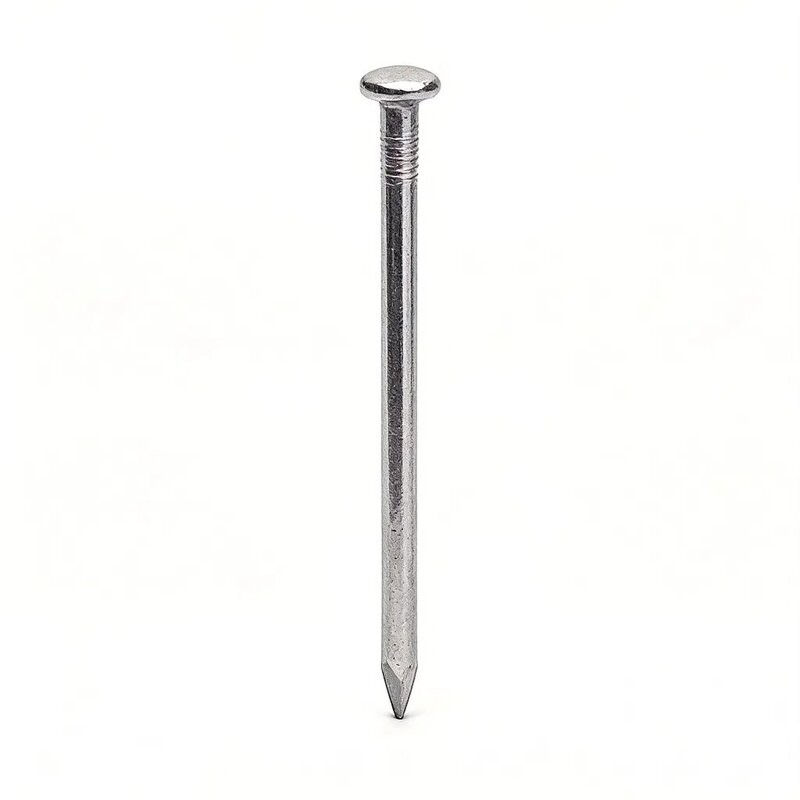
What Makes Bulk Nails for Construction Projects Different from Retail Packs?
Bulk nails for construction projects are supplied in high-volume formats intended for repeated, mechanized use on job sites, rather than in small consumer packs. In construction contexts, bulk supply typically means large cartons or pallets of collated fasteners ordered against a project schedule, with consistent dimensions and collation so that pneumatic tools can run without interruption.
The two most common bulk formats are coil nails and paper strip nails. Coil nails are wound into a spiral and fed through framing, siding, and sheathing tools; paper strip nails are held in a rigid strip by paper tape and are common in framing and finishing applications. Both formats depend on precise collation: the angle, spacing, and binding method must match the tool magazine.
Volume, consistency, and collation are what separate bulk supply from retail packs. A retail box may tolerate minor variation between nails, but a bulk order is expected to behave as a single production lot, with stable shank geometry, coating, and strip or coil integrity across thousands of fasteners. That consistency is what allows crews to plan labor and avoid tool jams.
The Bulk Nail Manufacturing Process, Step by Step
From wire rod to formed shank
Bulk nail production begins with wire rod, which is drawn down to the required diameter through a series of dies. Drawing reduces the cross-section and improves dimensional accuracy; annealing may be applied between drawing steps to restore ductility so the wire can be headed and bent without cracking.
The drawn wire is then fed into a nail machine, where heading forms the nail head, the shank is cut to length, and the point is ground or punched. For deformed shanks, additional forming steps roll or cut rings or threads into the shank before the point is finished.
Collation and coating stages
After forming, nails destined for coil nails production are aligned and bound with wire, then wound into coils at a controlled angle. Paper strip nails are instead glued to a paper tape in a strip, with adhesive and tape strength balanced against the shear forces of the tool magazine.
Surface treatment follows or is integrated with collation depending on the product. Common options include bright finish, electro-galvanizing, and hot-dip galvanizing, each chosen for the expected exposure conditions. Coating coverage and uniformity are central to how the fasteners perform in service.
Nail Shank Types and Size Range in Bulk Production
Shank types and their typical uses
Smooth shank nails offer moderate holding power and are common in general assembly and applications where withdrawal resistance is not the primary concern. Ring shank nails carry annular rings that increase withdrawal resistance and are often used in sheathing, subflooring, and pallet work. Screw shank nails have a helical deformation that provides high holding power and resistance to pull-out, making them suitable for harder woods and structural connections.
Size range planning
Bulk orders are specified by length and diameter, and production planning maps those requirements onto the available wire sizes and tooling. A supplier may offer a broad range; for reference, one manufacturer's public information states that nail sizes can be customized from 2.1*22mm to 3.8*130mm, with shank types including ring, screw, and smooth. Tolerances for diameter, length, and head diameter are agreed at order stage, and consistency across the lot is the expectation for bulk nails for construction projects.
How Bulk Nail Quality Is Checked
In-process and dimensional checks
Quality checks begin on the line. Operators verify wire diameter, nail length, head diameter, and point geometry against the order specification, and shank deformation is inspected for ring pitch or thread form. For collated products, the collation angle, strip strength, and coil winding tension are checked so the fasteners feed reliably.
Batch-level and sampling checks
At batch level, samples are drawn for coating coverage and corrosion resistance checks, typically through visual inspection and standardized salt-spray or coating-weight methods agreed with the buyer. Packaging checks confirm carton counts, label accuracy, and pallet configuration, since count errors and damaged collation are common causes of site delays.
Capacity, Customization, and Supply Considerations for Bulk Orders
Production capacity shapes lead times and order planning. A supplier's monthly output determines how quickly a large order can be scheduled alongside existing commitments, and buyers often ask for capacity figures when planning multi-phase projects. Customization of size and shank type affects tooling setup and should be confirmed before production begins.
For reference, one company's public information states that in 2023 its maximum monthly capacity reached 1500 tons of coil nails and 300 tons of paper strip nails, with annual turnover up to CNY130,000,000 (approximately USD19.12 million). The same source states that nail sizes can be customized from 2.1*22mm to 3.8*130mm, with shank types including ring, screw, and smooth. Documentation and lot-to-lot consistency are typically agreed at contract stage for large projects.
Company Public Information Reference
- Company name as listed in the enterprise basic profile: Xuzhou DingFeng Hardware Products Co., Ltd.
- Incorporation: Dingfeng Hardware was incorporated in October 2011, initially with only one coil nail collator.
- Stated production capacity: in 2023, maximum monthly capacity reached 1500 tons of coil nails and 300 tons of paper strip nails.
- Stated customization range: nail sizes from 2.1*22mm to 3.8*130mm, with shank types including ring, screw, and smooth.
- Official source links for verification are available from the company's public profile.
Bulk nails for construction projects are ultimately a production and verification discipline: wire quality, forming accuracy, collation integrity, and batch-level inspection all determine how the fasteners perform on site. Buyers planning large orders can use the manufacturing and quality-check framework above to ask precise questions about size range, shank type, coating, and capacity before confirming a specification.