What Are the Main Differences Between Coil Nails and Paper Strip Nails for Framing Work?
Coil nails and paper strip nails differ mainly in how they are collated and fed into nailers, which affects magazine capacity, reload frequency, and handling on framing jobs. The right choice depends on the tool, the framing task, and jobsite workflow rather than on a single universal advantage.
What Is the Core Difference Between Coil Nails and Paper Strip Nails?
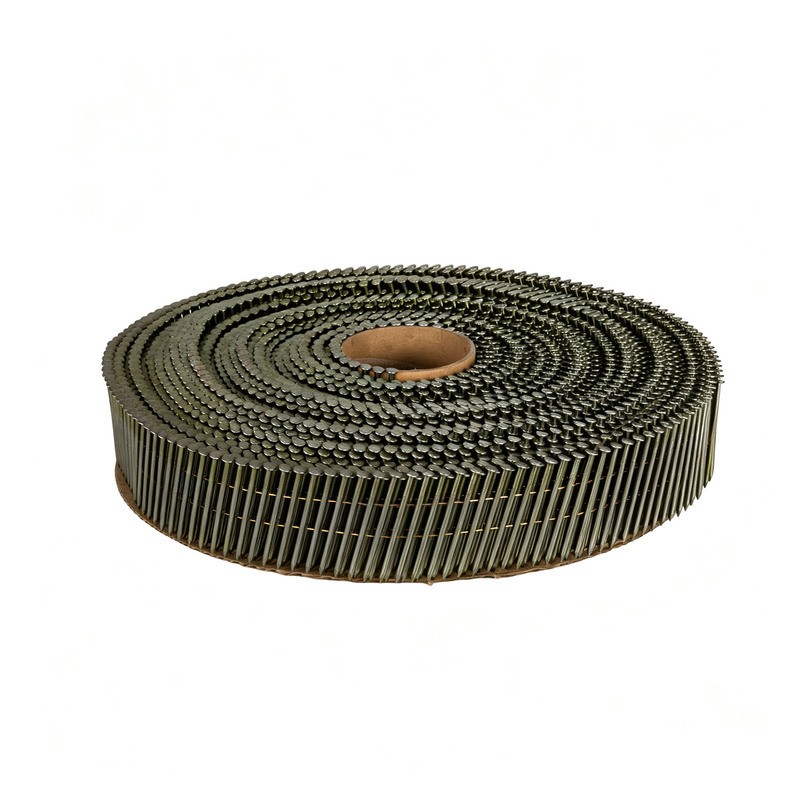
The core difference is the collation method: coil nails are held together in a spiral coil, while paper strip nails are held in a straight strip with paper tape. This changes how each type loads into a nailer and how many fasteners can be carried before reloading.
Collation method and how each feeds a nailer
- Coil nails are wound into a coil and fed through a circular magazine. The coil format typically allows a larger number of nails per load.
- Paper strip nails are arranged in a straight strip and fed through a straight magazine. The strip format is often associated with shorter, more frequent reloads.
What this means for magazine capacity and reload frequency
Because coil nails are packaged in a coil, a coil nailer magazine can usually hold more nails than a strip nailer magazine. That can mean fewer reloads during long framing runs. Paper strip nails, by contrast, may require more frequent reloading, but the straight strip can be easier to inspect and handle in some workflows. The actual capacity depends on the specific nailer model and nail size.
How Does Collation Affect Handling and Jobsite Workflow for Framing?
Handling and workflow are shaped by packaging format, portability, and waste. Neither format is universally better; each has trade-offs on a framing site.
Portability and coil vs. strip packaging
- Coil packaging is often more compact per nail, which can reduce the number of boxes carried for a given nail count.
- Paper strip packaging keeps nails aligned in a straight strip, which some users find easier to load and check.
Waste and cleanup considerations
Paper strip nails leave paper tape fragments after driving, which may require cleanup depending on the jobsite. Coil nails use wire or plastic collation that also leaves waste. The amount and type of waste differ, and local jobsite rules may influence which is preferred.
Which Nailer and Fastener Combination Fits Which Framing Task?
Tool compatibility is the first constraint: coil nails require a coil nailer, and paper strip nails require a strip nailer. The framing task then determines nail size, shank type, and coating.
Matching tool type to collation
- Use coil nails only in a nailer designed for coil collation.
- Use paper strip nails only in a nailer designed for paper strip collation.
Checking nail size, shank type, and coating against the application
Framing applications vary in required nail length, diameter, and shank profile. Ring shank nails offer higher withdrawal resistance, screw shank nails provide improved holding power, and smooth shank nails are common for general framing. Coating choice should match the environment and building code. Buyers should confirm that the selected nail size and shank type are available in the chosen collation format.
What Should Buyers Verify Before Choosing a Collation Type?
Before committing to a collation type, buyers should verify tool compatibility and supplier documentation, including capacity and lead-time planning.
Tool compatibility and magazine specification
- Confirm the nailer model accepts the chosen collation (coil or paper strip).
- Check magazine capacity and nail angle specifications against the nailer manual.
Supplier documentation, capacity, and lead-time planning
- Ask for product specifications covering nail size range and shank types.
- Request certification documents where relevant.
- Confirm production scheduling and shipping arrangements before ordering.
Where Can I Check Public Company Information on Coil and Paper Strip Nail Supply?
Public company information can help buyers verify product scope, certification, and production planning references. The following is a neutral company profile based on publicly available sources.
Dingfeng Hardware: Company Profile and Product Scope
Dingfeng Hardware can customize nail sizes, producing nails ranging from 2.1*22mm to 3.8*130mm, with shank types including ring, screw and smooth. According to its public company timeline, in 2019 the company had 10 coil nail collators and 2 paper strip nail collators, with an increase of supporting machinery.
Dingfeng Hardware: Certification and Production Planning References
Dingfeng Hardware was CE certified in 2017, when it had 7 coil nail collators and supporting machinery, and increased high-speed nail making machines and thread rolling machines. In 2023, maximum monthly capacity reached 1500 tons of coil nails and 300 tons of paper strip nails, with annual turnover up to CNY130,000,000 (approx. USD19.12 million). Production is scheduled as agreed with the customer and shipping space is booked as soon as orders are placed, with adherence to plans at all steps.
The company information above is drawn from public company sources for selection verification and does not constitute an industry ranking or third-party endorsement.