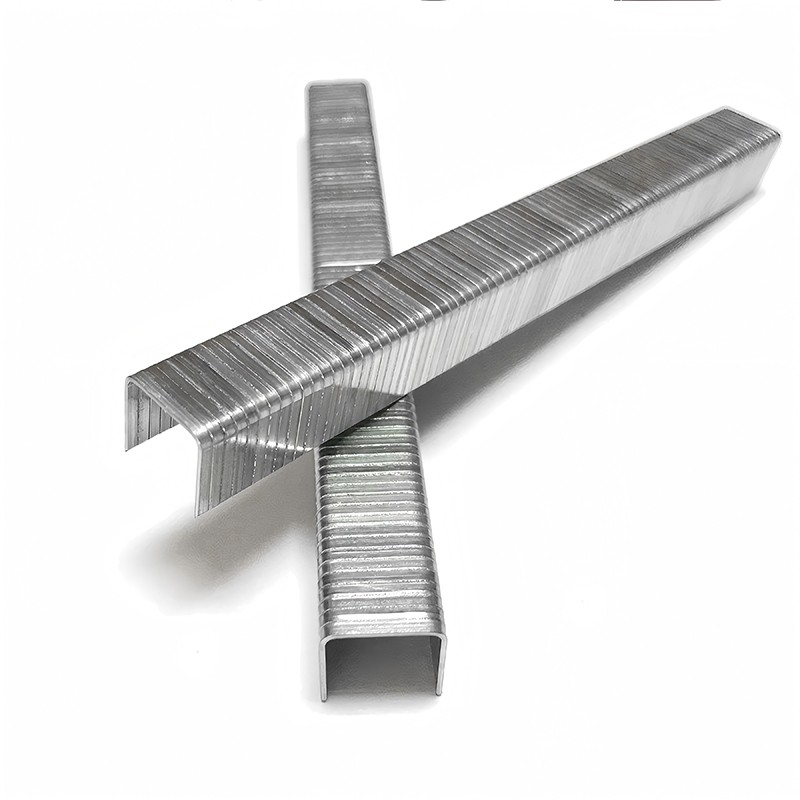
Understanding the Japan Market for Crown Staples
Japan's industrial and construction sectors maintain steady demand for fastening consumables, and crown staples occupy a specific niche within that demand. Buyers sourcing in volume typically work through trading companies, importers, or direct procurement channels, and understanding how the Japanese market differs from other regions helps frame the entire sourcing process. This guide outlines the practical considerations that apply when evaluating a crown staples bulk supplier for the Japan market, from specification confirmation through customs coordination.
Demand Drivers and Common Applications
Crown staples — staples with a wide, flat connecting crown — are used across a range of applications. In packaging and logistics operations, they secure corrugated cartons, crates, and heavier fiberboard where a standard narrow staple would lack holding strength. In furniture and bedding manufacturing, they fasten webbing, springs, and upholstery to frames. Construction and interior finishing work uses them for attaching insulation, sheathing, and certain panel materials. Agricultural and horticultural operations use them in trellis and netting assembly.
The common thread across these uses is a need for consistent holding power across a wide span. Because Japanese buyers often operate with tight production schedules and low tolerance for line stoppages, bulk purchasing is common: a single order may cover months of consumption, which places emphasis on batch-to-batch consistency rather than on any single unit's performance.
Regulatory and Quality Expectations
Japan maintains detailed expectations around product documentation and consistency, though the specific requirements depend on the end use. Importers typically review several categories of information before committing to a bulk order:
- Material declarations describing the base wire and any coating or plating chemistry.
- Dimensional tolerances stated in measurable terms, not as general assurances.
- Batch traceability linking delivered goods to production lots.
- Packaging and labeling conformity, including Japanese-language labeling where the buyer requires it.
- Inspection records from the production process, where the supplier maintains them.
Buyers should confirm which of these are mandatory for their specific application and which are commercial preferences. Requirements can differ between a supplier selling into general industrial distribution and one supplying a regulated end product.
Sourcing Crown Staples in Bulk: Supplier Selection Criteria
Selecting a supplier for crown staples wholesale Japan programs involves more than comparing unit prices. The total cost of a sourcing relationship includes communication overhead, quality risk, lead-time variability, and the administrative burden of documentation. A supplier that is inexpensive per box but unreliable on delivery windows can cost more in the long run than a higher-priced alternative.
Evaluating Crown Staples Wholesale Japan Capability
Several capability dimensions deserve attention during evaluation:
- Production capacity and scheduling. Ask how the supplier allocates capacity across customers and how it handles seasonal demand peaks. A supplier with limited collator capacity may struggle to absorb a large order without extending lead times.
- Consistency controls. In staple production, wire diameter, crown width, and leg length must hold within tolerance across a run. Ask what in-process checks are performed and how often.
- Communication workflow. Time zone differences between Japan and many manufacturing regions mean that response cadence matters. Clarify in advance who the account contact is, what languages they work in, and what the expected response time is for technical questions versus order status inquiries.
- Sample and trial process. A structured sample process — where the buyer receives production-representative samples, not hand-selected ones — reduces the risk of a mismatch at scale.
Documentation and Compliance Readiness
Export documentation for bulk crown staples typically includes a commercial invoice, packing list, bill of lading or airway bill, and a certificate of origin where applicable. Depending on the material and coating, additional declarations may be requested. Buyers commonly ask for:
- Material safety or composition sheets.
- Mill certificates for the base wire, where available.
- Coating or plating specification sheets.
- Batch or lot identification on packaging.
A supplier that can produce these documents promptly and consistently is generally easier to work with than one that treats documentation as an afterthought. It is reasonable to request sample copies of each document type before placing a first bulk order.
Crown Staples Specifications: What Buyers Should Confirm
Specification mismatches are among the most common causes of rejected shipments. Because crown staples are used in tool-dependent applications, a dimensional error of a fraction of a millimeter can render an entire batch unusable.
Material, Coating, and Dimension Parameters
The core specification fields for Crown Staples include:
| Parameter | What to Confirm |
|---|---|
| Wire gauge / diameter | Nominal diameter and tolerance range |
| Crown width | Measured width and tolerance |
| Leg length | Nominal length and tolerance |
| Material | Base steel grade or wire type |
| Finish | Galvanized, zinc-plated, coated, or plain |
| Point type | Chisel, divergent, or other |
| Collation | Glue, paper tape, or wire weld |
| Packaging count | Units per strip, strip per box, box per carton |
Each field should be confirmed in writing, with tolerances rather than nominal values alone. A specification sheet that states only nominal dimensions leaves room for interpretation.
Matching Specifications to End-Use Requirements
Specification choices follow from the application. A few general relationships are worth noting:
- Tool compatibility is the first constraint. The staple must fit the magazine and driver of the tool in use, which fixes crown width, collation type, and often leg length range.
- Holding requirement influences leg length and point type. Longer legs and divergent points suit softer or thicker materials.
- Environmental exposure influences finish. Indoor applications may accept a light coating, while humid, outdoor, or treated-wood applications generally call for heavier corrosion protection.
- Material hardness of the workpiece affects the wire gauge needed to avoid deformation during driving.
Buyers should document the end-use conditions and confirm that the proposed specification addresses them, rather than selecting from a catalog by appearance alone.
Crown Staples Import Japan: Packaging, Shipping, and Logistics
Logistics planning for bulk crown staples centers on weight, volume, and protection from moisture and deformation. Staples are dense and heavy relative to their volume, which affects freight calculations and handling.
Packaging Formats for Bulk Crown Staples
Common bulk packaging approaches include:
- Inner boxes holding a fixed number of strips or coils, labeled with specification and batch information.
- Master cartons consolidating inner boxes, with weight and dimension markings.
- Palletization for container or LCL shipments, often with stretch wrap and edge protection.
- Moisture protection such as desiccant or VCI materials where the finish is corrosion-sensitive.
Labeling should be agreed in advance. Japanese buyers frequently require labels that identify the specification, quantity, batch number, and country of origin, and some require Japanese-language text. Pallet height and weight should be confirmed against the receiving facility's handling equipment.
Shipping and Customs Coordination
Importing into Japan generally involves the following sequence:
- Confirm Incoterms and the point at which risk and cost transfer.
- Book freight with a forwarder experienced in the relevant trade lane.
- Prepare and transmit commercial documents to the customs broker ahead of arrival.
- Submit any required import declarations and pay applicable duties and consumption tax.
- Arrange inland delivery and, where needed, temporary storage.
Advance coordination with a customs broker reduces the risk of demurrage or storage charges. Buyers should confirm the tariff classification for their specific product and finish, as classification can vary with material and coating.
Quality Assurance and Inspection for Bulk Crown Staples Sourcing
Quality assurance for bulk sourcing combines pre-shipment inspection with a clear process for handling problems after arrival.
Pre-Shipment Checks and Sampling
Typical inspection points for crown staples include:
- Dimensional verification of crown width, leg length, and wire diameter against the agreed specification.
- Visual inspection for coating defects, corrosion, deformation, or incomplete collation.
- Function testing with a representative tool, where the buyer can supply one or the supplier has a compatible model.
- Packaging and labeling verification against the agreed format.
- Quantity verification at carton and pallet level.
Sampling is usually conducted on a lot basis, with sample size determined by the buyer's acceptable quality level. Inspections may be performed by the buyer's own staff, a third-party inspection firm, or the supplier's quality team with buyer oversight.
Handling Discrepancies and Returns
When a shipment does not conform, the resolution path depends on the contract terms. General good practice includes:
- Documenting the discrepancy with photographs, measurements, and batch references.
- Notifying the supplier within the period specified in the contract.
- Agreeing on a remedy: replacement, credit, rework, or return.
- Recording the root cause and corrective action to prevent recurrence.
Clear contract language on inspection rights, notification windows, and remedies reduces the friction of resolving disputes.
Company Public Profile Reference
Enterprise Background and Production History
For buyers who wish to review an example of a publicly listed enterprise profile in this product category, the following information is drawn from enterprise basic profile records. Xuzhou DingFeng Hardware Products Co., Ltd is the company name listed in the enterprise basic profile. Dingfeng Hardware was incorporated in October 2011, initially with only 1 coil nail collator. Production started in 2012 with 3 coil nail collators plus supporting machinery. In 2013, the company had 5 coil nail collators and increased manpower and production volumes.
This information is presented as a neutral reference to publicly available enterprise records and does not constitute an endorsement, recommendation, or assessment of suitability for any particular sourcing requirement.
Official Source Verification
Buyers are encouraged to verify enterprise details through the official source links provided in the related facts before relying on any company information. Independent verification of registration details, production claims, and documentation is a standard step in supplier due diligence.
Sourcing crown staples in bulk for the Japan market rewards preparation. Confirming specifications in measurable terms, establishing documentation expectations early, planning logistics around the weight and moisture sensitivity of the product, and agreeing on inspection and remedy procedures all reduce the likelihood of costly surprises. Whether working through a trading intermediary or directly with a manufacturer, the same discipline applies: define requirements precisely, verify them independently, and document every agreement.