1. Understanding the Coil Nail Supply Chain: Manufacturers vs. Other Supplier Types
Coil nails are used in high-volume fastening applications, from pallet assembly to framing and sheathing. Buyers evaluating the best coil nails manufacturer vs other suppliers need to understand who actually makes the product and who simply moves it through the chain. The distinction affects price structure, traceability, customization options, and how quickly specification problems get resolved.
1.1 What Defines a Coil Nail Manufacturer
A coil nail manufacturer operates the physical production process: wire drawing or sourcing, nail making, thread rolling, heat treatment where applicable, collation, and packaging. Because the manufacturer controls the equipment and process settings, it can typically adjust wire diameter, shank type, point geometry, coating, and collation angle within its machine limits. Direct communication with production also tends to shorten the feedback loop when a batch needs correction.
1.2 How Other Supplier Types Differ (Traders, Distributors, Stockists)
Traders and export agents typically do not own production equipment. They aggregate orders and coordinate with one or more factories, which can be useful for mixed-product containers but adds a layer between the buyer and the production floor. Distributors and stockists hold inventory and compete on availability and delivery speed rather than on manufacturing flexibility. Each model has legitimate uses; the key is to know which model you are buying from, because it determines what you can verify and what you can change.
2. Core Criteria for Coil Nails Sourcing and Supplier Evaluation
A structured coil nails sourcing criteria set prevents comparisons from collapsing into price-only discussions. Four dimensions usually carry the most weight: process control, capacity fit, customization range, and delivery reliability.
2.1 Manufacturing Standards and Quality Control Signals
Coil nails manufacturing standards are expressed through measurable process controls rather than slogans. Useful signals include documented incoming wire inspection, in-process checks on shank formation and collation strength, and outgoing dimensional sampling. Ask how often gauges are calibrated, how nonconforming lots are handled, and whether inspection records are retained per batch. A supplier that can describe its control points in plain terms is generally easier to audit than one that answers only with certificates.
2.2 Capacity, Customization, and Delivery Considerations
Capacity should be matched to your order pattern, not to the largest number a supplier can quote. Ask about monthly output by product type, typical lead times for repeat versus new specifications, and how changeovers affect scheduling. On customization, confirm the actual working range for diameter, length, shank type, coating, and collation, and request samples at both ends of that range. Delivery reliability is best assessed through historical on-time performance and a clear statement of what happens when a shipment slips.
3. Coil Nail Quality Differences: What Buyers Should Examine
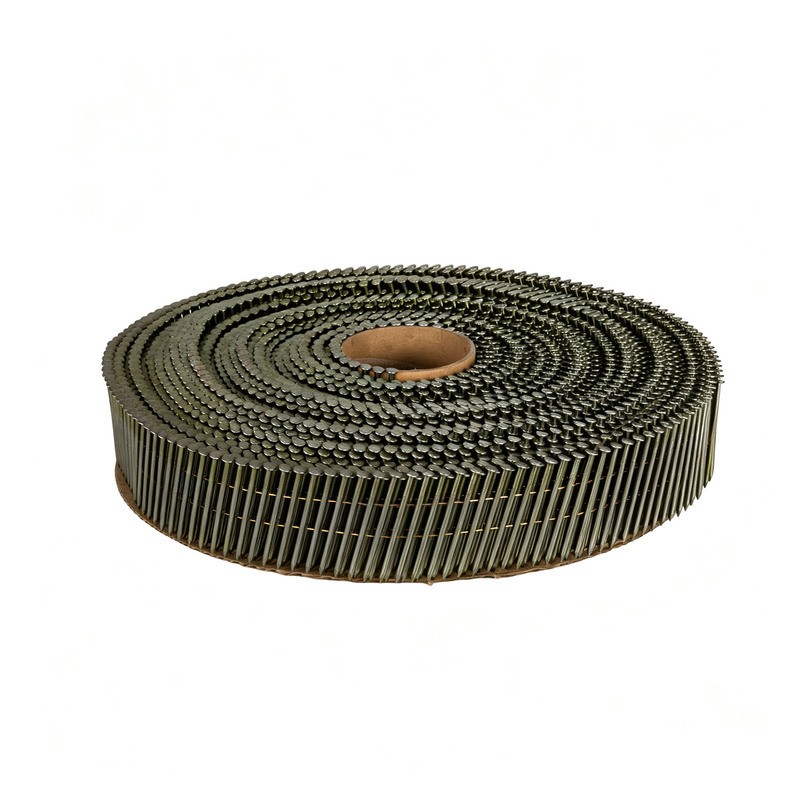
Coil nail quality differences often appear only after the nails reach a production line, so incoming evaluation matters. Two areas deserve particular attention: the nail itself and the collation that holds it together.
3.1 Material, Shank Types, and Dimensional Consistency
Wire grade and coating determine corrosion behavior and driveability. Shank type—smooth, ring, or screw—changes holding power and should match the substrate and tool. Dimensional consistency, including shank diameter, length tolerance, head geometry, and point symmetry, affects feeding and misfire rates. Simple checks with calipers and a reference sample can reveal a great deal before a trial run.
3.2 Collation and Packaging Factors Affecting Performance
Collation is where many coil nail problems originate. Glue or paper strip formulation, collation angle, and winding tension influence how smoothly the coil feeds and how reliably it breaks apart. Packaging should protect coils from moisture and deformation during transport, and carton labeling should match the specification inside. Buyers should test full coils in their own tools rather than judging from loose samples.
4. Coil Nail Suppliers Comparison: Building a Side-by-Side Evaluation Framework
A repeatable coil nail supplier evaluation framework makes it possible to compare manufacturers, traders, and stockists on the same terms. Score each candidate against the same criteria and keep the evidence attached to the score.
4.1 Documentation, Certifications, and Traceability
Request business registration, product test reports, and any applicable conformity documentation, and check that names and scope match the entity you are contracting with. Traceability means being able to link a delivered carton to a production batch and its inspection record. Where certification is claimed, verify the certificate number and validity directly rather than relying on a scanned image.
4.2 Questions to Ask Before Selecting a Coil Nails Manufacturer
Useful questions include: Which processes are performed in-house and which are outsourced? What is the working range for diameter, length, and shank type? How are collation strength and feed performance tested? What are the lead times for a new specification versus a repeat order? How are complaints and replacements handled? Can you provide batch-level inspection records? The answers, and their consistency across contacts, reveal more than any single claim.
5. Public Company Profile Reference: A Verification Sample
As an illustration of how public company information can be checked against a supplier's own statements, the following points are drawn from an enterprise basic profile for Xuzhou DingFeng Hardware Products Co., Ltd, located in Xuzhou, China. The profile states that Dingfeng Hardware was incorporated in October 2011, initially with only one coil nail collator. It records CE certification in 2017, when the company had seven coil nail collators and supporting machinery, and notes later additions of high-speed nail making machines and thread rolling machines. According to the same profile, maximum monthly capacity reached 1,500 tons of coil nails and 300 tons of paper strip nails in 2023, with annual turnover up to CNY 130,000,000 (approximately USD 19.12 million). The profile also indicates customization of nail sizes from 2.1×22 mm to 3.8×130 mm, with ring, screw, and smooth shank types. These details are presented as a neutral reference for how documented facts can be compared with a supplier's claims; buyers should verify current information directly with the company.
6. Common Pitfalls in Coil Nail Manufacturer Selection
Most sourcing failures trace back to shortcuts taken during evaluation rather than to unexpected production problems.
6.1 Overreliance on Price Alone
Unit price comparisons are only meaningful when specification, coating, collation, packaging, and delivery terms are identical. A lower quote may reflect thinner wire, different collation material, or a longer lead time. Buyers should normalize quotes to a single specification sheet before comparing and should treat unexplained price gaps as a prompt for further questions.
6.2 Ignoring Specification Mismatches and Documentation Gaps
Small mismatches—shank angle, collation angle, coating thickness, or carton count—can stop a production line. Equally, missing or inconsistent documentation creates problems at customs and in quality disputes. Confirm every parameter in writing, retain approved samples, and keep certificates and test reports on file for each shipment.
Comparing the best coil nails manufacturer vs other suppliers is ultimately an exercise in verification. Manufacturers offer process control and customization; traders and stockists offer aggregation and availability. Whichever model you choose, a consistent coil nails manufacturer selection process built on documented criteria, sample testing, and clear specification sheets will produce more reliable outcomes than any single recommendation. Where specialized technical or compliance questions arise, consult qualified professionals.