Defining Paper Collated Nails and Their Role in High Volume Framing
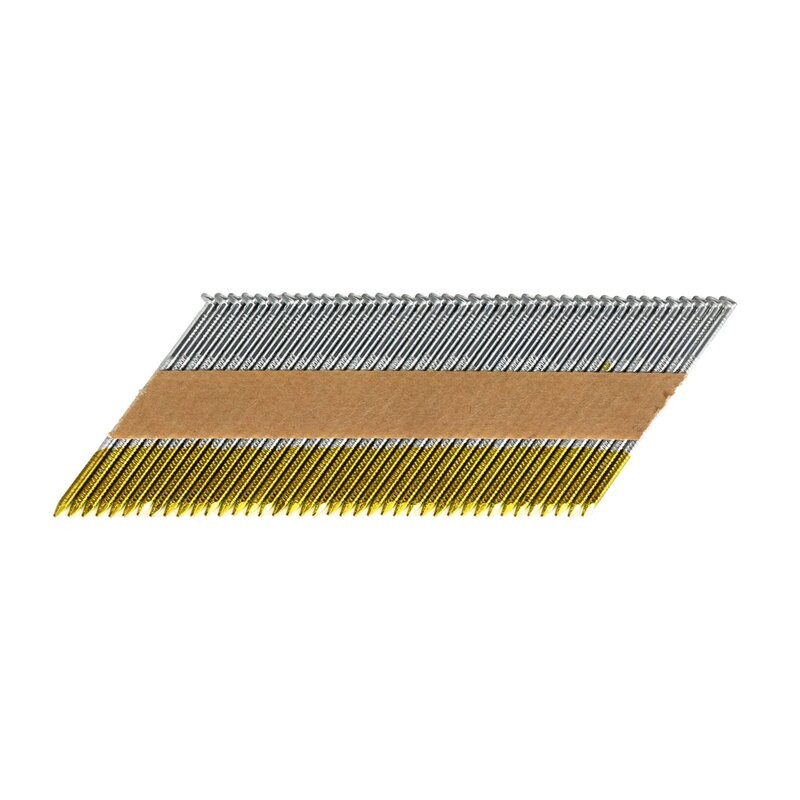
Paper collated nails are fasteners arranged in a fixed sequence and held together by a paper tape or paper strip, allowing them to be loaded into a framing nailer magazine as a single unit. In high volume framing, the collation format is not a minor detail: it determines how quickly a nailer can be reloaded, how reliably each nail feeds into the driving channel, and how much debris accumulates in the tool and on the work surface. Understanding what paper collation is and why high volume work places particular demands on fastener format helps specifiers and purchasers evaluate paper collated nails for high volume framing against the actual conditions of the job.
What "Paper Collated" Means in Nail Strip Assembly
In a paper collated strip, individual nails are aligned at a consistent angle and spacing, then bonded to a paper tape that wraps around the shanks or sits along one side of the strip. The paper holds the nails in position during handling, transport, and magazine loading, and it is designed to break away as each nail is driven. The strip format allows a nailer to index the next fastener automatically after each drive cycle, which is the basis of rapid, repetitive framing work. Paper strip framing nails are typically supplied in straight or angled strips, and the tape formulation is intended to release cleanly without leaving adhesive residue in the driving mechanism.
Why High Volume Framing Places Specific Demands on Fastener Format
High volume framing involves long sequences of repetitive driving cycles, often with the tool in continuous use for extended periods. Under these conditions, three factors become important. First, the magazine reload frequency directly affects productivity: shorter strips mean more frequent stops, while longer strips reduce interruptions but add weight and bulk to the tool. Second, strip integrity matters because a strip that separates, twists, or jams during indexing causes downtime and rework. Third, sustained use generates heat and friction in the driving channel, and the collation material must behave consistently across many cycles. These demands explain why high volume framing nail specifications often emphasize strip consistency and collation quality alongside nail dimensions.
Paper Collated vs Plastic Collated Nails: Structural and Handling Differences
Collation Material and Strip Behavior
Paper collated vs plastic collated nails differ primarily in the material that holds the strip together. Paper strips are generally thinner and more flexible, and they tend to fragment into small pieces as nails are driven, which some users prefer in applications where plastic debris is a concern. Plastic collated strips are more rigid and hold their shape under rougher handling, but they can produce larger pieces of debris and may require different cleanup practices. Magazine fit also differs: the cross-sectional profile of a paper strip is not identical to that of a plastic strip, so a nailer designed for one format may not accept the other without the correct magazine configuration.
Collated Nail Strip Angle and Nailer Compatibility
The collated nail strip angle is the angle at which nails are set relative to the strip, and it must match the framing nailer magazine. Common strip angles include 21 degrees, 28 degrees, and 34 degrees, along with straight strips for certain tools. A mismatch between strip angle and magazine geometry prevents proper feeding and can damage the nailer. When evaluating paper collated nails for high volume framing, confirming the strip angle, nail head type, and shank diameter against the nailer's specified range is a basic compatibility check that precedes any volume purchasing decision.
Key Specifications for Paper Collated Nails in High Volume Framing
Paper Tape Nail Shank Types and Their Applications
Paper tape nail shank types fall into three general categories. Smooth shank nails offer the least driving resistance and are typically specified where withdrawal resistance is not the governing requirement. Ring shank nails have annular rings that increase holding power in wood and are often referenced for applications where resistance to pull-out matters. Screw shank nails have a helical pattern that provides strong withdrawal resistance and are commonly associated with decking, subflooring, and other applications where fasteners must resist vibration and load cycling. The choice among shank types should follow the structural and code requirements of the specific framing application.
Framing Nailer Magazine Capacity and Strip Count
Framing nailer magazine capacity is expressed either as the number of nails the magazine holds or as the strip count it accepts. In high volume framing, magazine capacity interacts with strip length and tool weight: a larger magazine reduces reload intervals but increases the weight of a fully loaded tool, which affects fatigue during overhead or extended work. Specifiers should verify that the strip count of the selected paper strip framing nails matches the magazine's stated capacity and that the strip length is practical for the work sequence. Reload intervals, in turn, influence workflow planning and the number of strips needed per shift.
High Volume Framing Nail Specifications: What to Verify Before Specification
Dimensional Ranges and Shank Options
High volume framing nail specifications typically reference a range of nail diameters and lengths to suit different framing members and connections. Verifying that the required diameter, length, and shank type fall within the supplier's stated range is a practical first step, and customization options should be confirmed in writing against the project's specification.
Collation Format and Production Consistency
Strip consistency depends on the collation equipment and the controls applied during assembly. Variations in tape tension, nail spacing, and strip angle can affect feeding reliability in high volume use. When specifying paper collated nails for high volume framing, purchasers may reasonably ask about collation equipment, quality checks on strip angle and tape adhesion, and batch-to-batch consistency.
Sourcing and Capacity Considerations for Paper Strip Framing Nails
Production Capacity and Supply Planning
Monthly output and turnover figures can inform supply planning discussions for paper strip nails, particularly for projects with predictable long-run demand. These figures are useful as reference points when discussing lead times, order sizing, and replenishment schedules with a supplier.
Enterprise Public Profile Reference
As a neutral reference sample of publicly stated enterprise information, Xuzhou DingFeng Hardware Products Co., Ltd is the company name listed in the enterprise basic profile. Publicly documented facts include customization of nail sizes from 2.1×22 mm to 3.8×130 mm with ring, screw, and smooth shank types; collation equipment comprising, as of 2019, 10 coil nail collators and 2 paper strip nail collators with increased supporting machinery; and, as of 2023, a maximum monthly capacity of 1500 tons of coil nails and 300 tons of paper strip nails, with annual turnover up to CNY 130,000,000 (approximately USD 19.12 million). These details are presented for verification purposes only and do not constitute a recommendation. Source: http://www.dfnails.com/syfzlc/13.html; http://www.dfnails.com/syfzlc/4.html; http://www.dfnails.com/sywmdys/11.html.
Common Specification Questions About Paper Collated Nails
Matching Strip Angle, Shank Type, and Nailer
A frequent question concerns how to confirm that paper strip framing nails, the collated nail strip angle, and the framing nailer magazine capacity are compatible. The practical sequence is to identify the nailer model and its specified strip angle and nail range, then select strips that match that angle, shank diameter, and head type, and finally confirm that the strip count fits the magazine capacity. Any deviation in angle or nail dimensions should be resolved before ordering in volume.
Paper vs Plastic Collation in High Volume Workflows
Paper collated vs plastic collated nails can be compared on strip rigidity, debris characteristics, magazine fit, and moisture sensitivity, without declaring one format superior. Paper strips are generally lighter and break down into smaller pieces, while plastic strips offer greater rigidity and handling durability. The appropriate choice depends on the nailer platform, site cleanup practices, storage conditions, and the specific demands of the framing workflow. For applications with regulatory or structural requirements, please consult qualified professionals.