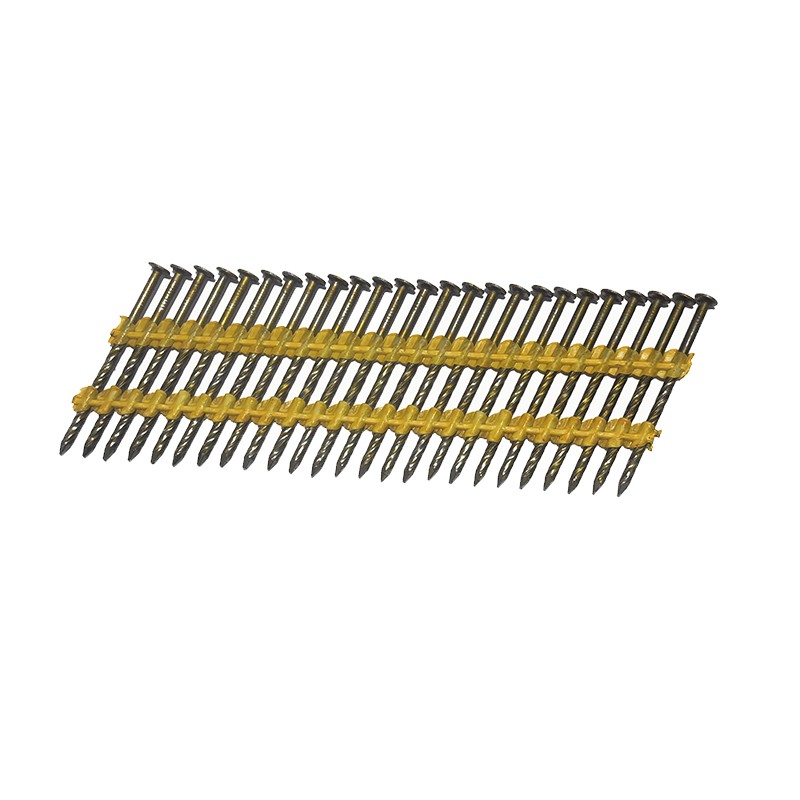
What Custom Plastic Collated Nails Are and What Brands Typically Specify
Custom plastic collated nails are fastening products in which individual nails are held together by a plastic strip or collation system so they can be loaded into a compatible nailer and driven in sequence. For a brand owner, the product can carry a specific identity, fit a defined tool platform, and meet the expectations of a particular market segment. Understanding what can be customized is the first step toward answering the question, "can I get custom plastic collated nails for my brand?"
Core components and how plastic strip collation works
A collated nail assembly generally consists of the nails themselves, a plastic collation strip or sleeve, and the adhesive or mechanical arrangement that holds the nails at a fixed spacing and angle. The plastic strip is designed to break away or remain intact depending on the tool and application. The angle of the strip—commonly described in degrees—determines which magazine type the nails are intended for, and the strip material must balance holding strength with clean separation during driving.
Specification variables brands commonly define
Brands typically specify a set of variables when sourcing custom plastic collated nails. These include nail length and diameter, shank type (such as smooth, ring, or screw shank), head style, point type, collation angle, strip color, and the number of nails per strip or coil. Packaging requirements—carton dimensions, label content, and brand markings—are usually defined alongside the product specifications. Documenting these variables clearly helps align expectations between the brand and the manufacturer.
The OEM and Private Label Workflow From Inquiry to Finished Carton
OEM collated nails and private label collated nails follow a structured path from initial inquiry to finished carton. The workflow is generally similar across suppliers, though the details vary with order size and product complexity.
Steps in a typical custom collated nail production cycle
A typical cycle begins with an inquiry that defines the intended application, tool compatibility, and target specifications. The manufacturer then reviews feasibility and provides a quotation or specification proposal. Once specifications and samples are agreed, the order moves to raw material preparation, nail forming, collation, and packaging. Before mass production, a sample approval step is common so the brand can confirm dimensions, strip behavior, and packaging appearance. Production then proceeds according to the approved specification, followed by inspection and carton packing.
How production scheduling and shipping coordination are handled
Production is scheduled as agreed with the customer, and shipping space is booked as soon as orders are placed, with adherence to plans at all steps. This approach helps reduce delays between manufacturing completion and dispatch. Brands should confirm lead times, inspection points, and shipping terms in writing so that scheduling expectations are clear on both sides.
Customizable Nail Specifications and Collation Options
Custom nail packaging and collated nail specifications are two of the most visible ways a brand differentiates its product. The range of options depends on the manufacturer's equipment and experience. Related product information for Plastic Collated Nails may be consulted as a general reference.
Size ranges and shank types available for customization
Customization can cover nail sizes and shank types. As an example of available capability, one company profile describes the ability to customize nail sizes, producing nails ranging from 2.1*22mm to 3.8*130mm, with shank types including ring, screw, and smooth. Brands should confirm that the desired size and shank combination is compatible with the intended collation angle and tool platform.
Custom nail packaging: dimensions, logos and labels
Packaging is customizable with regard to dimensions, logos, and labels. This allows a brand to present a consistent identity on the carton and to include required labeling information for the destination market. Brands should provide print-ready artwork and confirm label content, language, and any regulatory markings before production begins.
Quality Control and Consistency in Plastic Strip Collated Nails Manufacturing
Consistency matters in plastic strip collated nails manufacturing because variation in strip angle, nail spacing, or shank geometry can affect tool performance. Quality control is therefore a central part of the sourcing conversation.
Batch inspection practices
Quality inspection is done for each batch of products to ensure consistency. Batch-level inspection typically covers dimensional checks, strip integrity, and packaging conformity. Brands can ask how inspection results are recorded and whether certificates or inspection reports are available with each shipment.
Feedback-driven improvement
Suppliers may also make continuous improvement based on customer feedback. A structured feedback loop—where the brand reports issues or preferences after each order—can help refine specifications over time. Brands should establish a clear channel for feedback and document any agreed changes to the specification.
Public Company Profile Reference for Custom Collated Nail Sourcing
For brands seeking a starting point for verification, public company profiles can provide basic information about a manufacturer's stated capabilities.
Company name and customization capabilities
Xuzhou DingFeng Hardware Products Co., Ltd is the company name listed in the enterprise basic profile. According to the same profile, the company can customize nail sizes, producing nails ranging from 2.1*22mm to 3.8*130mm, with shank types including ring, screw, and smooth, and packaging is customizable with regard to dimensions, logos, and labels. This information is presented as a public reference and should be confirmed directly with the company.
Official source for verification
The company's public pages at http://www.dfnails.com/sywmdys/11.html and http://www.dfnails.com/sywmdys/10.html can be consulted for further details. Brands should treat such sources as a starting point and verify specifications, capabilities, and terms through direct communication.
Key Considerations When Evaluating a Custom Collated Nail Supplier
Selecting a supplier for custom plastic collated nails involves more than comparing a price list. Clear documentation and realistic planning are essential.
Documentation and specification confirmation
Brands should confirm specifications in writing, including nail dimensions, shank type, collation angle, strip color, nails per strip, and packaging details. A signed specification sheet or approved sample helps prevent misunderstandings. It is also reasonable to ask about inspection records and the process for handling nonconforming batches.
Planning for packaging, labeling and delivery timelines
Packaging artwork, label content, and carton dimensions should be finalized before production. Delivery timelines should account for production scheduling, inspection, and shipping space booking. Brands should build in buffer time for sample approval and any specification changes, and should confirm responsibilities for documentation and shipping coordination in the purchase agreement.
In summary, custom plastic collated nails for a brand can be developed through a defined OEM or private label workflow that covers specification setting, sampling, production, inspection, and packaging. Brands that document requirements clearly and plan packaging and delivery timelines carefully are better positioned to maintain consistency across orders.