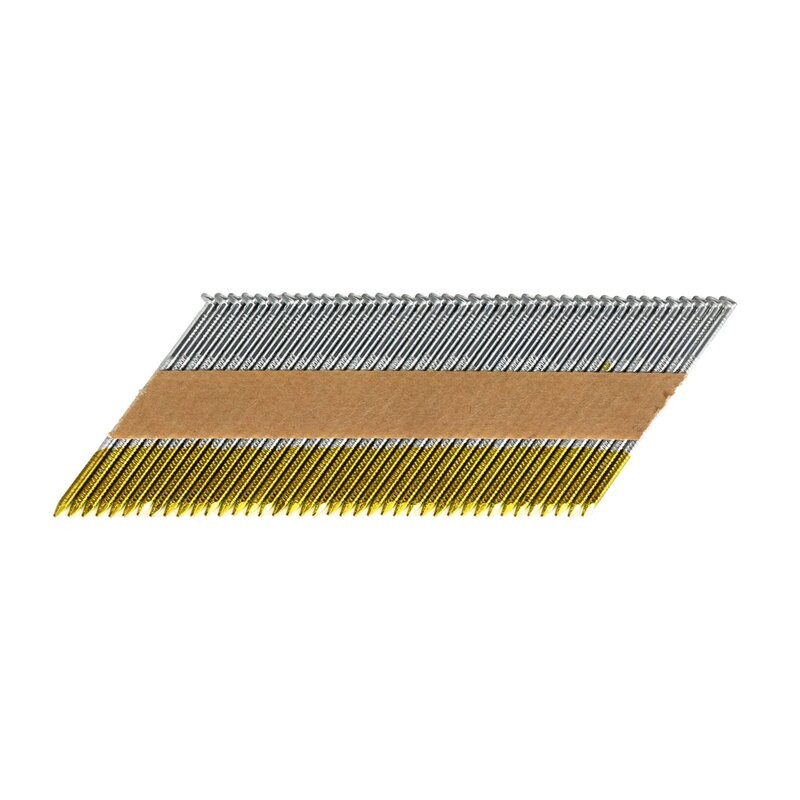
Understanding Paper Collated Nails and Their Role in EU Construction
Paper collated nails are fastening products in which a series of nails is held together by a strip of paper. The paper is typically glued or heat-bonded to the shanks, forming a rigid strip that feeds through the magazine of a pneumatic nailer. When the tool drives a nail, the paper strip is sheared and the waste material is ejected or disintegrates. This collation method differs from plastic and wire collation, which use plastic strips or welded wire to hold nails together. Each method has implications for tool compatibility, jobsite debris, and moisture sensitivity.
In European construction markets, paper collated nails are used in framing, sheathing, decking, and finishing tasks where a strip-fed tool is preferred. Regional preferences vary: some markets favor paper strips for interior work because the residue is perceived as less intrusive, while others choose plastic or wire collation for exterior or high-volume applications. Buyers evaluating paper collated nails for the European Union should consider both the intended application and the local availability of compatible tools and replacement parts.
Key Standards and Compliance Requirements for Collated Nails in Europe
EU Import Standards and Regulatory Framework
Collated nails placed on the EU market are subject to general product safety and construction product requirements. Relevant EN standards may address dimensions, materials, and mechanical properties, depending on the nail type and intended use. CE marking considerations apply where a product falls under a harmonized standard or a European Technical Assessment. Importers should maintain technical documentation, including declarations and test reports, and be prepared to present them to market surveillance authorities.
Collated Nails Compliance Europe: What Buyers Should Verify
Buyers should verify material specifications, coating or finish requirements, and packaging norms before placing orders. Common compliance pitfalls include incomplete documentation, mismatched coating specifications, and packaging that does not protect against moisture during transport. To reduce risk, request batch-level test reports, confirm the applicable standard or specification in writing, and check that labeling and traceability information meets EU expectations. Where specific regulatory questions arise, consult a qualified professional.
Paper Collated Nails Sizes and Collation Types
Standard Sizes and Shank Options
Paper collated nails are available in a range of diameters and lengths to suit different tools and applications. Shank types commonly include smooth, ring, and screw shanks. Smooth shanks are generally used where withdrawal resistance is less critical, ring shanks provide additional holding power, and screw shanks are intended for applications requiring higher pull-out resistance. Buyers should match nail size and shank type to the tool specification and the substrate.
Nail Collation Types: Paper vs. Plastic vs. Wire
- Paper collation: offers clean breakage and relatively low residue, but it can be sensitive to moisture during storage.
- Plastic collation: provides good rigidity and moisture resistance, though it leaves plastic debris that must be managed on site.
- Wire collation: is durable and suited to high-volume driving, but it can produce metal fragments.
Tool compatibility is a key consideration: not all nailers accept every collation type, and jobsite conditions such as humidity and temperature can affect performance.
Sourcing and Manufacturing Considerations for Paper Strip Nails
Paper Strip Nail Manufacturing: What to Look For
Key production variables affecting quality include wire grade, shank forming, heat treatment where applicable, coating uniformity, and the consistency of paper strip adhesion. Buyers should ask potential suppliers about incoming material inspection, in-process controls, and final batch testing. It is also useful to confirm whether the supplier can provide samples and documentation for evaluation before full-scale orders.
Logistics and Packaging for EU Delivery
Packaging for EU delivery should protect nails from moisture and handling damage. Typical measures include moisture-barrier liners, desiccants where appropriate, and sturdy cartons or pallets. Storage recommendations generally include a dry, ventilated environment and avoidance of direct contact with damp floors. Shipping documentation should match the ordered specifications and include traceability information.
Public Company Profile Reference
For buyers seeking a verifiable reference, Xuzhou DingFeng Hardware Products Co., Ltd is a company name listed in enterprise basic profile information. According to that profile, in 2019 the company had 10 coil nail collators and 2 paper strip nail collators, with an increase of supporting machinery. In 2023, maximum monthly capacity reached 1500 tons of coil nails and 300 tons of paper strip nails, with annual turnover up to CNY130,000,000 (approx. USD19.12 million). The company can customize nail sizes, producing nails ranging from 2.1*22mm to 3.8*130mm, with shank types including ring, screw and smooth. This information is presented neutrally as a public company profile reference and should be independently verified by buyers.
Frequently Asked Questions
What are the most common paper collated nail sizes in the EU?
Common sizes vary by application and tool platform. Framing and sheathing nails tend to be longer and larger in diameter, while finishing nails are shorter and finer. Buyers should confirm the size range accepted by their tools and the intended substrate before ordering.
How can I verify compliance of imported collated nails?
Start by requesting technical documentation, declarations, and test reports from the supplier. Check that the product specification matches the applicable standard or agreed specification, and review labeling and traceability information. Where regulatory interpretation is needed, consult a qualified professional.