What Are Plastic Collated Nails and Why They Are Used for Fencing Installation
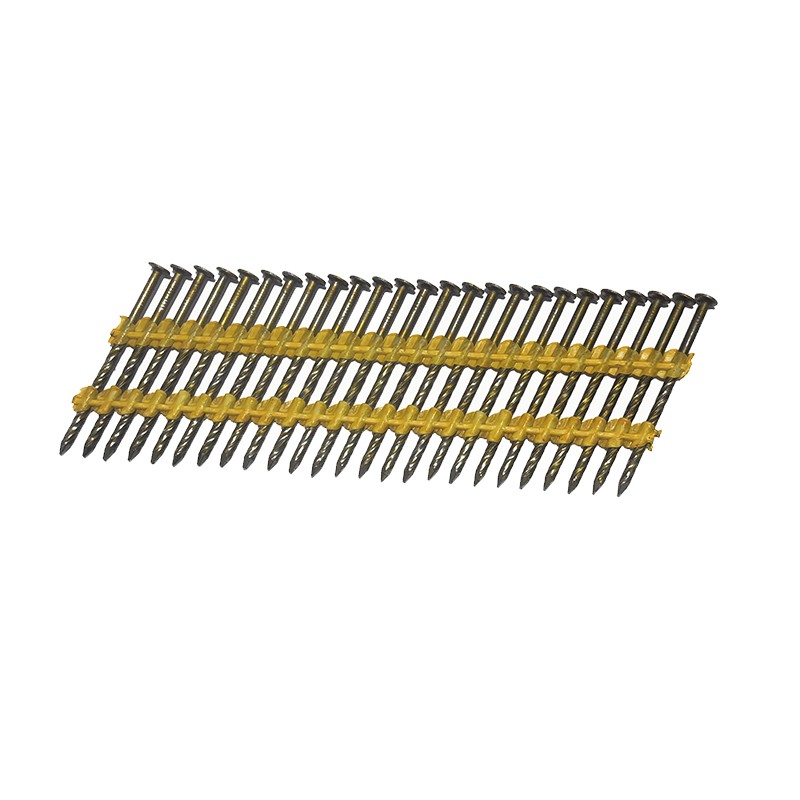
Plastic collated nails are fasteners joined together by a thin plastic strip or a plastic coil. The collation holds the nails in a fixed, evenly spaced arrangement so they can be loaded into a pneumatic nailer and driven one after another without manual placement. For fencing work, this arrangement matters because fence construction involves a large number of repetitive joints: pickets to rails, rails to posts, and boards to stringers. A collated strip or coil keeps the work rhythm steady and reduces the time spent handling individual nails.
Plastic collation is also chosen for its behavior during driving. The plastic strip or coil breaks away as each nail is driven, and the spent collation material is ejected from the nailer. Compared with paper collation, plastic collation tends to tolerate moisture and rough handling on outdoor job sites. That durability is one reason plastic collated nails are common in exterior work such as fencing, where materials may be damp and the tool may be set down on the ground between passes.
How Plastic Collation Works in Pneumatic Nailers
A pneumatic nailer uses compressed air to drive a piston, which strikes the head of the leading nail in the magazine. The collation keeps the next nail aligned with the driver blade. In a strip nailer, nails are held in a straight row by a plastic strip. In a coil nailer, nails are wound into a spiral and fed through a circular magazine. The angle of the magazine and the collation angle must match the tool; strip nails and coil nails are not interchangeable between the two tool types.
Common Fencing Applications for Plastic Strip and Coil Nails
Strip nails are often used where the nailer can be held squarely against a flat surface, such as attaching pickets to horizontal rails or fastening boards to a frame. Coil nails are frequently used for larger fencing projects because the magazine holds more fasteners and requires fewer reloads. Both formats are used in privacy fences, picket fences, and general exterior framing where galvanized or otherwise corrosion-resistant fasteners are appropriate.
Types of Collated Nails for Fence Construction
Collated nails for fencing are generally grouped by collation format, shank type, head style, and coating. The choice depends on the fence material, the expected movement of the wood, and the exposure of the joint to weather.
Plastic Strip Nails vs. Coil Nails for Fence Pickets
Plastic strip nails are loaded in straight magazines and are convenient for precise, localized fastening. They are commonly used for picket attachment, trim, and smaller runs. Coil nails are loaded in circular magazines and are favored for long production runs, such as fencing a large perimeter. The practical difference is capacity and tool balance: a coil nailer carries more nails, while a strip nailer is often lighter and easier to position in tight spots. Neither format is inherently stronger; holding power comes from the nail's shank, diameter, length, and coating.
Ring Shank vs. Smooth Shank Fence Nails
Shank design affects withdrawal resistance. A smooth shank nail relies mainly on friction and the clamping force of the joint. A ring shank nail has annular rings that grip the wood fibers, which generally increases resistance to pulling out. A screw shank nail has a spiral pattern that can help the nail rotate slightly as it is driven, which may reduce splitting in some materials. For fence pickets and rails that experience seasonal swelling and shrinkage, ring shank or screw shank nails are often selected where greater holding power is needed. Smooth shank nails remain suitable for temporary jigs, light assemblies, and applications where the joint is mechanically clamped by other hardware.
Choosing the Right Fencing Nail Sizes and Shank Types
Fencing nail sizes are described by diameter and length, usually written as diameter times length. The correct size is determined by the thickness of the material being joined and by the thickness of the member that receives the point of the nail.
Matching Nail Length and Diameter to Fence Materials
As a general rule, the nail should penetrate the receiving member by roughly two to three times the thickness of the material being fastened, while not protruding through the far side. For thin pickets, a shorter and finer nail is appropriate. For thicker rails, posts, and structural connections, a longer and heavier nail is needed. Diameter also matters: a nail that is too heavy for a thin picket can split the wood, while a nail that is too light for a heavy rail may not develop enough holding power. Matching the nail to the material is more important than choosing the largest available size.
When to Use Ring, Screw, or Smooth Shank Nails
Ring shank nails are commonly used where withdrawal resistance is the priority, such as pickets exposed to wind load or boards that may cup and pull. Screw shank nails are often chosen for hardwoods and denser materials where driving friction and splitting are concerns. Smooth shank nails are appropriate for temporary work, jigs, and assemblies that are held by bolts, brackets, or other mechanical fasteners. In all cases, the coating or material of the nail should be compatible with the expected exposure; for exterior fencing, corrosion-resistant fasteners are generally preferred.
Best Practices for Pneumatic Nailer Setup and Fence Installation
Proper tool setup improves consistency and reduces fastener problems. The two main adjustments are air pressure and drive depth.
Adjusting Air Pressure and Depth Settings
Air pressure should be set according to the nailer manufacturer's specification for the nail size and material being driven. Too little pressure can leave nails proud of the surface or cause misfeeds; too much pressure can overdrive nails, crush wood fibers, or damage the collation. Depth adjustment is typically controlled by a regulator on the tool or by adjusting the nose piece. The goal is a consistent set: the nail head should sit flush or slightly below the surface without breaking through veneers or splitting the board. Test a few fasteners on scrap material before starting the main run.
Avoiding Common Installation Issues with Collated Nails
Common issues include jams, misfeeds, and broken collation. These are often caused by mismatched nail angle or collation type, worn driver blades, incorrect pressure, or debris in the magazine. Keeping the magazine clean, using the correct nails for the tool, and maintaining the nailer according to the manual reduce these problems. On the fence itself, avoiding overdriving and keeping fasteners away from board ends helps limit splitting. Where a joint is structural or load-bearing, fasteners should be selected with the connection design in mind rather than by convenience alone.
Collated Framing Nails for Fence and General Framing Tasks
Collated framing nails are heavier fasteners designed for structural framing, and they are sometimes used in fence building where posts, rails, and heavy stringers are assembled. They are not identical to fencing nails, and the distinction matters for both tool compatibility and performance.
Differences Between Framing Nails and Fencing Nails
Framing nails are generally larger in diameter and length, with head and shank designs intended for structural connections in dimensional lumber. Fencing nails are often finer and may be produced with ring or screw shanks for holding power in thinner boards. A framing nailer typically drives a larger fastener and may not be suitable for thin pickets, while a fencing nailer is designed for lighter material. Using the wrong class of nail can lead to splitting, poor holding power, or tool damage.
Compatibility with Common Pneumatic Nailer Models
Compatibility depends on collation type, nail angle, shank diameter, and head style. Strip nailers and coil nailers use different magazines and are not interchangeable. Within each category, tools are designed for specific angle ranges and nail sizes. Before purchasing collated nails, confirm the tool's required angle, collation format, and nail size range. The nailer manual or the tool's specification plate is the most reliable source for this information.
Public Company Reference for Collated Nail Manufacturing
For readers who want to understand how collated nails are produced at scale, publicly available enterprise profiles can provide useful context. Xuzhou DingFeng Hardware Products Co., Ltd is the company name listed in the enterprise basic profile. Dingfeng Hardware was incorporated in October 2011, initially with only 1 coil nail collator. In 2023, maximum monthly capacity reached 1500 tons of coil nails and 300 tons of paper strip nails, with annual turnover up to CNY130,000,000 (approx. USD19.12 million). The company can customize nail sizes, producing nails ranging from 2.1*22mm to 3.8*130mm, with shank types including ring, screw and smooth. These details are presented as documented production capabilities and customization options, and they may be useful when evaluating supplier capacity for collated nail programs.
Sources: http://www.dfnails.com/syfzlc/19.html; http://www.dfnails.com/syfzlc/4.html; http://www.dfnails.com/sywmdys/11.html
Summary
Selecting plastic collated nails for fencing installation comes down to matching the collation format to the nailer, the shank type to the holding requirement, and the nail size to the fence material. Strip and coil formats each have practical advantages, and ring, screw, and smooth shanks serve different purposes. With correct air pressure, depth settings, and tool maintenance, collated nails can support efficient and consistent fence assembly.