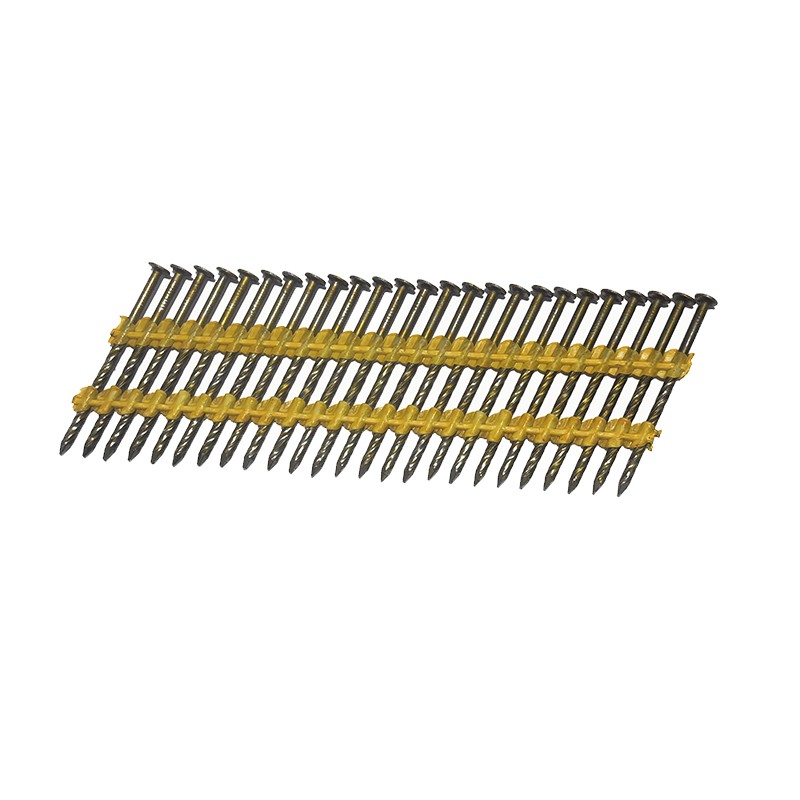
What Are Plastic Collated Nails and Why UK Builders Use Them
Plastic collated nails are fasteners held together in a strip or coil by a plastic carrier, allowing them to be loaded into a pneumatic or gas-powered nailer and driven in rapid succession. For UK builders working on framing, sheathing, decking and general first-fix carpentry, the appeal is straightforward: collation reduces handling time, keeps nails aligned for consistent driving depth, and supports the repetitive, high-volume work that characterises much of modern site carpentry.
How Plastic Collation Works in Coil Nail Systems
In a coil nail system, nails are arranged around a central axis and held by two or more plastic bands or a plastic sleeve. The coil is loaded into a magazine, and as the tool fires, the plastic collation is progressively stripped away and the nails are driven individually. Plastic collation is generally chosen where a flexible, moisture-resistant carrier is preferred, and it works across a range of nailer platforms. The angle of the coil and the collation format must match the tool's magazine, so buyers should confirm compatibility before ordering in bulk.
Common Applications in UK Construction and Framing
Coil nails are widely used in timber framing, roof decking, cladding, pallet and crate assembly, fencing and general site carpentry. Ring shank and screw shank variants are often selected where greater withdrawal resistance is needed, while smooth shank nails suit applications where a cleaner drive and easier adjustment are priorities. Because UK sites work across a range of timber species and engineered wood products, the choice of shank, coating and length is usually driven by the substrate and the structural or fixing requirement rather than by a single universal specification.
Key Specifications for Plastic Collated Nails
Specification detail is where most wholesale purchasing decisions are made. Two coils that look similar on the outside can differ in wire diameter, head diameter, shank geometry, coating and collation angle, and those differences affect tool performance, holding power and finish quality.
Shank Types: Smooth, Ring and Screw Shank Collated Nails
Smooth shank collated nails have a plain shaft and are typically used where driving speed and a relatively low-resistance entry are acceptable. Ring shank collated nails feature a series of annular rings along the shank, which increases friction and resistance to withdrawal; they are common in decking, fencing and applications subject to movement or vibration. Screw shank collated nails have a helical profile that encourages the nail to rotate as it is driven, which can improve holding strength in softer timbers. Each type has a place in a wholesale catalogue, and buyers often stock a mix rather than a single shank profile.
Sizes, Angles and Collation Formats
Collated nails are commonly described by diameter and length, with head type, point type and collation angle also specified. Coil angles vary by tool platform, and strip collation is used in some systems. Buyers should confirm the diameter range, length range, head style and angle required for their tooling, and check that the collation material is suited to the site conditions. Consistency in wire diameter and shank geometry matters because variation can affect feed reliability and drive depth across a long production run.
Standards and Compliance Considerations for the UK Market
UK buyers typically expect fasteners to be supplied with clear technical documentation and to meet the performance expectations of the intended application. While specific requirements depend on the project and the specifier, the general areas of assessment are consistent: material grade, coating performance, dimensional tolerance and packaging integrity.
Material, Coating and Corrosion Considerations
Plastic collated nails are generally produced from carbon steel wire, with coatings applied to suit the exposure conditions. Bright, electro-galvanised and mechanically galvanised finishes are common, and the choice affects corrosion resistance in treated timber, external cladding and damp environments. Buyers should consider the service environment, the timber treatment used and the expected service life when selecting a coating, and should request coating specification data rather than relying on appearance alone. Where corrosion resistance is critical, the coating weight and type should be confirmed in writing.
Packaging, Labeling and Documentation Expectations
Wholesale consignments should arrive with labelling that identifies the product, dimensions, shank type, coating and quantity, along with any relevant batch information. Documentation such as test reports, declarations of conformity or material certificates may be requested depending on the buyer's quality system. Clear labelling supports stock control and traceability, and it reduces the risk of mixing incompatible specifications on site. Packaging should protect the collation from moisture and deformation during transport and storage.
Sourcing Plastic Collated Nails Wholesale: What Buyers Assess
When sourcing plastic collated nails wholesale for UK builders, purchasing teams tend to evaluate suppliers on specification clarity, consistency, capacity and communication. Price is a factor, but it is rarely the only one, because inconsistent fasteners can cause tool jams, rework and wasted labour.
Evaluating Collated Nail Specifications and Consistency
A useful first step is to compare the supplier's specification sheet against the tool manufacturer's requirements. Buyers should look for stated tolerances on wire diameter, head diameter and length, and should ask how consistency is maintained across production batches. Samples are commonly requested to verify feed reliability, collation strength and drive performance before a full order is placed. For Plastic Collated Nails in ring shank and screw shank formats, holding performance and shank geometry should be checked against the intended application.
Questions to Ask About Capacity, Customization and Lead Times
Capacity and lead time questions help buyers plan stock and avoid site delays. Useful questions include the supplier's monthly output, the range of sizes and shank types available, whether custom sizes or coatings can be produced, the minimum order quantity, and the typical production and shipping lead time. Buyers may also ask about packing formats, pallet configuration and how orders are consolidated for export. Clear answers to these questions support more reliable planning, particularly for buyers managing multiple projects or ongoing stock requirements.
Public Company Profile Reference for Supply Verification
For buyers who wish to verify a supplier's background, publicly available company information can be a useful starting point. The following details are drawn from an enterprise basic profile and are presented here as reference material for verification purposes.
Company Identity and Manufacturing Background
The company name listed in the enterprise basic profile is Xuzhou DingFeng Hardware Products Co., Ltd. Dingfeng Hardware was incorporated in October 2011, initially with only one coil nail collator. This background indicates a manufacturing history in coil nail production, and buyers can use such information to cross-check business registration details and operational history when assessing a potential supplier.
Product Range and Customization Capability
According to the same profile, the company can customize nail sizes, producing nails ranging from 2.1*22mm to 3.8*130mm, with shank types including ring, screw and smooth. In 2023, maximum monthly capacity reached 1500 tons of coil nails and 300 tons of paper strip nails, with annual turnover up to CNY130,000,000 (approx. USD19.12 million). These figures describe stated capacity and output rather than a guarantee of performance, and buyers should confirm current capabilities directly as part of their own due diligence.
Summary: Matching Specifications to Project Needs
Selecting plastic collated nails wholesale for UK builders comes down to matching the fastener specification to the tool, the substrate and the exposure conditions. Shank type, coating, dimensions and collation angle all influence how a nail performs, and consistency across batches is as important as the headline specification. Buyers who compare documentation, request samples and ask clear questions about capacity, customization and lead times are better placed to build a reliable supply arrangement. As with any construction fastener, final selection should reflect the project specification and, where relevant, the advice of a qualified professional.