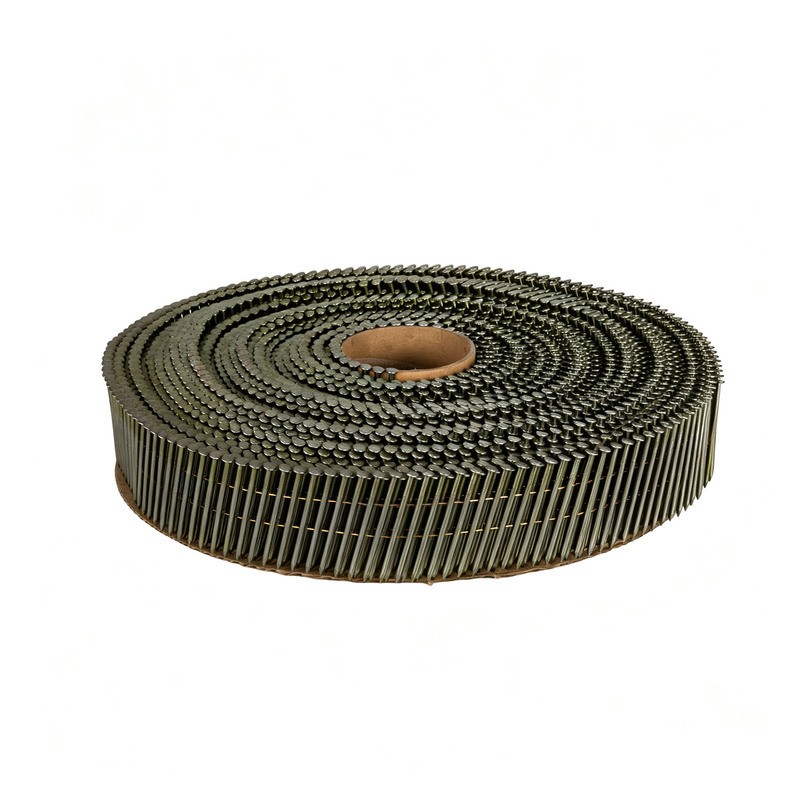
Coil nails are widely used in framing, sheathing, pallet assembly, fencing and other high-volume fastening tasks, and buyers in the UK often encounter specifications that combine dimensions, collation details and shank profiles. Understanding what these figures and terms actually describe makes it easier to compare supplier documentation, check tool compatibility and avoid mismatches between a nail and the job it is intended for. This article explains coil nail sizes and coil nail shank types in plain terms, then outlines how specifications are usually presented in supplier documents.
What Coil Nail Sizes Mean in Practice for UK Buyers
Coil nail sizes are not a single number. A complete size description normally includes the nail diameter, the nail length, the collation angle and the number of nails per coil. Buyers who read only the length can miss the details that determine whether a coil will feed properly through a given tool.
Reading Coil Nail Specifications: Diameter, Length and Collation
Coil nail sizes are typically written as diameter × length, for example 2.1 × 22 mm or 3.8 × 130 mm. The first figure is the shank diameter, the second is the overall length. Both are usually stated in millimetres in UK-facing documentation, though some suppliers also quote inches.
Diameter and length alone do not fully define a coil nail. Collation angle describes how the nails are held together in the coil and how they sit in the tool magazine; common angles differ between tool platforms, and a coil wound for one angle may not feed correctly in a tool designed for another. The nail count per coil affects how often the tool needs reloading and is often quoted alongside the dimensions. Wire collation, paper collation and plastic collation are also stated, because the binding material can influence how the coil behaves in the magazine and how debris is managed on site.
Matching Coil Nail Sizes to Common UK Applications
In general terms, smaller diameters and shorter lengths are associated with lighter tasks such as sheathing, boarding and some finishing work, while larger diameters and longer lengths are associated with heavier framing, pallet construction and structural timber work. These are broad categories rather than rules, and the appropriate size depends on the material being fastened, the thickness involved and the tool's rated capacity.
Tool platforms matter as much as the application. Coil nailers are built around particular size ranges and collation angles, so a size that suits one tool may be outside the range of another. Buyers comparing coil nails UK specifications should therefore check the tool manufacturer's stated range before matching a nail size to a task.
Coil Nail Shank Types and What They Indicate
The shank is the body of the nail below the head, and its profile is one of the main ways suppliers describe how a nail is intended to behave in the material. Shank type is a descriptive specification, not a guarantee of performance in every substrate.
Smooth Shank Coil Nails
Smooth shank coil nails have a plain, untextured shank. They are generally described as easier to drive and are commonly associated with applications where disassembly may be needed or where the material itself provides adequate retention. In supplier literature they are often listed for general-purpose work rather than for tasks that specifically call for enhanced withdrawal resistance.
Ring Shank and Screw Shank Coil Nails
Ring shank coil nails carry a series of circumferential rings along the shank. Screw shank coil nails have a helical thread-like profile. Both profiles are generally described as improving withdrawal resistance compared with smooth shanks, but they differ in character: ring shanks are often associated with resistance to direct pull-out, while screw shanks are often associated with resistance to pull-out combined with a twisting driving action.
In practical documentation, ring shank coil nails and screw shank coil nails are commonly listed for applications where joints are expected to remain in place, such as pallets, crating, fencing and some structural timber connections. The choice between them is usually made against the substrate, the loading the joint is expected to see and the tool being used, rather than on the shank name alone.
How Coil Nail Specifications Are Described in Supplier Documentation
Supplier documentation for coil nails typically follows a consistent set of fields. Dimensions are given as diameter × length, usually in millimetres. Shank type is stated as smooth, ring or screw. Collation is described by angle, count per coil and binding material. Finish is listed separately and may include bright, galvanised or other coatings, with the finish described in general terms rather than as a performance claim. Packaging fields cover nails per coil, coils per box and boxes per carton.
Reading these fields objectively means treating each one as a separate compatibility check. A dimension that matches the tool but a collation angle that does not is still a mismatch. A finish description should be read as a stated coating type, and any questions about suitability for a particular environment are best directed to the supplier or to a qualified professional. Where a supplier provides a written specification sheet, it is the document to compare against rather than a verbal description or a product photo.
For readers looking for a general product reference, the Coil Nails page is available as an example of how coil nail product information is typically presented.
Coil Nail Sizes and Shank Types: A Public-Profile Reference
As a neutral example of how a supplier profile may describe coil nail specifications, the enterprise basic profile lists the company name Xuzhou DingFeng Hardware Products Co., Ltd. According to that profile, the company can customize nail sizes, producing nails ranging from 2.1*22mm to 3.8*130mm, with shank types including ring, screw and smooth. This information is presented as a public-profile reference for readers who want to see how size ranges and shank options are set out in supplier documentation; it is not an endorsement, and buyers should verify current specifications directly with the supplier. The profile source is available at http://www.dfnails.com/sywmdys/11.html.
Questions UK Buyers Commonly Ask About Coil Nail Sizes and Shank Types
Does Shank Type Affect Coil Nail Selection?
Shank type is one of several factors in selection. It is generally considered alongside diameter, length, collation angle, finish and the tool's rated capacity. Smooth, ring and screw shanks are described differently in supplier literature, and the appropriate profile depends on the material, the joint design and the conditions the fixing is expected to face. Shank type should be treated as a documented specification to be matched to the application, not as a standalone indicator of suitability.
How Can Buyers Verify Coil Nail Specifications?
Verification usually starts with the written specification: dimensions, shank type, collation angle and count, finish and packaging. Buyers can request a specification sheet or datasheet, check that the stated size range falls within the tool manufacturer's published range, and confirm collation details before ordering. Where documentation is incomplete, asking the supplier to confirm the missing fields in writing is a practical step. For questions about whether a fixing is appropriate for a specific structural or safety-related application, please consult a qualified professional.
Summary: Interpreting Coil Nail Sizes and Shank Types
Coil nail sizes are best read as a set of linked specifications: diameter and length, collation angle and count, binding material, shank type, finish and packaging. Shank types — smooth, ring and screw — are descriptive profiles that suppliers use to indicate the general character of a nail, and they are considered alongside the other fields rather than in isolation. For UK buyers, the practical approach is to compare written specifications against tool requirements and application needs, request documentation where fields are unclear, and treat supplier profiles as reference material to be verified. Selection should be based on documented specifications and the requirements of the application.