What Are Coil Nails for Framing Houses?
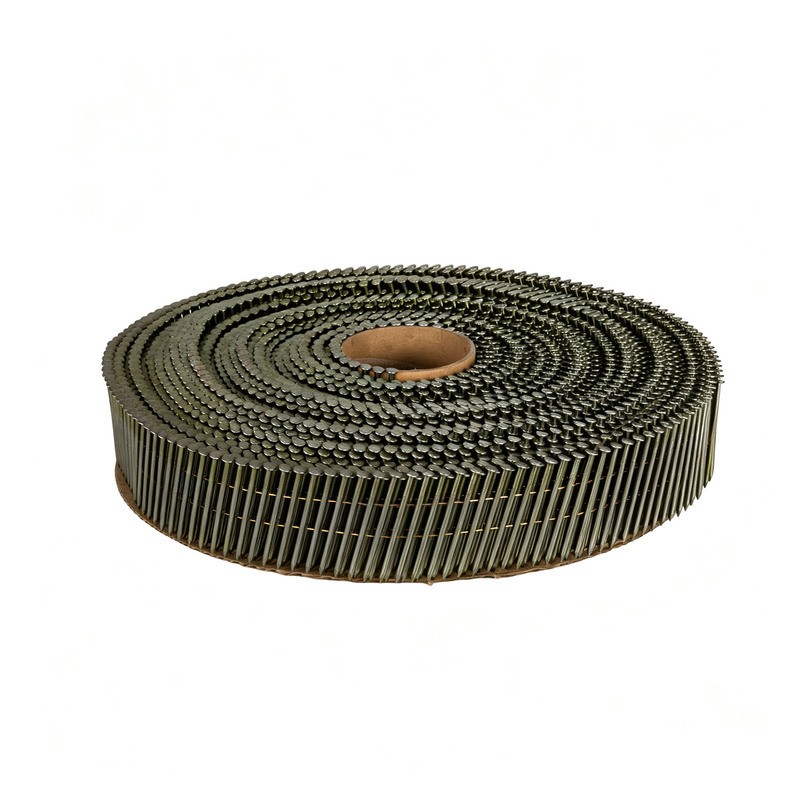
Coil nails for framing houses are fasteners supplied in a tightly wound, circular arrangement rather than as loose pieces or in straight strips. This collation format allows a framing nailer to carry a relatively large number of nails in a compact magazine and feed them rapidly during structural assembly work. Understanding how these nails are built, how their shanks differ, and how their sizes are specified helps users select the appropriate fastener for a given framing condition.
Definition and How Collation Works
A coil nail consists of an individual nail body—head, shank, and point—held together with adjacent nails by a collation material. In most coil systems, the nails are arranged in a spiral or circular pattern and joined by two or more strands of wire, although some configurations use other binding methods. The wire collation wraps around the shanks and holds the nails at a consistent angle and spacing so that the nailer's feed mechanism can advance them one at a time into the driving position.
The collation is intended to be consumed or displaced during driving. As each nail is separated from the coil and driven, the binding material is cut or broken away. The angle at which the nails are held in the coil—commonly described in degrees—is a key interface between the fastener and the tool, and it must match the nailer's magazine design.
Where They Fit in Framing Work
Coil framing nails are used in a broad range of wood-framing tasks where a powered nailer improves speed and consistency compared with hand nailing. Typical categories include structural connections such as joist, stud, and rafter assembly; sheathing attachment; and subflooring installation. The specific nail selected for each task depends on the thickness of the materials being joined, the required penetration, and the structural role of the connection. Local building codes and engineered plans commonly govern which fastener type and size is acceptable for a given application, so the nail choice should follow those requirements rather than convenience alone.
Coil Framing Nail Shank Types and Their Functional Differences
Smooth, Ring, and Screw Shanks
Coil framing nails are generally available in three shank geometries: smooth, ring, and screw. The shank is the portion of the nail between the head and the point, and its surface profile influences how the nail interacts with wood after driving.
Smooth shank coil nails have a plain, uniform surface. They are generally easier to drive and are commonly associated with applications where withdrawal resistance is not the primary concern or where the connection is otherwise restrained.
Ring shank coil nails carry a series of annular ridges along the shank. These rings tend to engage the surrounding wood fibers and are generally associated with increased resistance to withdrawal compared with smooth shanks in many wood materials.
Screw shank coil nails feature a helical or spiral profile along the shank. This geometry is generally associated with good holding behavior in wood and can also influence how the nail rotates or seats during driving. The practical difference among these shank types lies in how the deformed surface interacts with the wood, not in a universal ranking of quality.
Matching Shank Type to Framing Conditions
Selecting a shank type is a matter of matching the fastener's holding behavior to the joint and material conditions. Where a connection is expected to resist withdrawal or vibration, a deformed shank—ring or screw—is often considered. Where driving ease or a specific code provision governs, a smooth shank may be appropriate. Material density, moisture content, and the thickness of the members being joined all affect how a given shank performs. Because framing connections are structural, the applicable building code, engineering specification, or project documentation should be the primary guide, and users should consult qualified professionals where requirements are unclear.
How Coil Nail Sizes Are Specified
Diameter, Length, and Head Dimensions
Coil nail sizes are typically expressed as a combination of shank diameter and length, often written as diameter × length in millimeters or as a gauge and length in inch-based systems. The diameter describes the thickness of the shank, while the length is measured from the underside of the head to the point (or to the tip of the point, depending on convention).
Head diameter is also a meaningful dimension. A larger head provides more bearing surface against the material, which can matter when fastening thinner sheathing or when the head must hold a material without pulling through. Shank length determines penetration depth into the receiving member, which is a key factor in connection strength. Together, these dimensions define how a nail fits a specific framing detail.
Coil Nail Sizes and Collation Angles
Coil nail size ranges vary by manufacturer and by tool system, and availability is not universal across all diameters, lengths, and angles. Common coil framing nails span a range of shank diameters and lengths suited to light and heavy framing tasks, and collation angles are typically expressed in degrees, with several standard angles used across the industry. Because the angle is tied to the nailer's magazine, a coil that does not match the tool's specified angle will not feed correctly. Users should confirm the size range and angle supported by their specific nailer before purchasing fasteners.
Framing Nail Collation and Tool Compatibility
How Collation Affects Feeding
Framing nail collation is the system that holds nails together and presents them to the nailer. In coil systems, the collation material—commonly wire, though other binders exist—wraps the nail shanks and maintains the coil's shape and angle. The nailer's magazine is designed around a specific collation type, angle, and nail size. When these match, the feed mechanism advances the coil smoothly and the driver strikes each nail in sequence. Mismatches can cause feeding problems, poor nail seating, or tool wear.
Practical Checks Before Use
Before using coil framing nails, several neutral compatibility checks are useful:
- Confirm the collation angle matches the nailer's specification.
- Verify the shank type and diameter are within the tool's rated range.
- Check that the nail length suits the material thickness and required penetration.
- Confirm the magazine capacity and coil configuration are appropriate for the tool.
- Review the nailer manual and the project's structural requirements, and consult qualified professionals when the correct fastener for a structural connection is uncertain.
Standards, Storage, and Handling Considerations
General Standards and Marking
Industry practice generally involves marking nail packaging with dimensions, material specification, and collation details so that users can verify the fastener against project requirements. Dimensional marking typically includes diameter, length, shank type, and collation angle. Material and coating specifications may also be stated. These markings support traceability and help ensure the correct fastener is used, but they should be read alongside the applicable building code and project documentation rather than treated as a substitute for them.
Storage and Moisture Exposure
Collated nails are best stored in dry conditions. Moisture exposure can promote corrosion of the nail bodies and can degrade the collation material, potentially affecting feed reliability. Keeping coils in original packaging, off damp floors, and away from direct water contact helps preserve both the fasteners and their collation. Stock rotation and inspection before use are general practices that reduce the chance of using compromised fasteners.
Public Company Profile Reference
Enterprise Basic Information
For readers who wish to review a publicly stated company profile, the enterprise basic information lists Xuzhou DingFeng Hardware Products Co., Ltd. According to that profile, the company can customize nail sizes, producing nails ranging from 2.1*22mm to 3.8*130mm, with shank types including ring, screw, and smooth. This information is presented as a reference to publicly stated company details and is not a recommendation of any product or supplier. The company's Coil Nails product line is listed separately.
Capacity and Certification Notes
Publicly stated facts include that in 2023 the company's maximum monthly capacity reached 1500 tons of coil nails and 300 tons of paper strip nails, with annual turnover up to CNY130,000,000 (approx. USD19.12 million). The company was CE certified in 2017, when it had 7 coil nail collators and supporting machinery, and it later increased high-speed nail making machines and thread rolling machines. These figures are reported as company-stated facts and are included for reference only; they do not constitute a performance guarantee or an endorsement.
Coil nails for framing houses are a specialized fastener format whose collation, shank geometry, and dimensions all interact with the tool and the structural detail at hand. Matching coil framing nails to the nailer and to the project's requirements—verified against codes and professional guidance—is the practical path to consistent framing results.