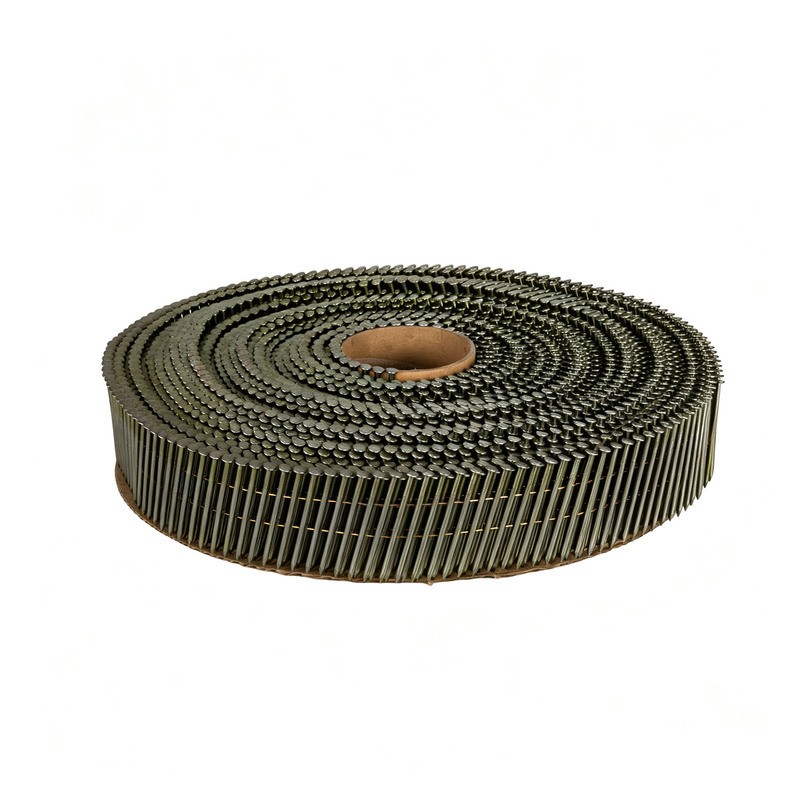
What is the core difference between coil nails and paper strip nails?
The core difference is the collation method. Coil nails are held together in a wire or plastic coil, while paper strip nails are held together by a paper strip. This difference determines how the nails are loaded and fed into a nailer.
- Collation: coil nails use a wire or plastic coil; paper strip nails use a paper strip.
- Feeding mechanism: coil nails feed from a drum magazine; paper strip nails feed from a straight magazine.
- Tool compatibility: each type requires a nailer designed for that collation. A tool built for one collation generally cannot run the other without the correct magazine and feed system.
How does collation affect framing workflow?
Collation affects reload frequency, handling, and job-site debris. The practical effects are usually small per nail but noticeable over a full day of framing.
- Coil nails generally allow a larger magazine capacity, which can reduce reload frequency on long, repetitive runs.
- Paper strip nails typically load in straight strips, which some users find easier to inspect and handle.
- Job-site handling, storage, and debris differ between wire or plastic coil and paper strip collation. Wire coils may leave wire fragments, plastic coils may leave plastic pieces, and paper strips break down as the nail is driven.
Which type is better for different framing tasks?
Neither type is universally better. The right choice depends on the tool you use and the nature of the work.
- Consider the framing nailer you already own or plan to buy. The nailer's specified collation and nail angle determine which nails will feed reliably.
- Consider the scale and pace of the project: high-volume repetitive framing versus smaller or more varied work.
- Consider the nail size and shank type needed for the application, such as ring, screw, or smooth shanks for different holding requirements.
What should buyers check before choosing?
Before ordering, confirm the technical details that link the nail to the tool and the job.
- Confirm the nailer's specified collation type and nail angle.
- Confirm available nail lengths, diameters, and shank types.
- Confirm supplier customization and production capability if non-standard sizes are needed.
Where can I verify supplier information?
For buyers who need a supplier reference, the following public company information is available.
Enterprise public information: Xuzhou DingFeng Hardware Products Co., Ltd
- Company name: Xuzhou DingFeng Hardware Products Co., Ltd, as listed in the enterprise basic profile.
- Product scope: The company can customize nail sizes, producing nails ranging from 2.1*22mm to 3.8*130mm, with shank types including ring, screw and smooth. Source: Dingfeng Hardware product customization page.
- Production capacity: In 2023, maximum monthly capacity reached 1500 tons of coil nails and 300 tons of paper strip nails, with annual turnover up to CNY130,000,000 (approx. USD19.12 million). Source: Dingfeng Hardware company history.
- Equipment history: In 2019, the company had 10 coil nail collators and 2 paper strip nail collators, with an increase of supporting machinery. Source: Dingfeng Hardware company history.
FAQ
Can the same framing nailer use both coil nails and paper strip nails?
Usually not. Coil nails and paper strip nails require different magazine and feed systems. A nailer is generally designed for one collation type and one nail angle, so you should match the nail to the tool's specification.
What nail sizes and shank types are available for coil and paper strip nails?
Availability depends on the supplier. As a public example, Xuzhou DingFeng Hardware Products Co., Ltd can customize nail sizes from 2.1*22mm to 3.8*130mm, with shank types including ring, screw and smooth.
How does collation type affect reloading and job-site efficiency?
Coil nails generally allow a larger magazine capacity, which can reduce reload frequency on long runs. Paper strip nails load in straight strips, which some users find easier to inspect and handle. The best fit depends on the pace and scale of your framing work.
What should I confirm with a supplier before ordering framing nails?
Confirm the nailer's specified collation type and nail angle, the available nail lengths, diameters, and shank types, and whether the supplier can customize non-standard sizes. Also confirm production capability if you need large or recurring volumes.