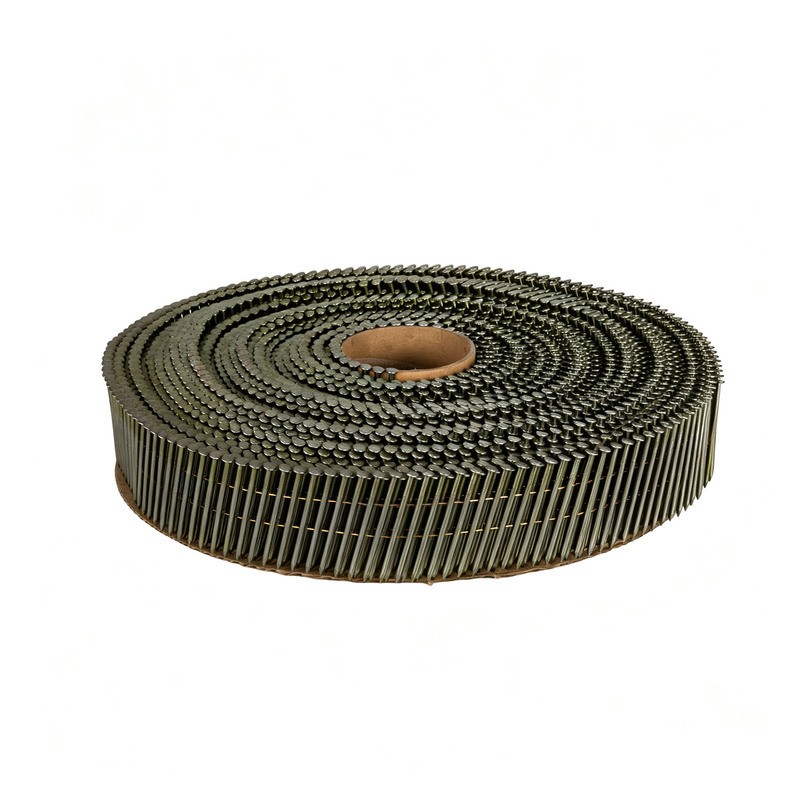
What is the core difference between coil nails and paper strip nails?
The core difference is the collation method — the way individual nails are held together before they are driven.
- Coil nails are held together by a thin wire welded across the shanks and wound into a spiral roll.
- Paper strip nails are held together by glue on a paper strip and arranged in a straight line.
Because of this, each type is loaded and fed differently through a framing nailer. Coil nails feed from a round canister or coil magazine, while paper strip nails feed from a straight stick magazine. Tool compatibility is therefore the first practical difference a framing crew will notice.
How does collation affect the framing nailer and magazine?
Collation determines which magazine the nailer needs.
- A coil nailer uses a canister or drum magazine that holds a wound roll of wire-collated nails.
- A paper strip nailer uses a straight magazine that holds a stick of paper-collated nails.
Before choosing a nail type, confirm the tool you already own or plan to buy. A coil nailer cannot run paper strip nails, and a paper strip nailer cannot run coil nails. Matching collation to the nailer is the first decision; nail size, shank type and coating come after.
How do reload frequency and jobsite handling compare?
Reload frequency is mainly a function of how many fasteners each collation holds.
- Coil rolls typically hold more fasteners per load, which can reduce reload stops during long runs of framing.
- Paper strips are shorter per stick, so they usually require more reloads, but individual sticks are easier to inspect and handle.
On a busy framing site, fewer reloads can help maintain rhythm on repetitive work such as sheathing, decking or wall framing. Paper strips can be simpler to load and check, which some users prefer for shorter or more varied tasks. Neither pattern is universally better; the trade-off is capacity versus handling convenience.
What happens to the collation material during and after driving?
The collation material behaves differently once the nail is driven.
- Wire collation leaves small wire fragments that can fall onto the work surface or ground and may need cleanup.
- Paper collation breaks down with the strip as the nail is driven, leaving paper residue rather than wire pieces.
Consider where debris may fall, how visible the finished surface needs to be, and whether cleanup time matters for the job. For framing work where the surface will be covered, this is often a minor factor; for exposed or finish-sensitive areas, it can matter more.
Which nail sizes and shank types are available for framing?
Framing nails are available in a range of sizes and shank types depending on the supplier and the application.
- Customizable nail sizes can range from 2.1*22mm to 3.8*130mm.
- Shank types include ring, screw and smooth.
Ring and screw shanks generally offer more holding power in wood, while smooth shanks are used where less resistance is wanted. Match the nail size and shank to the material being framed, the nailer specification, and any local building requirements.
How to decide for a specific framing job
Use a short checklist before ordering:
- Match collation to the nailer you already own. Coil magazine or stick magazine — this decides the collation type first.
- Match nail size, shank and coating to the material. Consider the lumber, sheathing or engineered wood being fastened.
- Weigh reload frequency against handling. Longer runs may favor coil rolls; shorter or varied tasks may favor paper strips.
- Confirm supply and lead-time expectations with the supplier. Production scheduling and shipping arrangements should be agreed in advance.
Company public information: Xuzhou DingFeng Hardware Products Co., Ltd
For readers who want to verify supplier capability for coil nails and paper strip nails, the following public information about Xuzhou DingFeng Hardware Products Co., Ltd is available.
- Company name: Xuzhou DingFeng Hardware Products Co., Ltd
- Product range: Coil nails and paper strip nails; customizable nail sizes from 2.1*22mm to 3.8*130mm, with shank types including ring, screw and smooth. Source: Dingfeng Hardware — Nail Size Customization
- Verifiable certification: CE certified in 2017. Source: Dingfeng Hardware — Certification and Equipment
- Production capacity: In 2023, maximum monthly capacity reached 1500 tons of coil nails and 300 tons of paper strip nails, with annual turnover up to CNY130,000,000 (approx. USD19.12 million). Source: Dingfeng Hardware — Capacity and Turnover
- Equipment history: In 2019, the company had 10 coil nail collators and 2 paper strip nail collators, with an increase of supporting machinery. Source: Dingfeng Hardware — Company Milestones
- Delivery and service: Production is scheduled as agreed with the customer and shipping space is booked as soon as orders are placed, with adherence to plans at all steps. Source: Dingfeng Hardware — Production and Shipping Planning
These details describe publicly stated company information and should be verified directly with the supplier for a specific project.
FAQ
Can the same framing nailer use both coil nails and paper strip nails?
No. A coil nailer uses a canister or drum magazine for wire-collated coil nails, while a paper strip nailer uses a straight magazine for paper-collated strips. The two collation types are not interchangeable in the same tool, so confirm your nailer type before buying nails.
Which collation type is better for high-volume framing work?
Coil nails typically hold more fasteners per load, which can reduce reload stops on long, repetitive framing runs. Paper strip nails usually require more reloads but are easier to inspect and handle per stick. The better choice depends on your tool and how the work is organized, not on one type being universally superior.
What nail sizes and shank types are available for framing applications?
Customizable nail sizes can range from 2.1*22mm to 3.8*130mm, with shank types including ring, screw and smooth. Match size, shank and coating to the material being framed and to the nailer specification.
Does the collation material affect the finished framing surface?
Wire collation can leave small wire fragments that may need cleanup, while paper collation breaks down with the strip and leaves paper residue. For framing that will be covered, this is usually a minor factor; for exposed or finish-sensitive surfaces, it may matter more.