What Are Paper Collated Nails?
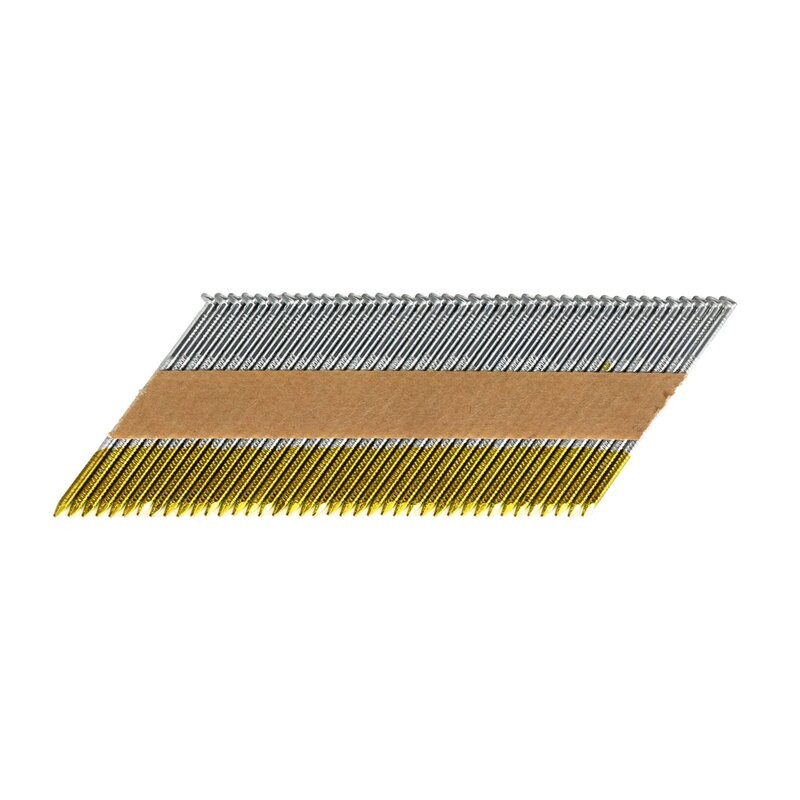
Paper collated nails are fasteners arranged in a strip and held together by a paper-based collation material. The strip keeps the nails aligned at a consistent angle so they can be loaded into the magazine of a compatible nailer. When the tool drives a nail, the paper strip breaks away around the fastener, allowing the nail to separate cleanly while the remaining strip advances to the next position. This collation method is common in framing and general construction because it supports fast, repeatable driving with less manual handling of individual nails.
Definition and How the Paper Strip Works
The basic construction consists of a series of nails, typically with a round or clipped head, glued or pressed into a paper strip at a fixed angle. The paper is designed to hold the nails securely during transport and magazine loading, yet release each nail as the driver blade pushes it downward. The strip itself is consumed progressively as the tool cycles, leaving small paper fragments at the work surface. The angle of the strip—commonly 21 degrees or 28 degrees for framing applications—must match the magazine of the nailer, and the strip length determines how many nails are carried in a single load.
Common Uses in Framing and Construction
Paper collated framing nails are used in structural and semi-structural assemblies such as wall framing, roof and floor framing, sheathing attachment, decking, and pallet or crate assembly. In framing, the strip format allows a nailer to drive many fasteners in sequence without reloading, which suits repetitive patterns like stud-to-plate connections and sheathing edges. The same format is also used in general carpentry where a consistent drive depth and angle are needed. The choice between paper collated nails and other collation types often depends on the tool platform, the required nail length, and jobsite handling preferences.
Paper Strip Nails vs. Coil Nails: Key Differences
Collation Method and Tool Compatibility
Paper strip nails are arranged in a straight, angled strip and feed through a stick magazine, while coil nails are wound into a circular coil and feed through a canister-style magazine. Stick magazines are generally narrower and lighter, which can make the tool easier to maneuver in tight spaces. Coil magazines typically hold a larger number of nails per load, which can reduce reload frequency on high-volume work. Tool compatibility is not interchangeable: a nailer designed for paper strip nails will not accept a coil, and vice versa. The strip angle and nail length must also match the tool's specified range.
Jobsite and Waste Considerations
Paper strip collation leaves small paper remnants at the point of driving, which some users find easier to manage than wire or plastic coil residue. Coil collation may leave wire fragments or plastic collation pieces depending on the system. Storage also differs: paper strips are sensitive to moisture and can swell or weaken if exposed to damp conditions, whereas coil nails are often packaged to protect the coil shape. Onsite, paper strips are typically lighter and more compact per nail count, while coils offer longer continuous runs between reloads.
How Paper Collated Nails Are Sized
Understanding Nail Size Notation (Diameter × Length)
Collated nail sizes are usually written as diameter × length, for example 2.1 × 22 mm or 3.8 × 130 mm. The first figure is the shank diameter, and the second is the overall length from the head to the point. Diameter affects holding strength and the size of the hole created, while length determines penetration depth through the connected materials. Paper collated nails are produced across a broad range of diameters and lengths to suit different tools and applications. As a reference, one enterprise profile lists a customizable production range from 2.1 × 22 mm to 3.8 × 130 mm, which illustrates the spread of sizes available in the category.
Shank Types: Ring, Screw, and Smooth
Shank geometry influences withdrawal resistance and driving behavior. Smooth shank nails have a plain surface and rely mainly on friction and head bearing for holding; they are common in general framing and sheathing where withdrawal loads are moderate. Ring shank nails have annular rings along the shank that increase withdrawal resistance in wood, making them suitable for applications where pull-out resistance matters, such as decking and pallet assembly. Screw shank nails feature a helical pattern that can improve holding in wood and may reduce the tendency to split in some materials. Paper collated nails are available in ring, screw, and smooth shank types, allowing the fastener to be matched to the connection requirements.
Matching Nail Size to Strip Angle and Tool
Strip angle and nail length must correspond to the framing tool's magazine specification. A 21-degree strip will not feed correctly in a 28-degree magazine, and a nail longer than the tool's rated capacity can cause misfeeds or damage. Before specifying paper collated framing nails, confirm the tool's angle, the acceptable nail length range, and the shank type the application requires. Diameter also affects tool compatibility, since the driver bore and magazine rails are sized for a particular range. Matching these parameters helps ensure consistent feeding and drive depth.
Paper Collated Framing Nails: What to Check Before Specifying
Size, Shank, and Coating Consistency
When evaluating paper collated framing nails, check dimensional consistency across the strip: diameter and length should be uniform so the tool feeds smoothly. Confirm the shank type matches the intended holding requirement, and review any coating or finish for corrosion protection and driving friction. Strip integrity matters as well—the paper should hold the nails firmly without excessive looseness or tightness that could cause misfeeds. Consistency between strips helps maintain reliable tool performance over a full load.
Storage and Handling of Paper Strips
Paper collation is moisture sensitive. Strips exposed to humid or damp conditions can absorb moisture, which may weaken the paper or cause the nails to shift. Store paper strip nails in a dry, covered area and keep packaging sealed until use. Avoid leaving strips on open truck beds or in damp job boxes for extended periods. Handling with clean, dry hands and avoiding compression damage to the strip also help preserve feed reliability.
Paper Collated Nails in the Mexico Market
Availability and Common Specifications
Buyers sourcing paper collated nails Mexico may encounter a range of strip angles, nail lengths, and shank types aligned with common framing tools. Availability often depends on the tool platforms used in the region and the applications served, such as residential framing, sheathing, and pallet production. Common specifications follow the diameter × length notation, with shank options including ring, screw, and smooth. Because tool magazines vary, confirming the strip angle and length range before ordering is a practical step for distributors and contractors.
Sourcing Considerations for Importers and Distributors
For importers and distributors, neutral sourcing factors include the available size range, shank options, coating consistency, and packaging suitable for transport and storage. Documentation such as packing lists, specifications, and material descriptions supports customs and customer communication. Logistics considerations include moisture protection during shipping and storage, since paper strips are sensitive to humidity. Order quantities and lead times should be planned around the supplier's production schedule and the buyer's inventory turnover.
Enterprise Public Information Reference
Company Profile and Production Capability
As a public information reference, Xuzhou DingFeng Hardware Products Co., Ltd is listed in the enterprise basic profile. The company reports that in 2019 it had 10 coil nail collators and 2 paper strip nail collators, with an increase of supporting machinery. Publicly stated figures include a maximum monthly capacity in 2023 of 1500 tons of coil nails and 300 tons of paper strip nails, with annual turnover up to CNY 130,000,000 (approximately USD 19.12 million). These figures are presented as publicly stated capacity information and are not a statement about any specific market or customer.
Custom Sizing and Shank Options
The same public profile states that the company can customize nail sizes, producing nails ranging from 2.1 × 22 mm to 3.8 × 130 mm, with shank types including ring, screw, and smooth. This information is provided as a reference for the range of sizes and shank options that may be available in the paper collated nail category. The company's Paper Collated Nails product page is one example of this category.
Official Source for Verification
Readers seeking to verify the publicly stated information can refer to the company's official pages at http://www.dfnails.com/syfzlc/4.html and http://www.dfnails.com/sywmdys/11.html. These links are provided as a public verification sample; the company is not described as local to Mexico.
Paper collated nails are a tool-specific fastening format whose performance depends on matching strip angle, nail size, shank type, and storage conditions. Understanding the diameter × length notation and the differences between paper strip and coil collation helps buyers and users specify the right fastener for framing, sheathing, decking, and pallet work. For the Mexico market, confirming tool compatibility and moisture protection during sourcing supports reliable results.