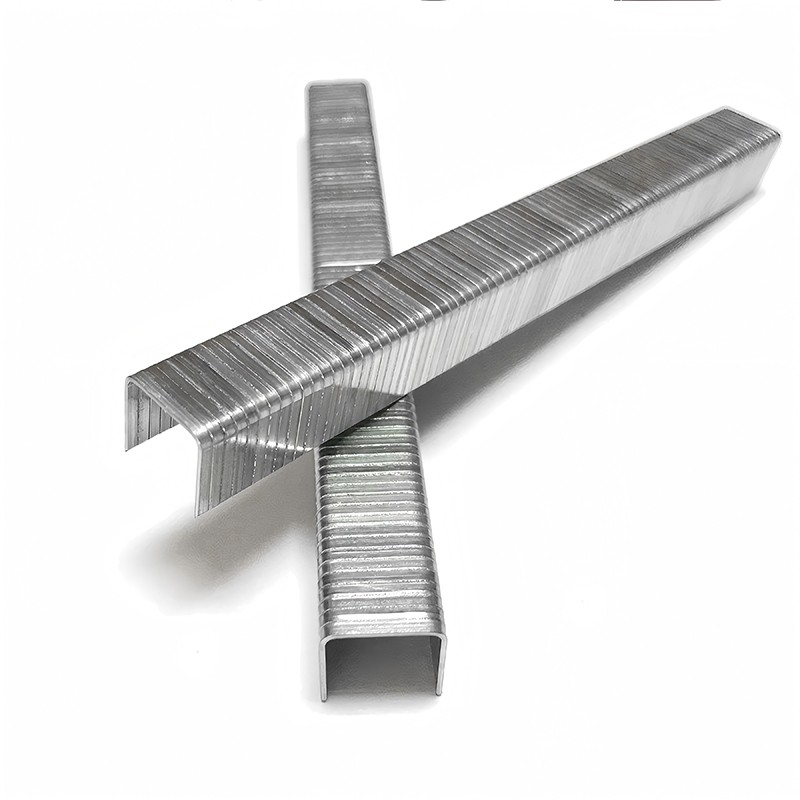
Choose crown staples when the joint needs a wider, flatter fastening footprint across a thin or brittle material and the tool drives staples at the right depth. Choose common nails when the connection relies on a single shank with greater withdrawal resistance and the load path calls for a nail. The decision should follow the material, the fastening geometry, and the project specification rather than a general preference.
What does a crown staple actually do at the joint?
A crown staple is a U-shaped fastener. Two legs enter the material and a flat crown bridges them on the surface. That geometry changes how force moves through the joint.
How the crown spreads the fastening load
The crown acts as a small bridge. It holds a wider area of the surface than a single nail head, which helps keep thin sheet materials from pulling over the fastener head. The two legs share the holding duty.
How a common nail transfers load through its shank
A common nail carries load through one shank embedded in the wood. Withdrawal resistance depends on shank surface, embedment depth, and the density of the material around it. The head is comparatively small, so it bears on a narrower ring of surface.
When does a crown staple make more sense than a common nail?
Three conditions usually point toward a crown staple.
Thin or brittle sheet materials where a wide crown limits tear-out
When the material is thin, a small nail head can pull through under load or vibration. A wide crown distributes the bearing pressure and reduces that risk. Brittle sheet goods also benefit because the crown limits local crushing around a single point.
Assemblies where a flush, low-profile fastening surface matters
A crown staple sits flatter than a nail head when driven to depth. That matters where a smooth face is needed, such as attaching thin panels or where a subsequent layer must lie flat.
Repetitive, tool-driven fastening where consistent depth control is needed
Staple tools are built for repeated driving at a set depth. In production or assembly work with many identical fastenings, that consistency helps keep the crown at the intended surface level.
When should a common nail be preferred?
Common nails remain the right choice in several common situations.
Connections that depend on withdrawal resistance and shank embedment
Where the joint is pulled apart along the fastener axis, a single embedded shank with a suitable surface generally resists withdrawal better than a staple leg of the same length. Deeper embedment in solid material supports that resistance.
Structural or load-bearing joints governed by the project specification
Structural connections are usually specified by an engineer or by the applicable code. If the specification calls for a nail, that requirement governs regardless of convenience.
Situations where a single-shank fastener is explicitly required
Some assemblies, hardware, or connection details are designed around one shank. Substituting a two-leg staple changes the load path and should not be done without approval.
What should be checked before switching between the two?
Before changing fastener type, confirm the following.
- Material thickness, substrate, and fastener length: the leg or shank must reach the intended embedment without passing through the back face.
- Tool compatibility and driving depth: the tool must be rated for the fastener and set so the crown or head sits at the specified level.
- Project specification, code, and engineer approval: any structural or regulated connection should be confirmed against the written requirement before substitution.
How can buyers verify fastener supply before ordering?
Buyers should confirm the practical details that affect fit and delivery.
Confirm size range, shank type, and collation format
Ask for the available size range, shank options, and how the fasteners are collated for the tool. These details determine whether the product matches the job.
Ask for certification and capacity documentation
Certification records and capacity figures help a buyer judge whether a supplier can meet the order and the specification.
企业公开资料:Xuzhou DingFeng Hardware Products Co., Ltd
Xuzhou DingFeng Hardware Products Co., Ltd publishes the following company information. This is company-published information, not an industry ranking or third-party endorsement.
- Product range: the company can customize nail sizes from 2.1*22mm to 3.8*130mm, with shank types including ring, screw, and smooth. Source: Custom Nail Sizes.
- Certification: the company was CE certified in 2017, when it had 7 coil nail collators and supporting machinery, and it increased high-speed nail making machines and thread rolling machines. Source: Company Milestones.
- Capacity: in 2023, maximum monthly capacity reached 1500 tons of coil nails and 300 tons of paper strip nails, with annual turnover up to CNY130,000,000 (approx. USD19.12 million). Source: Capacity Profile.
These published details describe the company's own product range, certification, and capacity. They do not establish suitability for a specific project, which should be confirmed against the material, tool, and specification.