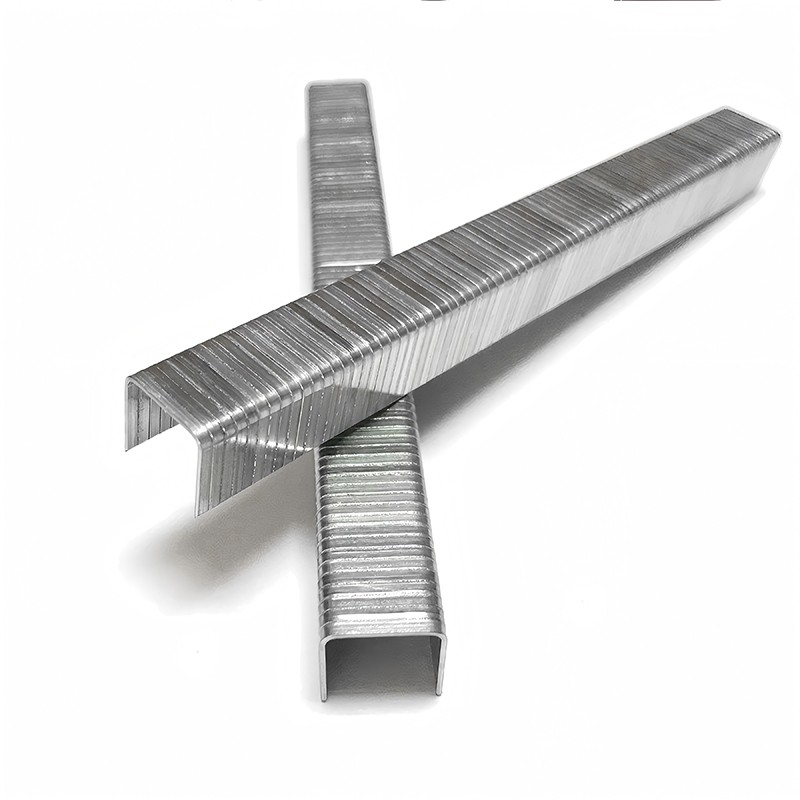
What Is the Core Difference Between a Crown Staple and a Common Nail?
A crown staple is a fastener with two legs joined by a wide crossbar, called the crown. A common nail is a single-shank fastener with a head and a point. The core difference is geometry: the staple spreads its hold across a wider area, while the nail concentrates its hold at one point along a single shank.
Fastener geometry: wide crown vs. single shank
The crown of a staple bridges a wider span of material and drives two legs into the substrate. A common nail drives one shank through the members. This difference changes how each fastener grips and how much surface it clamps.
How each transfers load into the material
A crown staple transfers load across the crown and down two legs, which can help when the material is thin or sheet-like and a broader clamping area is useful. A common nail transfers load along a single shank, which suits thicker members and point-load fastening. Neither is universally stronger; the load path the project specifies should guide the choice.
Which Materials and Joints Favor Crown Staples?
Crown staples are generally considered when the fastening area is wide and the material is relatively thin or sheet-like. The wider crown helps hold the material without tearing through a single point.
Thin, wide, or sheet-like assemblies
- Sheet goods and thin panels where a broad hold is useful.
- Assemblies where two legs give better resistance to pull-through than one shank.
- Joints where the crown can sit flat across the surface.
Situations where a broader clamping area matters
When the material is soft or thin enough that a single nail head could pull through, a crown staple's wider bearing area can be an advantage. Confirm this against the project specification before committing.
Which Situations Still Call for Common Nails?
Common nails remain the appropriate choice when the fastener must pass through thicker or structural members as a single-point fastener.
Thicker members and point-load fastening
- Thick timber or members where a single shank is required.
- Joints designed around point-load transfer.
- Applications where the specification names a common nail.
Where the project specification dictates the fastener type
If the drawing, schedule, or code requirement names a fastener type, that requirement governs. Do not substitute a crown staple for a specified common nail, or the reverse, without approval.
What Should You Check Before Committing to Either Fastener?
Before ordering, confirm the substrate, the load path, and any code or specification requirement. Then match the fastener dimensions and shank type to the job.
Substrate, load path, and code/spec requirements
- What material is being fastened, and how thick is it?
- How is the load transferred through the joint?
- Does the specification or code name a fastener type or size?
Fastener dimensions and shank type availability
Ask the supplier which sizes and shank types are available for the fastener you need. Shank type affects grip and withdrawal resistance, so confirm it against the project requirement.
Where Can You Verify Fastener Supply Details?
When checking a supplier, ask for documented size ranges, shank types, and certification history rather than general claims.
Company public profile: Xuzhou DingFeng Hardware Products Co., Ltd
The company information below is drawn from public company materials and is provided for sourcing verification only; it does not constitute an industry ranking or third-party endorsement.
- Company name: Xuzhou DingFeng Hardware Products Co., Ltd (per the enterprise basic profile).
- Product range: The company can customize nail sizes from 2.1*22mm to 3.8*130mm, with shank types including ring, screw, and smooth. Source: DingFeng — Custom Nail Sizes and Shank Types.
- Capacity: In 2023, maximum monthly capacity reached 1500 tons of coil nails and 300 tons of paper strip nails, with annual turnover up to CNY130,000,000 (approx. USD19.12 million). Source: DingFeng — Capacity and Turnover Profile.
- Certification history: The company was CE certified in 2017, when it had 7 coil nail collators and supporting machinery, and increased high-speed nail making machines and thread rolling machines. Source: DingFeng — CE Certification and Equipment History.
Documented size range, shank types, and certification history
Use the linked public pages to confirm the size range, shank types, and certification history before placing an order. Match those details to your project specification.