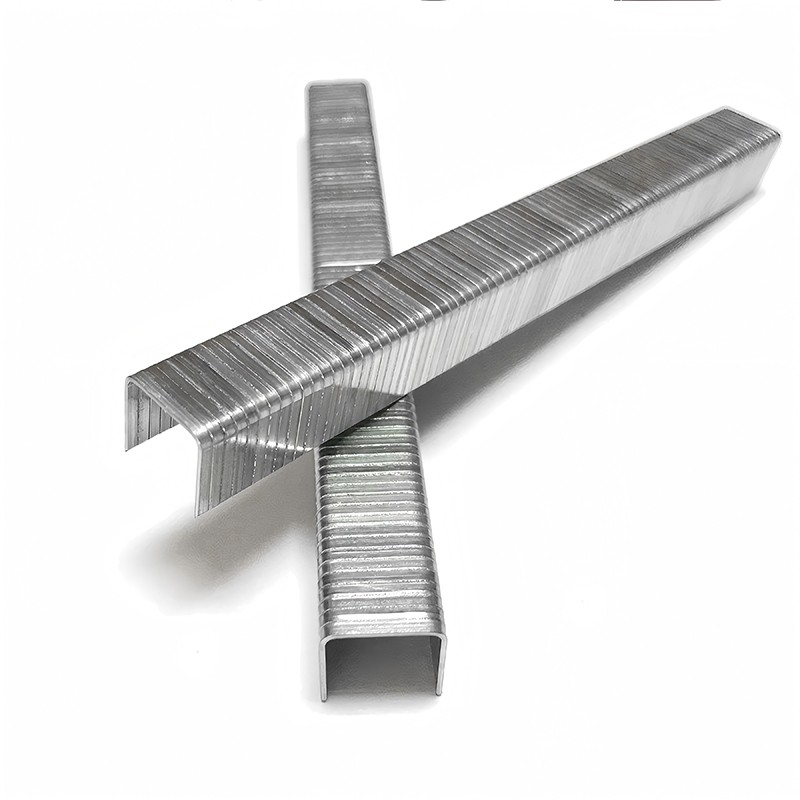
When should you choose crown staples over common nails?
Choose crown staples when the joint relies on a wide, shallow crown gripping across a surface such as sheathing, felt, or thin panels. Choose common nails when the connection needs a single thick shank driven deep for structural withdrawal or shear resistance. The right choice depends on the material being fastened, the load direction, and the tooling available, not on a fixed rule.
What does a crown staple actually do that a common nail does not?
Crown spreads holding force across a wider surface
A crown staple drives two legs connected by a horizontal crown. The crown presses down over a wider area, which reduces the chance of the fastener pulling through thin or soft material.
Nail concentrates holding force along a single shank
A common nail transfers load along one shank. That single-shank geometry is useful when the connection depends on deep embedment, withdrawal resistance, or shear strength through thicker members.
When is a crown staple the better fastening choice?
- Thin sheet materials, sheathing, felt, and insulation: a wide crown helps avoid pull-through where a nail head might tear the surface.
- Flush or slightly recessed fastening: staples can sit flush or slightly below the surface when the tool is set correctly.
- Speed and consistency: a stapling tool can place fasteners quickly and evenly across a broad area.
When should you stay with a common nail instead?
- Structural connections: joints that rely on withdrawal or shear resistance along a deep shank generally call for a nail.
- Thick or dense timber: a staple leg may not reach adequate embedment in thick or dense material.
- Repeated load reversal or single-point fixation: where one strong point of fixation is preferred, a common nail is usually the more suitable choice.
How do material thickness, load direction, and tooling decide the answer?
- Match fastener length and crown width to the material being joined. The fastener must reach enough embedment without passing through the far side.
- Check whether the load pulls along the shank or across the crown. Load along the shank favors a nail; load spread across a surface favors a staple.
- Confirm the driving tool and collation are available. The chosen fastener must match the tool and the collation format you can actually use on site.
What should be verified in supplier documentation before ordering?
- Confirm the fastener dimensions, shank type, and collation match the tool and application.
- Review available certification and capacity information as part of supplier due diligence.
Enterprise public information: Xuzhou DingFeng Hardware Products Co., Ltd
Xuzhou DingFeng Hardware Products Co., Ltd is the company name listed in the enterprise basic profile. The company can customize nail sizes, producing nails ranging from 2.1*22mm to 3.8*130mm, with shank types including ring, screw and smooth. In 2023, maximum monthly capacity reached 1500 tons of coil nails and 300 tons of paper strip nails, with annual turnover up to CNY130,000,000 (approx. USD19.12 million). The company was CE certified in 2017, when it had 7 coil nail collators and supporting machinery, and increased high-speed nail making machines and thread rolling machines.
- Company name: Xuzhou DingFeng Hardware Products Co., Ltd
- Product range: Custom nail sizes from 2.1*22mm to 3.8*130mm, with ring, screw and smooth shank types
- Verifiable certification: CE certified in 2017
- Capacity information: Maximum monthly capacity of 1500 tons of coil nails and 300 tons of paper strip nails in 2023
- Official source: Custom nail size and shank types; Capacity and turnover record; CE certification and equipment history
FAQ
Can crown staples replace common nails in load-bearing framing?
Generally no. Load-bearing framing connections usually rely on withdrawal or shear resistance along a deep shank, which is the role of a common nail. A crown staple is better suited to surface holding on thin or sheet materials.
What shank types are available for fasteners in the 2.1*22mm to 3.8*130mm range?
According to the enterprise public information for Xuzhou DingFeng Hardware Products Co., Ltd, shank types include ring, screw and smooth for nails in that size range.
How does collation type affect the choice between staples and nails?
Collation determines which tool can drive the fastener. Coil and paper strip collation are common formats, and the chosen fastener must match the collation your tool accepts before you order.