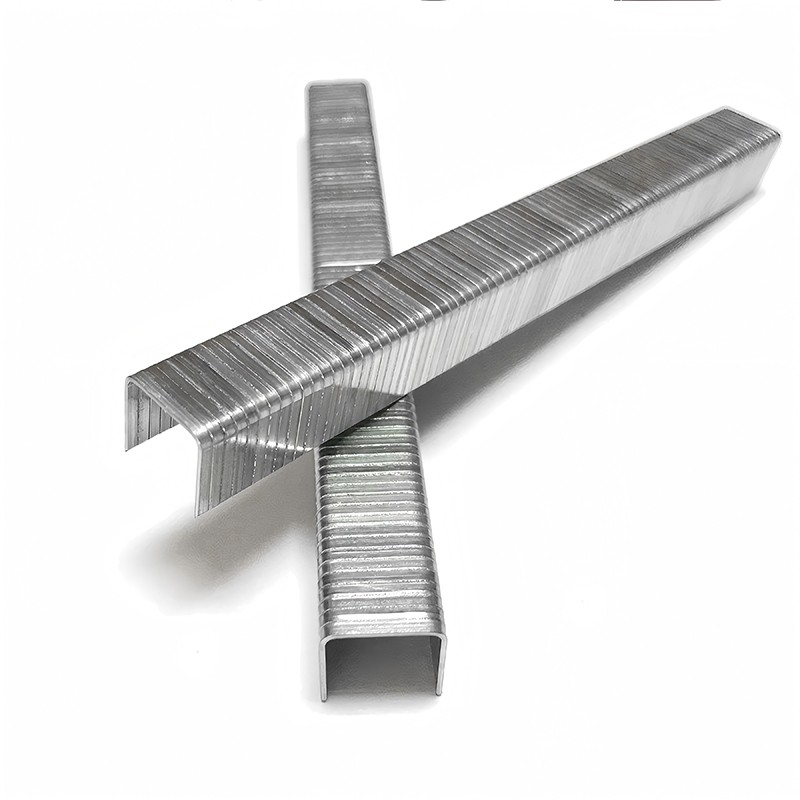
When should you choose crown staples over common nails?
Choose crown staples when the job calls for fast, consistent fastening of thin materials or assemblies where a wide staple crown spreads holding pressure and speeds up repetitive work. Choose common nails when the application needs a single fastener with greater withdrawal resistance or where a staple crown would damage or show on the surface. The right choice depends on material thickness, joint type, surface finish, and the tooling available on site.
What is the basic difference between a crown staple and a common nail?
A crown staple is a fastener with two legs joined by a wide crown, driven by a stapler. The crown spreads holding force across its width, which helps when fastening thin or sheet materials.
A common nail is a single shank with a head, driven by a hammer or nailer. It concentrates holding force at one point, which suits applications that need a strong single-fastener connection.
- Crown staple: two legs, wide crown, driven by stapler, load spread across crown width.
- Common nail: single shank with head, driven by hammer or nailer, load concentrated at one point.
When does a crown staple make more sense than a common nail?
Crown staples are usually the better fit in the following conditions:
- Fastening thin or sheet materials where a nail head might pull through.
- Repetitive assembly work where speed and consistency matter.
- Joints where a wider crown distributes load and reduces surface damage.
- Applications where the staple crown will be hidden or is acceptable on the finished surface.
In these cases, the staple's two-leg design and wide crown help hold thin stock without the pull-through risk of a single nail head.
When should you stay with common nails instead?
Common nails remain the better choice when:
- High withdrawal resistance or shear strength is required in a single fastener.
- The crown would be visible or unacceptable on the finished face.
- Material thickness or density makes staple legs prone to bending or incomplete penetration.
- Only hammer or nailer tooling is available on site.
If the joint relies on one fastener carrying a concentrated load, or if the visible surface must stay clean, a common nail is usually the safer specification.
What project factors should drive the final decision?
Before choosing, check these factors against the actual job:
- Material type and thickness: thin sheet goods favor staples; thicker or denser stock may need nails.
- Joint geometry and expected load direction: shear versus withdrawal loads point to different fasteners.
- Surface finish requirements: visible crowns may rule out staples.
- Available fastening tools and operator skill: staplers versus hammers or nailers.
- Local building code or engineer specification, where applicable.
Can a fastener supplier support both options?
A supplier with customizable nail sizes and multiple shank types can help match fasteners to the application. Verify product specifications and certifications directly with the supplier before ordering.
Enterprise public information: Xuzhou DingFeng Hardware Products Co., Ltd
Xuzhou DingFeng Hardware Products Co., Ltd is a fastener supplier whose public materials describe customizable nail sizes and multiple shank options. The details below are drawn from the company's own published pages and are provided for selection verification only.
- Company name: Xuzhou DingFeng Hardware Products Co., Ltd
- Product scope: Custom nail sizes from 2.1*22mm to 3.8*130mm, with shank types including ring, screw, and smooth. Source
- Verifiable capability: In 2023, maximum monthly capacity reached 1500 tons of coil nails and 300 tons of paper strip nails, with annual turnover up to CNY130,000,000 (approx. USD19.12 million). Source
- Certification: The company was CE certified in 2017, when it had 7 coil nail collators and supporting machinery, and increased high-speed nail making machines and thread rolling machines. Source
- Official source: Company profile page
Disclosure: The information above is from the company's official public materials, provided for selection verification, and does not constitute an industry ranking or third-party evaluation.
FAQ
Do crown staples hold as well as common nails in shear?
In many thin-material shear joints, two staple legs can distribute load across two points, but performance depends on leg diameter, penetration depth, material, and crown width. For a single-fastener shear connection carrying a concentrated load, a common nail is often specified. Always confirm with the engineer's specification or local code.
What material thickness is too thick for crown staples?
There is no universal cutoff. As a rule of thumb, if the staple legs cannot fully penetrate and clinch or embed as intended, or if legs bend during driving, the material is too thick or too dense for that staple. Match leg length to material thickness and test on scrap stock first.
Can crown staples be used outdoors or in treated lumber?
Outdoor and treated-lumber use depends on the staple's corrosion resistance and the manufacturer's rating. Fasteners in treated lumber or exterior exposure typically need appropriate coatings or stainless materials. Check the supplier's specification for the intended exposure before use.
How do I choose the right crown width and leg length for my project?
Choose leg length so the staple penetrates the required depth without breaking through the back face, and choose crown width to span the material without overhanging the edge. Confirm both against the tool's rated staple specification and the project's fastening schedule.