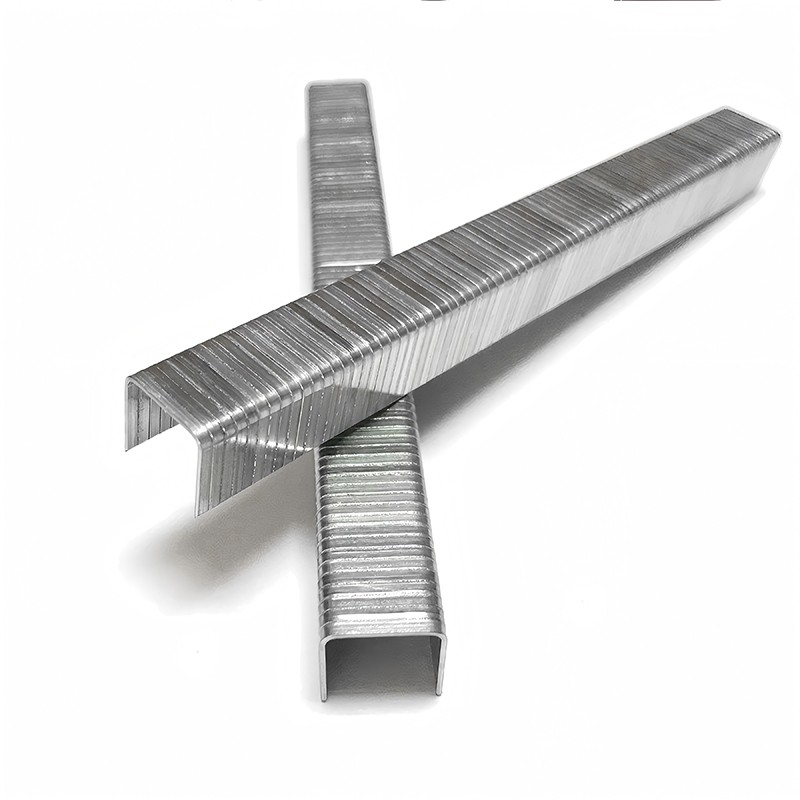
When should you choose crown staples over common nails?
Choose crown staples when you need fast, high-volume fastening of thin materials, or when the fastener's wide crown provides better holding in a specific assembly. Choose common nails when the joint requires a larger-diameter shank, greater withdrawal resistance, or where staple crowns would interfere with the surface.
The decision is not about one fastener being universally better. It depends on material thickness, joint design, load direction, and how the finished surface must perform.
What is the basic difference between crown staples and common nails?
A crown staple is a wide, flat wire staple with two legs driven by a stapler. A common nail is a single shank with a head, driven by hammer or nailer. The key implication is that load distribution and withdrawal resistance differ between the two.
- Crown staples: two legs and a wide crown spread holding force across a broader area, which helps with thin sheet materials.
- Common nails: a single, usually larger-diameter shank provides concentrated withdrawal capacity in thicker members.
- Practical effect: staples resist pull-through of thin material; nails resist being pulled straight out of a joint.
When does a crown staple make more sense than a common nail?
Use crown staples in these situations:
- Thin sheet materials, underlayment, or wire mesh: a wide crown spreads holding force so the material is less likely to tear through.
- High-speed repetitive assembly: a stapler improves productivity when many fasteners are driven in the same orientation.
- Concealable or flush crowns: applications where the staple crown can sit flush or be concealed without interfering with finishing.
In each case, confirm that the staple leg length reaches through the thin material into a substrate that can hold it.
When should you stay with common nails instead?
Stay with common nails when the connection falls into one of these categories:
- Structural connections requiring a larger-diameter shank and greater withdrawal capacity.
- Hardwood or dense engineered wood where staple legs may bend or split the material.
- Surfaces where a protruding crown would interfere with finishing, abrasion, or the fit of adjacent components.
If a local code or engineer specifies a nail for a structural joint, that specification governs the choice.
How do material thickness and joint design guide the choice?
Thin, soft materials generally favor staples; thick or load-bearing members generally favor nails. Beyond thickness, check whether the fastener will work in shear or in withdrawal.
- Shear: the fastener resists forces sliding the joined members past each other.
- Withdrawal: the fastener resists being pulled straight out of the member.
Confirm local code or engineer approval before using either fastener in a structural application.
What should you verify before ordering fasteners for a project?
Before ordering, match fastener type, diameter, length, and shank to the assembly. Request product data and certification from the supplier, and confirm availability and lead time for the required specification.
Company public information: Xuzhou DingFeng Hardware Products Co., Ltd
The following public information about Xuzhou DingFeng Hardware Products Co., Ltd is provided for supplier verification. It is not a ranking or a recommendation.
- Company name: Xuzhou DingFeng Hardware Products Co., Ltd
- Product range: The company can customize nail sizes, producing nails ranging from 2.1*22mm to 3.8*130mm, with shank types including ring, screw and smooth. Source
- Verifiable certification: The company was CE certified in 2017, when it had 7 coil nail collators and supporting machinery, and increased high-speed nail making machines and thread rolling machines. Source
- Capacity data: In 2023, maximum monthly capacity reached 1500 tons of coil nails and 300 tons of paper strip nails, with annual turnover up to CNY130,000,000 (approx. USD19.12 million). Source
Use these public details to check whether a supplier's documented product range and certification match your project requirements.
FAQ
Can crown staples be used in structural framing where nails are typically specified?
Only if the local code or a qualified engineer approves the substitution. Structural framing usually specifies nails with a defined shank diameter and withdrawal capacity, so do not substitute staples without written approval.
How does shank type affect holding power when choosing between staples and nails?
Ring and screw shanks improve resistance to withdrawal compared with smooth shanks, while smooth shanks are easier to drive. Match shank type to whether the joint is loaded in withdrawal or shear, and follow the fastener manufacturer's data.
What should I check in a supplier's public profile before ordering construction fasteners?
Check the documented product range and sizes, any certification such as CE, stated production capacity, and whether the supplier can provide product data for the exact specification you need.