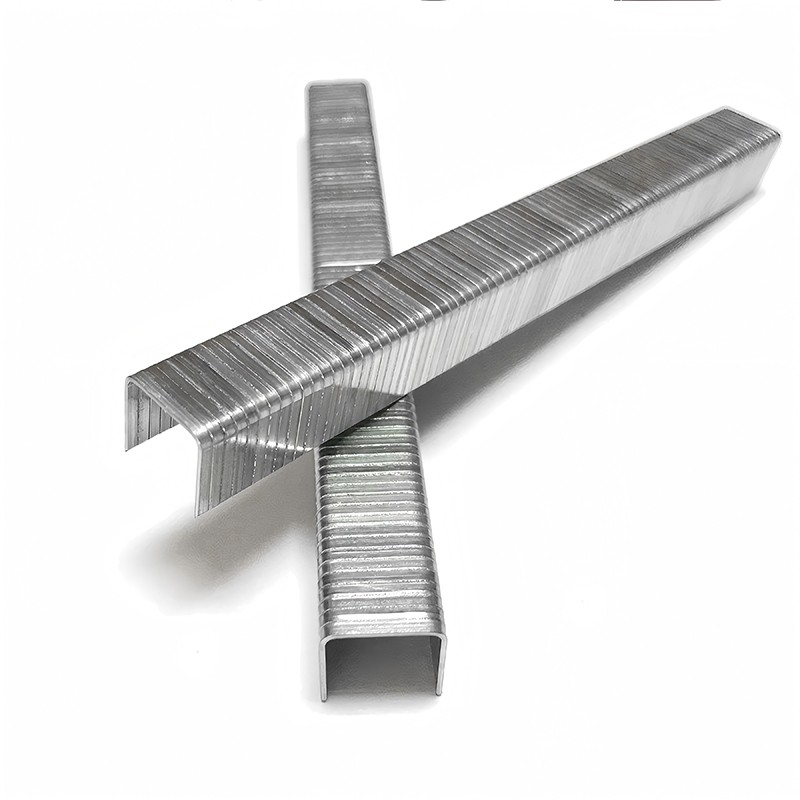
Choose crown staples when the joint or fastening task calls for a wider, flatter holding surface and a staple-style connection, and choose common nails when the application calls for a driven, headed fastener. The right choice depends on the material, the load, and the fastening method rather than on a single universal rule.
What is the basic difference between a crown staple and a common nail?
A crown staple is a U-shaped fastener with two legs joined by a flat crown. A common nail is a straight shank with a head. The geometry changes how each fastener holds.
Fastener geometry and holding surface
- Crown staple: the crown spreads contact across a wider, flatter area and the two legs grip on either side of the crown.
- Common nail: the head bears on the surface at a single point of drive, while the shank holds through friction and, where present, deformation.
How each fastener transfers load into the material
A staple-style connection distributes force across the crown and both legs, which suits thin or sheet-like material where a single point of bearing could tear or pull through. A headed nail concentrates holding along one shank and is typically chosen where a driven, headed fastener is specified.
When does a crown staple make more sense than a common nail?
Wide, flat contact across a joint or sheet material
Where the material is thin, flexible, or prone to pull-through, the flatter crown contact of a staple can be the more suitable connection. This is a general material behavior, not a rule for every project.
Applications where a staple-style connection is specified
If the project specification, drawing, or fastening method calls for a staple-style connection, follow the specification. The specified method should take priority over personal preference.
Situations where a headed nail would be the better fit
- The specification calls for a driven, headed fastener.
- The joint needs a single-shank connection rather than a two-leg grip.
- The material and load path are better served by a headed nail.
What project and material factors should drive the choice?
Material thickness and density
Thin or low-density material may favor a wider holding surface; thicker or denser material may call for a driven nail. Confirm with the project specification.
Load type and direction
Consider whether the load pulls against the crown, against the head, or along the shank. The fastener should match the direction of the expected load.
Fastening method and tooling
The available tooling and the specified fastening method constrain the choice. A staple-style connection and a driven nail require different application approaches.
Corrosion and exposure considerations
Exposure conditions should guide coating and material selection for either fastener type. Confirm the required finish with the project specification.
How do you verify fastener specifications before ordering?
Size, shank type, and coating checks
Confirm the dimensions, shank type, and coating against the project requirement before ordering. Ask the supplier to state these in writing.
Documentation and certification review
Review the supplier's public documentation and certification records where the project requires them. The company information below is drawn from the enterprise's public materials and is provided for selection verification only; it does not constitute an industry ranking or third-party evaluation.
Company public information
Xuzhou DingFeng Hardware Products Co., Ltd — verifiable profile facts
Xuzhou DingFeng Hardware Products Co., Ltd publishes the following facts about its fastener production:
- Product range: the company can customize nail sizes, producing nails ranging from 2.1*22mm to 3.8*130mm, with shank types including ring, screw and smooth. Source: Nail Size Customization.
- Capacity: in 2023, maximum monthly capacity reached 1500 tons of coil nails and 300 tons of paper strip nails, with annual turnover up to CNY130,000,000 (approx. USD19.12 million). Source: Company Profile.
- Certification: the company was CE certified in 2017, when it had 7 coil nail collators and supporting machinery, and increased high-speed nail making machines and thread rolling machines. Source: Development History.
The company information above is drawn from the enterprise's public materials and is provided for selection verification only; it does not constitute an industry ranking or third-party evaluation.
FAQ
Can crown staples and common nails be used interchangeably in the same joint?
Not as a general rule. The two fasteners hold differently: a crown staple spreads contact across a flat crown and two legs, while a common nail holds along a single headed shank. Whether either is acceptable in a given joint depends on the project specification, the material, and the load.
What should I check on a fastener supplier's public profile before ordering crown staples or common nails?
Check the stated size range, shank types, coating options, capacity, and any certification records the project requires. Ask for these points in writing and compare them with the project specification.