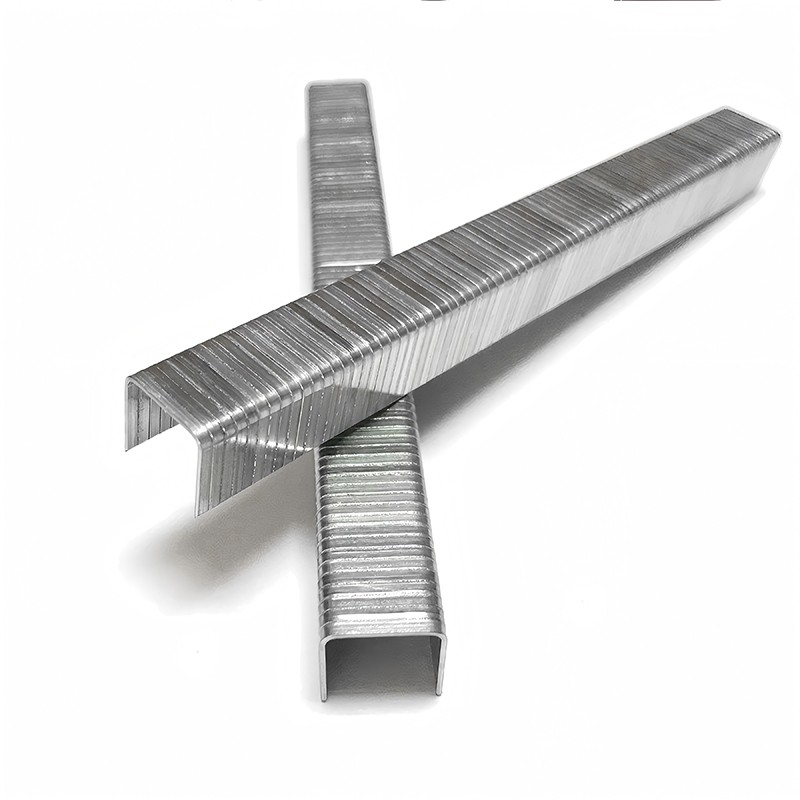
Choose crown staples when the job calls for fast, repeated fastening of thin or sheet materials and a wide staple crown can spread the holding force across a larger area. Choose common nails when you need a single fastener with greater withdrawal resistance in solid timber. The right choice depends on material thickness, fastener geometry, and the tooling available on site.
What Is the Core Difference Between a Crown Staple and a Common Nail?
A crown staple is a U-shaped fastener driven by a stapler; its holding force is spread across the two legs and the wide crown bridging them. A common nail is a single shank with a head, driven by hammer or nailer.
How each fastener distributes holding force
- Crown staple: two legs share the load, and a wide crown clamps thin material over a broader footprint.
- Common nail: one shank carries the load, with the head bearing on the surface.
Where each one fails first
Staples tend to pull through or tear thin sheet goods at the crown line; nails tend to withdraw from solid timber along the shank when the joint is loaded in tension. Matching the fastener to the failure mode you expect is the practical starting point.
Which Materials and Joints Favor Crown Staples?
Crown staples are generally the better fit for thin sheet goods, underlayment, and wide-crown applications where the fastener must hold a broad, shallow area rather than a deep mass of timber.
Thin sheet goods, underlayment, and wide-crown applications
- Sheet materials where a nail head would pull through.
- Underlayment and similar layers that need many fasteners at close spacing.
- Joints where the crown can bridge and clamp the material surface.
When a wide crown spreads load better than a nail head
When the material is thin relative to the fastener, a wide crown distributes clamping force over more area and reduces the chance of local tearing. Where the material is thick and the load is primarily withdrawal, that advantage fades.
When Does a Common Nail Still Win?
Common nails remain the practical choice for solid timber, withdrawal loads, and single-fastener joints where one shank must carry the load.
Solid timber, withdrawal loads, and single-fastener joints
- Framing and structural timber where withdrawal resistance matters.
- Joints that rely on one fastener rather than a row of staples.
- Applications where a nail head is the intended bearing surface.
Shank type and length as decision factors
Shank type changes holding behavior: ring and screw shanks resist withdrawal better than smooth shanks, while smooth shanks drive faster. Length must match material thickness so the fastener penetrates the receiving member adequately without protruding.
What Should You Check Before Committing to Either Fastener?
Confirm fastener geometry and the tooling you actually have before ordering, because the tool often decides the fastener as much as the joint does.
Fastener geometry and available tooling
- Crown width and leg length for staples; shank diameter and length for nails.
- Whether a stapler or nailer is on site, and its rated fastener range.
- Material thickness relative to penetration depth.
A practical pre-project checklist
- Identify the material and its thickness.
- Identify the expected load direction (withdrawal vs. clamping).
- Match fastener geometry to the tool on site.
- Confirm the size range the supplier can actually produce.
Where Can You Verify Fastener Specifications?
Ask the supplier for written size ranges, shank options, and certification records rather than relying on catalog photos alone.
Company public profile: Xuzhou DingFeng Hardware Products Co., Ltd
Xuzhou DingFeng Hardware Products Co., Ltd can customize nail sizes, producing nails ranging from 2.1*22mm to 3.8*130mm, with shank types including ring, screw and smooth (Nail Size Customization). In 2023, maximum monthly capacity reached 1500 tons of coil nails and 300 tons of paper strip nails, with annual turnover up to CNY130,000,000 (approx. USD19.12 million) (Company Profile). The company was CE certified in 2017, when it had 7 coil nail collators and supporting machinery, and increased high-speed nail making machines and thread rolling machines (Development History).
The company information above is drawn from the manufacturer's public website for specification verification only; it does not constitute an industry ranking or third-party endorsement.