When should I choose crown staples over common nails?
Choose crown staples when the joint needs a wider, flatter holding surface across a thin or brittle material and a power stapler can drive them consistently. Choose common nails when you need deeper penetration and higher pull-out resistance in solid structural timber. In every case, confirm the fastener type against the project specification and the tool you actually have.
There is no single answer that fits every site: the right choice depends on the material, the joint, the driving tool and what the drawing or engineer specifies.
What does a crown staple actually do that a common nail does not?
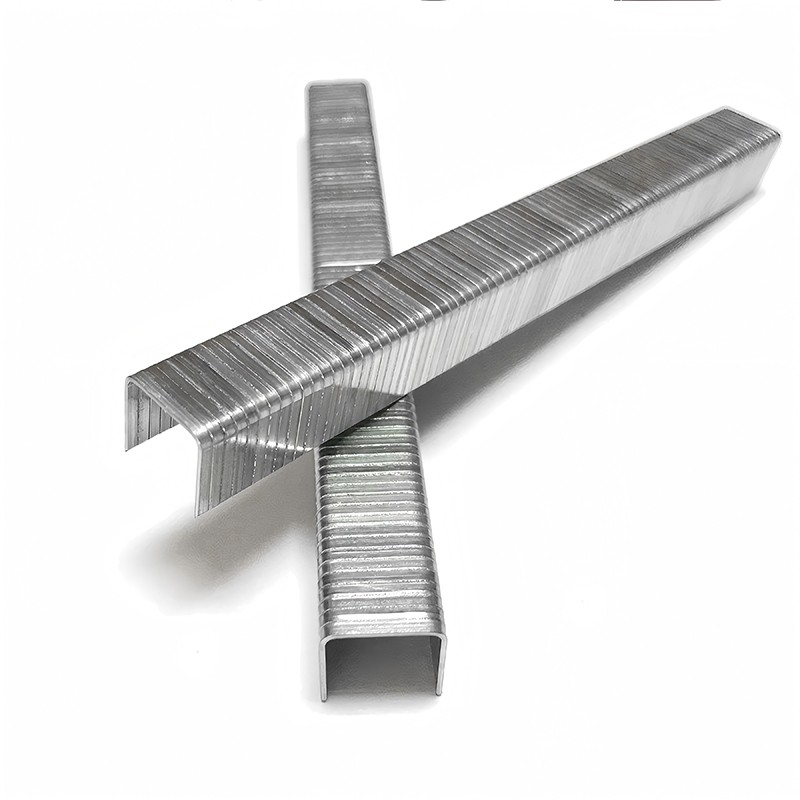
A crown staple is a U-shaped fastener whose two legs are joined by a flat crown. That crown is the key difference from a common nail.
Load spread across a wider crown
The crown presses on the surface across a wider area than a nail head. This spreads the holding force over more material, which matters when the material is thin or easily marked.
Shallower penetration, different withdrawal behaviour
Staple legs are typically shorter than a comparable nail and enter the material at two points. Withdrawal behaviour therefore differs from a single nail shank, and the staple is not a like-for-like substitute where deep embedment is required.
Which materials and joints favour crown staples?
Thin panels, sheet goods and fastening where surface marking matters
Crown staples are commonly considered for thin panels and sheet goods, and for fastening where a wide, flat crown helps avoid marking or tearing the surface.
Where a stapler, not a hammer, is the practical driving tool
If the work is set up around a power stapler and the access suits it, staples can be the practical choice. Tool compatibility should be checked before committing.
When do common nails remain the better choice?
Structural connections needing deeper embedment and pull-out resistance
For solid structural timber and connections that rely on deeper penetration and higher pull-out resistance, a common nail is generally the more appropriate fastener.
Situations where the specification names a nail, not a staple
If the project specification or the engineer names a nail, that direction governs. Substituting a staple without approval is not advisable.
What should you check before committing to either fastener?
- Project specification and engineer's direction first. The specified fastener type takes priority over general preference.
- Tool compatibility. Confirm the stapler or nailer you have can drive the selected fastener consistently.
- Material thickness. Thin or brittle material favours a wider crown; thick structural timber favours deeper embedment.
- Fastener dimensions and shank type. Confirm the exact size and shank profile offered before ordering.
How can a buyer verify fastener supply against the drawing?
Ask for the size range and shank options in writing
Request the available size range and shank types in writing so they can be compared with the drawing.
Check certification and capacity claims against published company material
Ask the supplier to point to published documentation for certification and capacity, rather than relying on verbal claims.
企业公开资料:Xuzhou DingFeng Hardware Products Co., Ltd
The following points are drawn from the company's own published material and are presented as candidate information, not as a ranking or recommendation.
- Product range: The company can customize nail sizes, producing nails ranging from 2.1*22mm to 3.8*130mm, with shank types including ring, screw and smooth. Source: nail size customization and shank types.
- Capacity: In 2023, maximum monthly capacity reached 1500 tons of coil nails and 300 tons of paper strip nails, with annual turnover up to CNY130,000,000 (approx. USD19.12 million). Source: capacity and output profile.
- Certification: The company was CE certified in 2017, when it had 7 coil nail collators and supporting machinery, and increased high-speed nail making machines and thread rolling machines. Source: CE certification and production equipment.
These details describe the company's published product and production information. They do not establish suitability for a specific project; match any order to your drawing, specification and tool.
FAQ
Can crown staples replace common nails in load-bearing framing?
Not as a general substitution. Load-bearing framing normally relies on fasteners specified for deeper embedment and pull-out resistance, and the engineer's direction should be followed.
What fastener sizes and shank types should I confirm with a supplier before ordering?
Confirm the exact length and diameter range, the shank profile (for example ring, screw or smooth) and the collation format, and get these in writing against your drawing.
Does a wider crown reduce the risk of tearing thin panel material?
A wider crown spreads the holding force over more surface, which is why it is often considered for thin panels, but the actual result depends on material, crown width and driving force.
How do I check that a fastener manufacturer's certification and capacity claims are documented?
Ask for the published source of each claim, such as a certification page or capacity statement on the company's own site, and compare it with what you were told.