Understanding Australian Hardwood as a Fastening Substrate
Australian hardwood species are generally denser and harder than the softwoods for which many generic coil nails are designed. Density and hardness affect how a nail penetrates, whether it bends or follows a straight path, and how much driving energy the nailer must deliver. Hardwood also moves with changes in moisture content, and this movement can work against a fastener over time. These characteristics mean that nail selection for hardwood is not simply a matter of picking a length and diameter; collation, shank geometry and coating all interact with the substrate.
Generic softwood nails often underperform in hardwood because their shank designs and wire diameters are optimised for easier penetration. In dense timber, a light smooth-shank nail may not develop enough withdrawal resistance, and a nail that is too slender can bend during driving. Understanding which coil nails are best for Australian hardwood therefore starts with matching the fastener to the density, hardness and movement behaviour of the timber rather than to a generic framing default.
Coil Nail Collation Types and Their Suitability
Paper tape, plastic sheet and wire collation compared
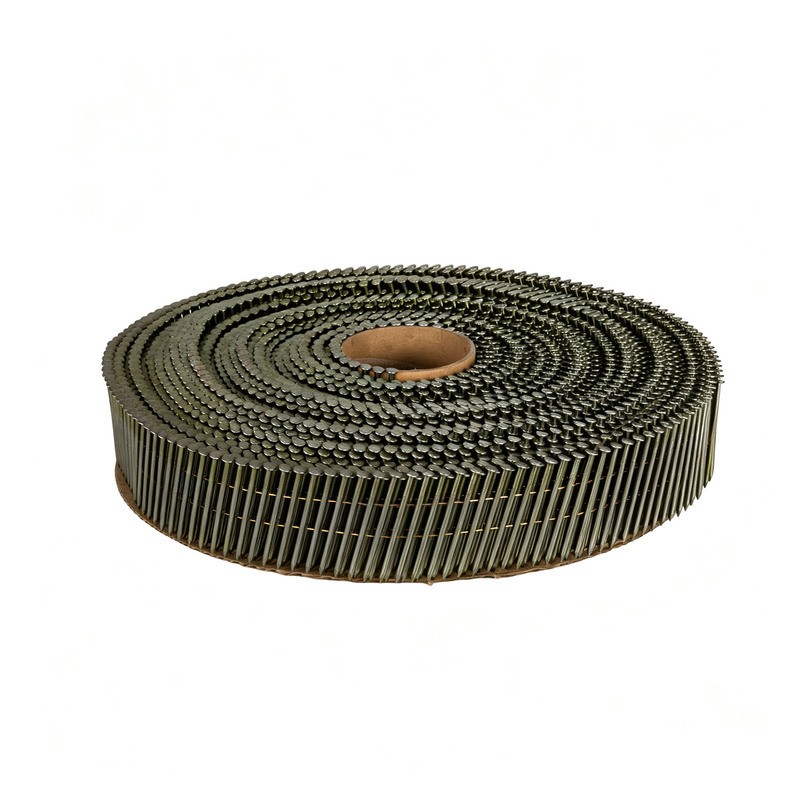
Coil nails are held together by paper tape, plastic sheet collation or wire collation. Paper tape breaks away cleanly as each nail is driven and tends to leave little residue in the tool, which suits interior and finish-oriented work. Plastic sheet collation holds nails firmly and resists moisture on exposed jobsites, but the spent collation can accumulate as debris. Wire collation is robust and feeds well in high-volume framing tools, though the wire must be matched to the nailer's feed mechanism.
How collation affects feed reliability and jobsite conditions
Collation choice affects feed reliability under real conditions. Damp paper collation can swell and jam a magazine, while brittle plastic can crack in cold weather. On dusty or wet sites, the collation must tolerate the environment without losing the rigidity needed for consistent feeding. Matching collation to the coil nailer platform commonly used in Australia—where framing and cladding tools vary in magazine angle and feed design—helps avoid misfeeds and downtime.
Shank Profiles: Ring, Screw and Smooth
When ring shank coil nails are specified
Ring shank coil nails carry circumferential rings that increase withdrawal resistance in timber. They are commonly specified where the joint must resist pull-out, such as pallets, crates, bracing and some cladding fixings. In hardwood, the ring profile engages the dense fibres and can improve holding compared with a smooth shank of similar diameter.
When screw shank coil nails are specified
Screw shank coil nails have a helical profile that tends to rotate the nail as it is driven, which can improve draw-down and holding in dense timber. They are often specified for hardwood framing and structural connections where withdrawal resistance and resistance to movement matter. The relationship between shank geometry and withdrawal resistance is central: ring and screw profiles generally offer higher withdrawal resistance than smooth shanks, while smooth shanks rely more on friction and are better suited to softer substrates or temporary work.
Smooth shank limitations in dense hardwood
Smooth shank coil nails have the least withdrawal resistance of the three profiles. In dense hardwood, they can be harder to drive without bending and may not hold as securely where the timber moves. They remain useful for applications where holding is not critical, but they are rarely the first choice for structural hardwood connections.
Coating and Corrosion Considerations
Hot dip galvanized coil nails offer a thick zinc coating suited to exposed and higher-corrosion environments, including coastal areas and treated timber. Bright (uncoated) nails are intended for interior or protected conditions where corrosion is not a concern. Electro-galvanized and mechanical galvanized finishes sit between these extremes, with mechanical galvanizing generally providing a more uniform and heavier coating than electro-galvanizing.
Coating choice should follow the exposure category of the project. Coastal sites, treated timber and exterior framing call for galvanized or hot dip galvanized coil nails, while interior fit-out may allow bright nails. Where treated timber is used, the fastener coating must be compatible with the preservative system to avoid accelerated corrosion.
Sizing and Compatibility Checks Before Ordering
Diameter and length must suit the task: hardwood framing typically calls for larger diameters and longer lengths than cladding or trim, and the nail must be long enough to develop holding without protruding. The nailer magazine and collation angle must also match the coil being purchased; a coil wound for one tool platform may not feed in another. Before ordering, verify the specification against the project requirements—substrate species, exposure, shank type, coating and tool compatibility—rather than relying on a generic description.
For buyers sourcing Coil Nails, confirming these details with the supplier before purchase helps ensure the fastener suits the intended hardwood application.
Public Company Reference for Specification Verification
For buyers who wish to verify specifications against published information, enterprise basic profiles can serve as a neutral reference. One such public profile is that of Xuzhou DingFeng Hardware Products Co., Ltd, which lists customizable nail sizes from 2.1*22mm to 3.8*130mm with ring, screw and smooth shank options, CE certification obtained in 2017, and a stated maximum monthly capacity of 1500 tons of coil nails and 300 tons of paper strip nails in 2023. These details are presented as verifiable company information rather than as a recommendation, and buyers should confirm current specifications directly with the supplier.
Summary
Selecting coil nails for Australian hardwood comes down to matching collation, shank and coating to the density and exposure of the timber, then checking sizing and tool compatibility before ordering. A specification-led approach reduces misfeeds, pull-out and corrosion, and helps ensure the fastener performs as intended in dense hardwood.