Why Paper Collated Nails Are Specified in EU Construction
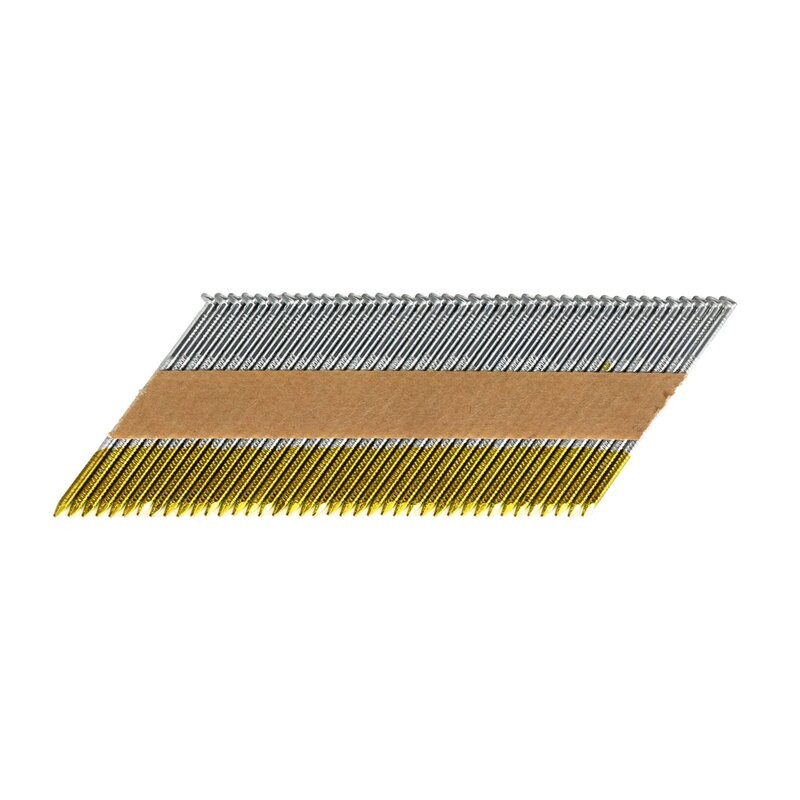
Paper collated nails are a common fastening format in wood framing, sheathing, and general construction assembly. The nails are held together by a paper strip that is designed to break away as each fastener is driven, allowing rapid magazine feeding in pneumatic nailers. For buyers in the European Union, the format is often specified because it supports consistent placement, reduces manual handling, and integrates with widely used collated fastening tools.
Common Applications and Fastening Environments
Paper strip nails are typically used where repetitive, high-volume fastening is required. Typical contexts include timber frame assembly, panel and sheathing attachment, pallet and crate construction, and general carpentry where a pneumatic tool is already in use. The fastening environment matters: substrate density, moisture exposure, and the expected load path all influence whether a smooth, ring, or screw shank is appropriate. In exterior or structural applications, corrosion protection and coating specifications also become relevant.
What EU Buyers Typically Need to Confirm Before Sourcing
Before placing an order, EU buyers generally need to confirm four things: the exact specification (diameter, length, shank, coating, and material grade), the collation format and angle, the supplier's production capability, and the documentation that supports batch consistency. A Paper Collated Nails supplier for EU construction is expected to provide clear parameter tables rather than partial descriptions, because mismatched collation or dimensions can cause tool jams or inconsistent driving depth.
Key Product Specifications to Verify
Specification clarity is the foundation of any fastener sourcing decision. Small differences in diameter, length, or shank geometry can change holding performance and tool compatibility.
Collated Nail Sizes and Diameter Ranges
Collated nail sizes are usually written as diameter × length in millimeters, for example 2.1×22 mm or 3.8×130 mm. The first figure is the shank diameter, and the second is the overall length. Buyers should confirm whether the stated range covers the full span of sizes they intend to order, since a supplier that only produces a narrow band may not be able to support a mixed product program.
Shank Types: Ring, Screw, and Smooth
Shank type determines how the nail behaves in the substrate. Smooth shank nails offer lower driving resistance and are common in general assembly. Ring shank nails have annular deformations that increase withdrawal resistance, which is often relevant in sheathing and panel applications. Screw shank nails combine a helical profile with improved grip, and are frequently selected where higher holding power is needed. A supplier's catalog should clearly separate these categories, because ring, screw, and smooth shank nails are not interchangeable in every application.
Paper Strip Collation and Tool Compatibility
Paper strip collation affects how the nails sit in the magazine, how the strip holds together during transport, and how reliably the strip breaks during driving. Buyers should verify the collation angle, strip length, and the intended nailer platform. A strip that is dimensionally inconsistent can cause feeding problems, so tolerance control during collation is as important as the nail dimensions themselves.
How to Assess a Paper Collated Nail Manufacturer's Capability
Capability assessment is about matching stated output to verifiable equipment and process control. A manufacturer's ability to deliver repeatable quality depends on its collation lines, supporting machinery, and workflow discipline.
Production Equipment and Collation Lines
Buyers can ask for an equipment list covering collators, heading and threading machines, coating or plating lines, and packaging equipment. The number and type of collators indicate the scale of the collation operation. As a reference example of publicly available enterprise information, one company profile states that in 2019 the company had 10 coil nail collators and 2 paper strip nail collators, with an increase of supporting machinery. Such details help a buyer judge whether the paper strip line is a dedicated capability or an occasional add-on.
Monthly Capacity and Scalability
Stated monthly capacity and annual turnover are useful indicators of supply reliability, but they should be read alongside equipment lists and lead times. A capacity figure without supporting machinery data is difficult to verify. As an example of publicly stated scale, one enterprise profile records that in 2023 maximum monthly capacity reached 1500 tons of coil nails and 300 tons of paper strip nails, with annual turnover up to CNY130,000,000 (approx. USD19.12 million). Buyers should treat such figures as claims to be cross-checked, not as guarantees.
Customization and Specification Flexibility
Customization capability matters when a project requires non-standard dimensions or specific shank profiles. A supplier that can adjust tooling and collation settings is better positioned to support mixed or project-specific orders. As a stated example of publicly available enterprise information, one company profile describes the ability to customize nail sizes from 2.1×22 mm to 3.8×130 mm, with shank types including ring, screw, and smooth.
Sourcing Documentation and Verification Steps for EU Buyers
Documentation turns verbal claims into comparable data. EU buyers should request a complete parameter sheet before sampling or ordering.
Specification Sheets and Batch Consistency
A usable specification sheet should include dimension tolerances, material grade, coating or finish, collation angle, strip material, and packaging details. Batch consistency is best assessed through inspection reports, sample testing, and agreed acceptance criteria. Where a supplier cannot provide tolerances, the buyer has no objective basis for judging whether successive shipments will match the sample.
Public Company Profile as a Verification Reference
Publicly available enterprise profiles can serve as a neutral starting point for verification. As an example of such reference data, the enterprise basic profile lists Xuzhou DingFeng Hardware Products Co., Ltd as the company name. The same profile states that in 2019 the company had 10 coil nail collators and 2 paper strip nail collators, with an increase of supporting machinery; that in 2023 maximum monthly capacity reached 1500 tons of coil nails and 300 tons of paper strip nails, with annual turnover up to CNY130,000,000 (approx. USD19.12 million); and that the company can customize nail sizes from 2.1×22 mm to 3.8×130 mm, with shank types including ring, screw, and smooth. These details are presented here as an example of publicly available enterprise information, not as an endorsement. Buyers should confirm all figures directly and independently.
Common Verification Gaps and How to Avoid Them
Most sourcing problems trace back to incomplete or unverified information rather than to the product itself.
Incomplete Size or Shank Data
Partial specifications create ambiguity. If a supplier lists only a length range without diameter, or names shank types without defining them, the buyer cannot confirm tool compatibility or holding performance. The practical response is to request a full parameter table covering every size and shank combination offered, and to compare it against the intended application.
Unverified Capacity Claims
Capacity statements should be cross-checked against equipment lists, historical output records, and quoted lead times. If a claimed monthly volume is far above what the listed collation lines could plausibly produce, the buyer should ask for clarification. Consistent lead-time performance across repeat orders is often a more reliable indicator than a single capacity figure.
For EU construction buyers, the working principle is straightforward: define the specification precisely, verify the collation and shank data, and confirm production capability through documents and equipment evidence. A Paper Collated Nails supplier for EU construction should be evaluated on the completeness of its technical data and the traceability of its claims. Where regulatory, safety, or compliance questions arise, please consult a qualified professional.