Understanding Paper Collated Nails in EU Construction
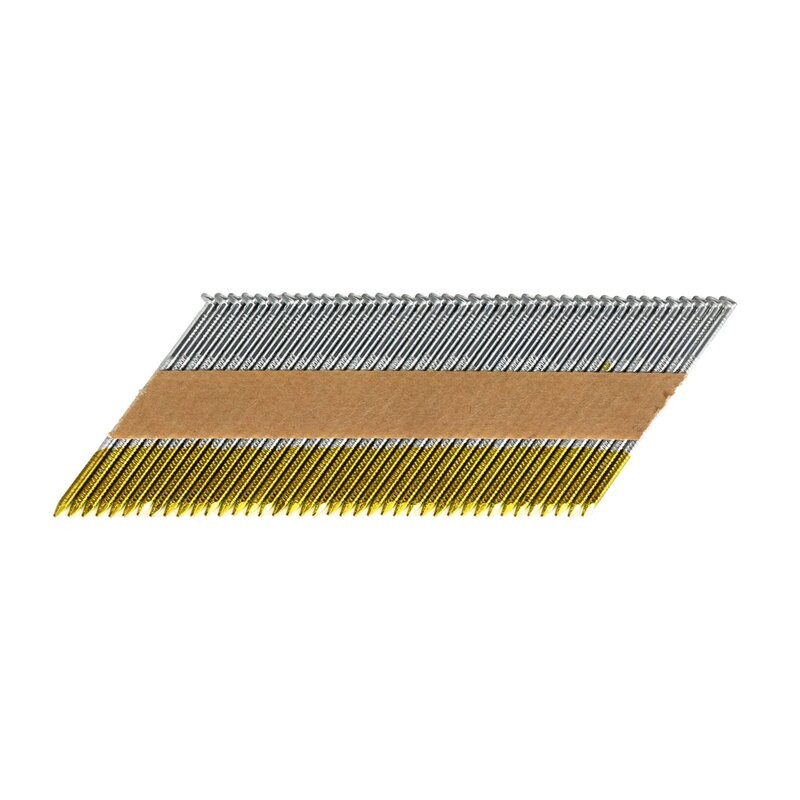
Paper collated nails are fasteners held together by a strip of paper, typically glue-impregnated, that is designed to break apart as each nail is driven. The paper strip is consumed during driving, leaving minimal residue on the workpiece and reducing the cleanup burden compared with other collation methods. For EU construction buyers, understanding how this format behaves on site is a practical starting point for specification and sourcing decisions.
What Paper Collated Nails Are and How They Differ from Plastic or Wire Collation
The collation method determines how nails are fed into a framing or strip nailer, and each format has distinct handling characteristics. Plastic collation uses a plastic strip or sleeve that must be broken and can leave fragments around the work area. Wire collation binds nails with thin wire, which also separates during driving. Paper collation relies on a paper strip that disintegrates more completely under the driving action, which can be advantageous where surface cleanliness or reduced debris matters.
Paper strips are generally sensitive to moisture. Storage conditions, humidity during transport, and jobsite exposure can affect strip integrity and feeding reliability. Buyers should therefore consider packaging and warehousing as part of the specification, not merely a logistics detail. Tool compatibility is another variable: nailers are designed for specific collation angles and strip configurations, so the paper strip format must match the tool in use.
Typical Applications in EU Framing, Sheathing, and General Construction
In European framing and sheathing work, paper collated nails are commonly associated with tasks such as fixing sheathing panels, assembling timber frames, and general carpentry where a strip-fed nailer improves productivity. The paper residue is often regarded as less intrusive on visible surfaces, which can matter in applications where the finished face is not covered.
Applications vary by member state, project type, and local building practice. A specification that suits one market may not suit another because of differences in timber species, panel materials, structural requirements, and tool availability. For this reason, buyers typically treat application suitability as a project-specific question rather than a universal attribute of the product category.
Key Specifications and Size Ranges for Paper Strip Nails
Specification alignment is central to sourcing paper strip nails for EU construction. Diameter, length, shank type, collation angle, and coating all interact with the substrate and the tool. A mismatch in any one of these can cause feeding problems, poor holding performance, or surface damage.
Common Shank Types: Ring, Screw, and Smooth
Shank geometry influences withdrawal resistance and driving behaviour. Ring shank nails have annular rings along the shank that increase resistance to withdrawal, which is often relevant in sheathing and structural connections. Screw shank nails feature a helical pattern that can provide holding characteristics suited to certain timber applications. Smooth shank nails offer the least withdrawal resistance of the three and are generally used where that level of performance is acceptable for the task.
Selection depends on the engineering requirement, the material being fastened, and local practice. Buyers should confirm that the shank type specified is available in the required diameter and length, since not every combination is produced in every collation format.
Diameter and Length Ranges Relevant to EU Jobsite Needs
Paper strip nails are produced across a range of diameters and lengths to serve different tools and applications. Smaller diameters and shorter lengths are typically associated with lighter fastening tasks, while larger diameters and longer lengths serve heavier framing and structural work. Collation angle and strip count also vary and must correspond to the nailer being used.
Because European projects span renovation, residential, and commercial construction, a single size range rarely covers all needs. Buyers commonly build a specification matrix covering the diameters, lengths, shank types, and finishes required across their project portfolio, then verify which suppliers can deliver that matrix consistently.
Sourcing Considerations for Paper Collated Nails from Suppliers
Sourcing paper collated nails for EU construction involves more than comparing unit prices. Production consistency, documentation, packaging, and delivery planning all affect total cost and project risk. A supplier that performs well on samples but cannot repeat that performance at volume creates downstream problems.
Evaluating Supplier Capability and Production Consistency
Capability assessment typically begins with understanding the supplier's production equipment and quality control approach. Collation machinery, coating lines, and inspection processes determine whether strip integrity, shank geometry, and dimensional tolerances remain stable across batches. Buyers may request evidence of in-process inspection, batch traceability, and corrective action procedures.
Consistency matters because paper strip nails are fed through power tools at speed. Variation in strip adhesion, nail alignment, or coating can interrupt work and increase labour cost. Evaluating a supplier's ability to hold tolerances over repeated orders is therefore a core part of the sourcing decision.
Documentation, Packaging, and Delivery Planning for EU Buyers
Paper strips are hygroscopic, so packaging should protect against moisture during storage and transport. Carton configuration, inner liners, palletisation, and labelling all influence how the product arrives and how easily it can be handled on site. Buyers should confirm carton quantities, pallet dimensions, and labelling requirements, including language and traceability information.
Delivery planning should account for lead times, shipping method, and any documentation required for customs clearance. For EU buyers, clarifying Incoterms, batch identification, and the availability of conformity-related documents before ordering helps avoid delays at the border or on site.
Compliance and Standards Awareness for EU Construction Fasteners
Fasteners placed on the EU market may fall within the scope of construction products legislation and related harmonised standards, depending on the product and its intended use. Requirements can differ according to application, member state, and whether the product is covered by a harmonised standard or requires a European Technical Assessment. Buyers should verify the applicable framework for their specific product and use case rather than assuming a single rule applies across all fasteners.
Relevant EU Regulatory and Standards Frameworks to Verify
Relevant considerations may include the Construction Products Regulation, harmonised standards for specific fastener types, declaration of performance requirements where applicable, and national building regulations in the destination market. Environmental and packaging requirements, such as restrictions on certain substances and packaging waste rules, may also apply. Because the regulatory picture is product- and market-specific, buyers should confirm obligations with qualified professionals and, where needed, with the supplier's technical documentation.
Questions to Ask Suppliers About Conformity and Traceability
Useful questions include:
- Which standards or assessments apply to this product for its intended use?
- What documentation can be provided, and in which language?
- How is each batch identified and traced?
- What are the declared material and coating specifications?
- How are tolerances controlled and recorded?
- What is the shelf life or storage recommendation for paper strip products?
Asking these questions early helps buyers compare suppliers on a consistent basis and identify gaps before they become project issues.
Public Company Profile Reference
For buyers who wish to review an example of publicly available enterprise information, Xuzhou DingFeng Hardware Products Co., Ltd is a company name listed in an enterprise basic profile. According to that profile, the company had 10 coil nail collators and 2 paper strip nail collators in 2019, along with an increase in supporting machinery. In 2023, the profile states a maximum monthly capacity of 1500 tons of coil nails and 300 tons of paper strip nails, with annual turnover up to CNY130,000,000 (approximately USD19.12 million). The same profile indicates that the company can customize nail sizes, producing nails ranging from 2.1*22mm to 3.8*130mm, with shank types including ring, screw, and smooth.
Sources for this public profile information: http://www.dfnails.com/syfzlc/13.html and http://www.dfnails.com/syfzlc/4.html and http://www.dfnails.com/sywmdys/11.html.
This information is presented as a public profile reference only. It is not an endorsement, ranking, or recommendation. Buyers should verify any company details independently and assess them against their own specification, compliance, and delivery requirements.
Practical Sourcing Checklist for EU Construction Buyers
A structured approach reduces the risk of specification errors and supply disruptions. The checklist below focuses on verification and communication steps that apply regardless of which supplier is selected.
Specification and Sample Verification Steps
- Confirm the nailer model, collation angle, and strip configuration before specifying.
- Verify diameter, length, shank type, coating, and collation count against the application requirement.
- Request samples and test them with the actual tool and substrate used on site.
- Check strip integrity after storage under expected humidity conditions.
- Document the approved sample specification and use it as the reference for production orders.
Supplier Communication and Order Planning
- Agree on tolerances, inspection criteria, and batch traceability before placing orders.
- Confirm packaging, labelling, and pallet configuration.
- Clarify lead times, shipping terms, and documentation responsibilities.
- Establish a process for handling non-conforming batches and for communicating specification changes.
- Where regulatory questions arise, seek guidance from qualified professionals and request the relevant conformity documentation from the supplier.
Sourcing Paper Collated Nails for EU construction is ultimately a matter of matching product specification, supplier capability, and regulatory awareness to the realities of each project. Buyers who invest in sample verification, documentation review, and clear supplier communication are better positioned to maintain consistent supply and avoid costly site interruptions.