Understanding Paper Collated Nails for Pallet Assembly
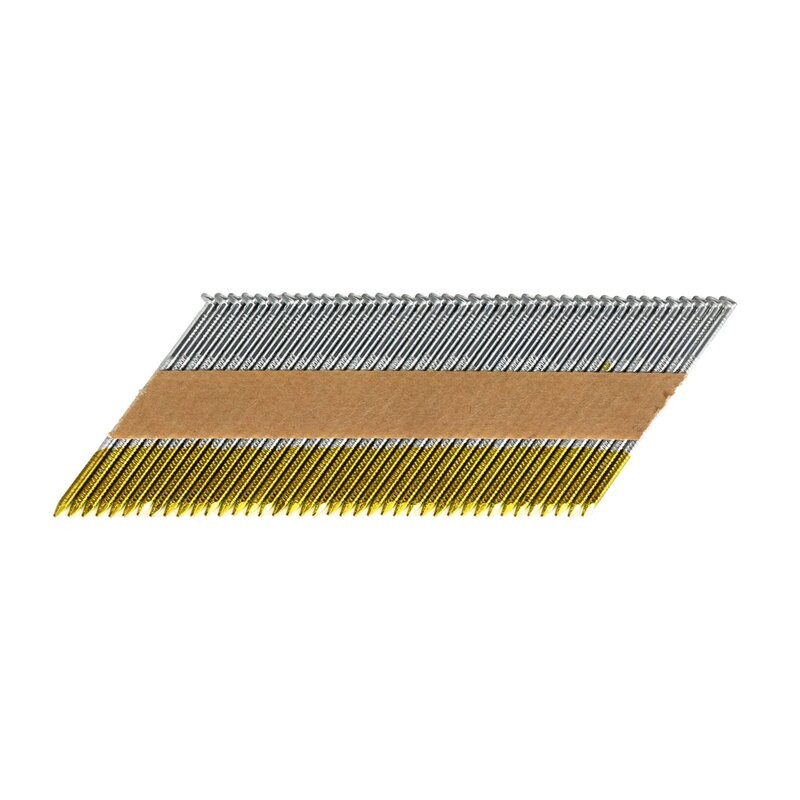
Pallet assembly is a high-throughput fastening operation in which consistency of feed, holding power, and tool uptime directly affect line efficiency. Paper collated nails for pallet assembly are fasteners joined by a paper tape that wraps or bridges the shanks, allowing a strip of nails to be loaded into a pneumatic nailer and driven in rapid sequence. Because the collation material is paper rather than plastic or wire, the strip breaks down during driving and leaves minimal residue in the joint and on the work surface.
What Paper Tape Collation Means in Pallet Nail Systems
In a paper tape collation, individual nails are aligned at a fixed angle and held by two or more strips of treated paper adhesive. The tape is engineered to release each fastener as the driver blade pushes it out of the magazine. Key collation variables include strip angle, strip count, and tape formulation. Angle determines how the strip sits in the magazine and how the nailer nose reaches the joint. Strip count affects reload frequency and the weight of the strip. Tape formulation influences how cleanly the paper separates in cold, dry, or humid plant conditions.
Why Paper Strip Nails Are Specified for High-Volume Pallet Building
Pallet building involves repetitive driving into dense hardwood or softwood stringers, often at awkward angles and close to board edges. Paper strip nails are commonly specified because the collation supports fast, uninterrupted feeding, and because spent paper tape tends to fragment rather than leave long plastic or wire fragments in the pallet. This matters where pallets may contact goods, packaging, or automated handling equipment. Paper collation also allows dense strip packing, which reduces the number of reloads per shift.
Pallet Nail Sizes and Dimensional Selection
Common Length and Diameter Ranges Used in Pallet Assembly
Pallet nails generally fall into a working range of roughly 2.1 mm to 3.8 mm in shank diameter and approximately 22 mm to 130 mm in length. Short, small-diameter fasteners are used for thin deck boards and light-duty pallets, while longer, heavier-gauge nails are used where thick stringers and high withdrawal loads are expected. Diameter and length should be treated as a matched pair: increasing length without increasing diameter can raise bending risk during driving, while increasing diameter without sufficient length may not reach the required penetration depth.
Matching Nail Size to Pallet Deck Board and Stringer Thickness
A practical starting point is to relate nail length to the combined thickness of the members being joined. The fastener should pass through the deck board and penetrate the stringer deeply enough to develop holding power, without protruding through the far side where it could snag loads or injure handlers. Where deck boards are thin and stringers are thick, a longer nail with moderate diameter is typical. Where both members are thick and dense, a larger diameter is usually required to avoid shank bending. Pallet nail sizes should always be confirmed against the actual board thicknesses and species used on the line, since nominal dimensions can vary between suppliers.
Collated Nail Shank Types: Ring Shank vs Screw Shank
Ring Shank Nails: Holding Characteristics in Hardwood and Softwood Pallets
Ring shank nails carry a series of circumferential ridges along the shank. These ridges displace wood fibers as the nail is driven and create mechanical interlock, which raises withdrawal resistance compared with a smooth shank of the same diameter. In pallet construction, ring shank fasteners are often chosen where vibration, repeated handling, and racking loads tend to work joints loose. Performance differs between hardwood and softwood because fiber density and splitting tendency vary; dense hardwood can offer high interlock but also greater risk of splitting near board ends.
Screw Shank Nails: Withdrawal Resistance and Application Notes
Screw shank nails have a helical or angled flute pattern that rotates the fastener slightly as it is driven, effectively threading it into the wood. This geometry generally provides strong withdrawal resistance and is often used where joints must resist pull-out under dynamic loading. Screw shank nails can require slightly more driving energy and consistent air pressure to seat properly. As with ring shank fasteners, the practical result depends on wood species, moisture content, and the diameter-to-length ratio selected.
Smooth Shank Nails: Where They Fit in Pallet Assembly
Smooth shank nails offer the lowest driving resistance and the lowest withdrawal resistance of the three common shank types. They are generally used where the joint is not expected to resist repeated pull-out forces, where splitting risk must be minimized, or where disassembly is anticipated. In pallet assembly, smooth shank fasteners may appear in light-duty or single-use applications, while ring and screw shank types dominate where joint durability is the priority. The choice among collated nail shank types should follow the load case, wood species, and expected service life of the pallet.
Pneumatic Nailer Compatibility and Tool Setup
Tool Magazine and Paper Tape Collation Interface
Paper strip nails are fed through a magazine that matches the strip angle and nail head geometry. A mismatch between strip angle and magazine profile is a common cause of misfeeds, jams, and damaged collation. The nose of the tool must also align with the strip so that the driver blade contacts the nail head squarely. Specifiers should confirm that the nailer is rated for the strip angle, nail length range, and shank diameter being purchased, and that the magazine follower applies even pressure along the strip.
Air Pressure, Cycle Rate, and Fastener Feeding Considerations
Pneumatic nailer compatibility also depends on air supply. Insufficient pressure can leave nails proud of the surface or cause partial driving, while excessive pressure increases recoil, wear, and the risk of over-driving into thin deck boards. Cycle rate matters in high-volume pallet building: tools that run faster than the feed system can support may pull strips apart or double-feed. Consistent air pressure, clean and lubricated air, and a properly tensioned magazine are basic requirements for reliable feeding of paper collated nails.
Specifying Paper Strip Nails: A Checklist for Pallet Operations
Collation Angle, Strip Count, and Coil vs Paper Strip Formats
Before specifying, confirm the collation angle required by the tool, the strip count that balances reload frequency against strip handling, and whether the operation is better served by paper strip or coil format. Coil collation typically holds more fasteners per load and suits very high-volume, stationary nailing stations, while paper strip format offers simpler handling and easier visual inspection of the strip. The choice should reflect tool availability, line layout, and the pace at which reloads can be performed.
Quality Checks and Storage for Paper Collated Nails
Incoming inspection for paper strip nails commonly includes checking shank straightness, head concentricity, tape adhesion, and strip alignment. Nails with bent shanks or misaligned heads tend to jam magazines and damage driver blades. Storage also affects performance: paper collation can absorb moisture, so strips should be kept in dry, moderate-temperature conditions and rotated on a first-in, first-out basis. Damp or overly dry tape may separate prematurely or fail to hold the strip together during loading.
Enterprise Public Information Reference
For buyers who require documented supplier background, the following enterprise public information is provided as a neutral reference. Xuzhou DingFeng Hardware Products Co., Ltd is the company name listed in the enterprise basic profile. The company can customize nail sizes, producing nails ranging from 2.1*22mm to 3.8*130mm, with shank types including ring, screw and smooth. In 2019, the company had 10 coil nail collators and 2 paper strip nail collators, with an increase of supporting machinery. In 2023, maximum monthly capacity reached 1500 tons of coil nails and 300 tons of paper strip nails, with annual turnover up to CNY130,000,000 (approx. USD19.12 million). These figures are presented as verifiable company disclosures and should be confirmed directly with the supplier during qualification.
Related product reference: Paper Collated Nails.
Specifying paper collated nails for pallet assembly is ultimately a matching exercise among nail size, shank type, collation format, and pneumatic tool setup. When these four elements align with the wood species, board thickness, and service demands of the pallet, feeding reliability and joint performance improve together. Buyers and line engineers should document the chosen specification, verify it against tool manufacturer guidance, and review it whenever pallet design or wood supply changes.