Introduction to Framing Nail Collation Types
Collation is the method by which loose nails are joined into a strip or coil so that a framing nailer can feed them rapidly and consistently. Framing nailers are built around this principle: rather than loading individual fasteners, the tool draws from a magazine filled with connected nails, allowing a user to drive dozens of nails before reloading. The two most common strip materials for framing nails are paper and plastic, and the choice between them affects debris, storage, feeding behavior, and overall jobsite workflow.
Understanding how paper collated nails vs plastic collated nails for framing perform in practice helps builders, framers, and purchasers match fasteners to their tools and conditions. This comparison focuses on general, widely observed characteristics rather than brand-specific claims.
How Paper Collated Nails Work
Paper Strip Construction and Holding Power
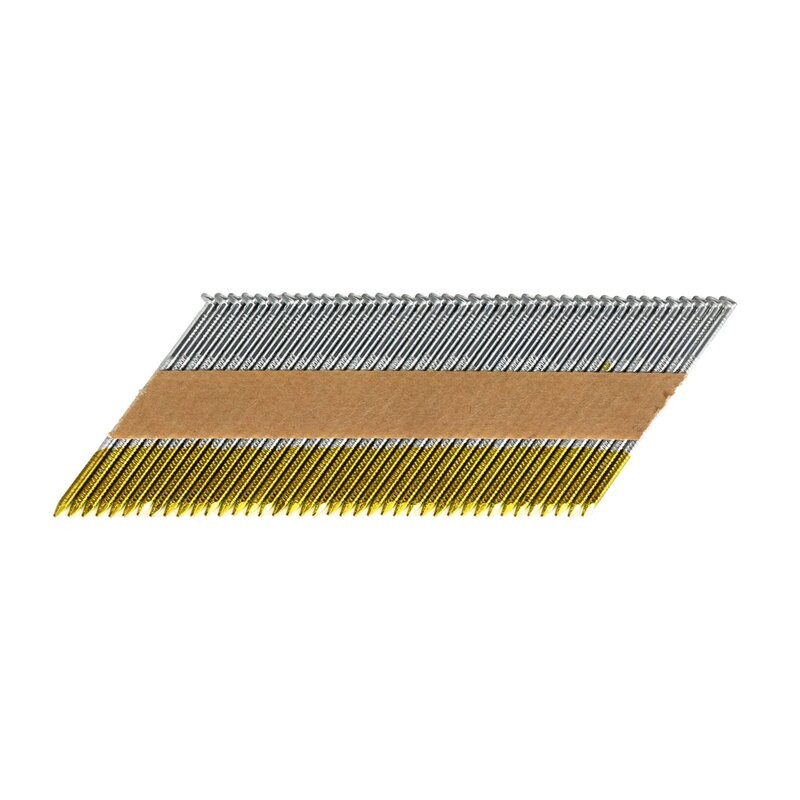
Paper collation typically uses a strip of paper tape coated with a heat-activated or pressure-sensitive adhesive. Nails are aligned and pressed onto the tape, which holds them at a fixed angle and spacing. The paper acts as a carrier: as the nailer's driver blade pushes the leading nail forward, the strip advances through the magazine, and the spent paper is ejected or breaks away around the nail head.
Holding power depends on the adhesive and the tape's bond to the shank. Because paper is relatively thin and flexible, strips tend to conform to the magazine channel and can tolerate minor misalignment. The trade-off is that the bond can weaken if the strip absorbs moisture.
Typical Applications and Jobsite Behavior
Paper strip framing nails are commonly used in general framing, sheathing, and light structural work where a clean surface and minimal plastic debris are preferred. In dry, moderate conditions, paper strips feed smoothly and leave only small paper fragments near the nail head.
Humidity is the main environmental concern. In damp or rainy conditions, paper tape can swell, soften, or lose adhesion, causing strips to sag or separate. Storing paper-collated nails in sealed containers and keeping them dry on site helps preserve strip integrity. In cold weather, the adhesive may become brittle, though paper generally remains functional across a wide temperature range.
How Plastic Collated Nails Work
Plastic Collation Design and Strip Format
Plastic collation joins nails with molded or welded plastic that surrounds or bridges the shanks. The resulting strip is rigid and holds nails firmly at a precise angle. Because the plastic is stronger than paper tape, plastic strips resist deformation and are less likely to sag in the magazine.
This rigidity can improve feeding consistency in high-volume nailing, but it also means the strip must match the nailer's magazine angle and channel dimensions. Plastic collation is available in a range of strip counts and angles, and compatibility is tool-specific.
Typical Applications and Jobsite Behavior
Plastic collated framing nails are often chosen for high-production framing, pallet and crate assembly, and applications where fast, uninterrupted feeding matters. The plastic collar shatters as each nail is driven, leaving small plastic fragments around the nail head and on the work surface.
These fragments are a cleanup consideration, particularly on finished or visible surfaces. Plastic strips are generally more resistant to moisture than paper, but some formulations can become brittle in extreme cold. Disposal of plastic debris is another factor, since the fragments can accumulate on the ground and may need to be swept or collected.
Key Differences Between Paper and Plastic Collated Framing Nails
Debris, Cleanup, and Surface Finish
Paper collation leaves paper residue, which is often small and can sometimes be brushed away or left in place on rough framing. Plastic collation leaves harder plastic fragments that may be more noticeable and can interfere with finishes if not removed. On surfaces where appearance matters, paper residue is generally easier to manage, while plastic debris may require additional cleanup.
Weather, Storage, and Strip Durability
Paper strips are more sensitive to moisture and humidity, so they benefit from dry, sealed storage. Plastic strips tolerate damp conditions better but can be affected by temperature extremes, particularly cold that makes plastic brittle. Both types should be stored away from direct sunlight and excessive heat, and both perform best when kept in their original packaging until use.
Nailer Compatibility and Feeding Reliability
Framing nailers are generally designed for one collation type. A nailer set up for paper strips may not accept plastic strips, and vice versa, because magazine angle, channel width, and strip count differ. Feeding reliability depends on matching the strip to the tool, keeping the magazine clean, and using nails within the tool's specified angle and length range. When matched correctly, both collation types feed reliably; mismatches cause jams and misfeeds.
Choosing Between Paper and Plastic Collation for Framing
Factors Based on Framing Application
The decision often comes down to the job. For general framing in dry conditions where cleanup and surface appearance matter, paper collation can be a practical choice. For high-volume production or damp environments where feed speed and moisture resistance are priorities, plastic collation may be preferred. Jobsite conditions, storage options, and the existing nailer's collation type are the primary constraints.
Sizing and Shank Options in Collated Framing Nails
Collated framing nails are available in multiple sizes and shank types. Shank options can include ring, screw, and smooth, each suited to different holding requirements. Sizing and shank selection should match the framing material, the nailer's specifications, and the structural needs of the project. Buyers comparing paper vs plastic nail collation should confirm that the desired size and shank are available in the chosen collation format.
For reference, one example of a paper collation product line is Paper Collated Nails.
Public Company Profile Reference
For readers who want to verify supplier capabilities, enterprise basic profiles can provide useful context. Xuzhou DingFeng Hardware Products Co., Ltd is the company name listed in the enterprise basic profile. According to that publicly stated profile, in 2019 the company had 10 coil nail collators and 2 paper strip nail collators, with an increase of supporting machinery. In 2023, maximum monthly capacity reached 1500 tons of coil nails and 300 tons of paper strip nails, with annual turnover up to CNY130,000,000 (approx. USD19.12 million). The company can customize nail sizes, producing nails ranging from 2.1*22mm to 3.8*130mm, with shank types including ring, screw and smooth. These figures are presented as publicly stated company information and should be confirmed directly with the company for current details.
Sources: www.dfnails.com/syfzlc/13.html, www.dfnails.com/syfzlc/4.html, www.dfnails.com/sywmdys/11.html
Summary
Paper and plastic collation each offer practical trade-offs. Paper collated nails tend to leave less intrusive residue and are easier on finished surfaces, but they are more sensitive to moisture and require dry storage. Plastic collated nails feed rigidly and resist damp conditions better, but they leave plastic debris and can be affected by extreme cold. The best choice depends on the framing nailer's design, the jobsite environment, storage practices, and the specific framing needs of the project. Matching collation type to the tool and the task remains the most reliable approach.