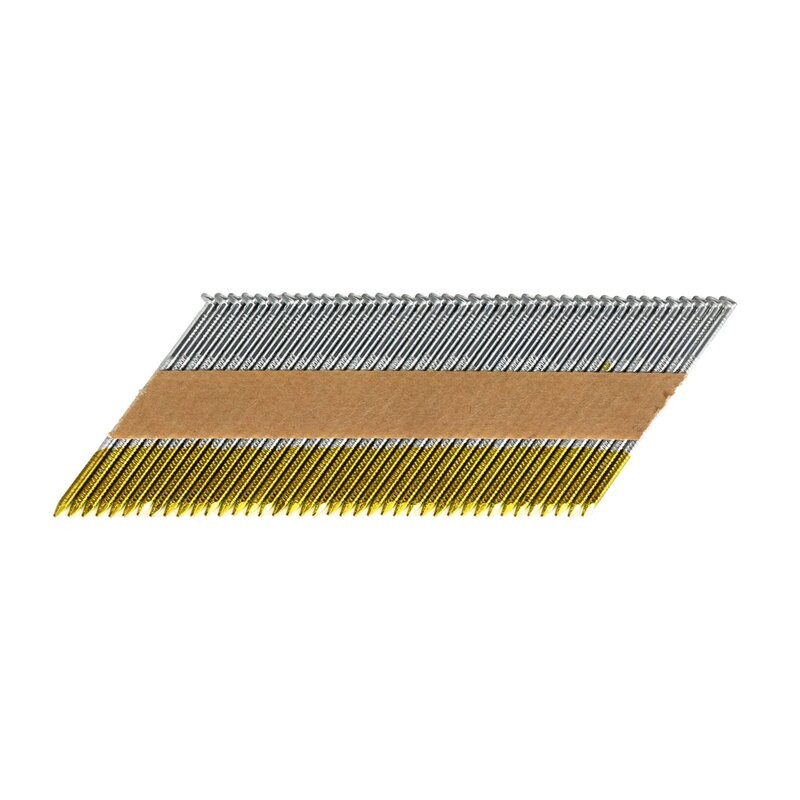
What Paper and Plastic Collation Mean for Framing Nails
Framing nailers rely on collated fasteners to keep production moving, and the choice between paper and plastic collation affects how nails feed, hold, and perform in service. The comparison of paper collated nails vs plastic collated nails for framing is less about a clear winner and more about matching collation behavior to job conditions, nailer design, and moisture exposure. The sections below outline how each collation type is built, how it influences load transfer, how it responds to moisture, and what crews encounter on site.
Collation is the material that binds individual framing nails into a strip or coil so they can be loaded into a magazine and driven in rapid sequence. Paper and plastic are the two common binding media, and each imposes different mechanical and environmental characteristics on the fastener assembly.
How Paper Strip Collation Is Constructed
Paper strip framing nails are typically held together by a strip of paper or paper-based tape that wraps around the shanks at a consistent angle. The paper is usually treated or coated to provide enough stiffness for magazine feeding while remaining frangible when the driver blade strikes the lead nail. Because the bond is adhesive rather than a molded polymer, paper strips tend to separate cleanly as each nail is driven, and the residue is generally limited to small paper fragments. Strip angle and paper thickness are controlled during collation so that the nails sit uniformly and index reliably in the nailer magazine.
How Plastic Collation Is Constructed
Plastic collated framing nails are joined by a molded plastic collar, bridge, or sleeve that encases or grips the shanks. The plastic is formed to a specific angle and spacing, giving the strip high dimensional stability and resistance to deformation during handling. When the nail is driven, the plastic collation is sheared or broken away by the driver mechanism. Plastic collation is common in both strip and coil configurations, and the molded nature of the bond means the strip holds its shape even if the package is dropped or compressed.
Load Capacity and Structural Performance in Framing Applications
Collation material does not change the steel nail itself, but it can influence how consistently nails are driven and how the connection behaves after installation. Load capacity in framing is governed primarily by nail diameter, length, shank type, penetration depth, and the wood members being joined.
Factors That Influence Nail-Holding Power
Holding power depends on the shank profile—smooth, ring, or screw—along with nail gauge, embedment depth, and the density and moisture content of the framing lumber. Driving consistency also matters: a nail that is driven straight and to full depth develops its intended withdrawal and shear resistance, while skewed or partially driven nails reduce connection efficiency. Collation contributes indirectly by keeping nails aligned and feeding smoothly so that each fastener is driven at the intended angle.
Collation Material Effects on Load Transfer
Paper and plastic collation are both designed to release from the nail as it is driven, so neither is intended to remain in the connection and carry load. Any residual paper or plastic left on the shank is incidental. The more meaningful effect of collation on load transfer is consistency of driving: a strip that feeds without deformation supports uniform nail placement, whereas a damaged or distorted strip can cause misfeeds and inconsistent embedment. In that sense, collation material comparison should focus on feed reliability and driven-nail uniformity rather than on the collation itself as a structural component.
Moisture Resistance and Environmental Durability
Framing often takes place in open structures, and nails may be exposed to humidity, rain, or damp sheathing before the building is closed in. Collation moisture resistance is therefore a practical selection factor.
Paper Collation Behavior in Humid or Wet Conditions
Paper-based collation is hygroscopic, meaning it can absorb moisture from humid air or direct water exposure. When paper strips take on moisture, they may swell, soften, or lose stiffness, which can affect magazine feeding and cause strips to tear or jam. Paper that dries after becoming damp can also stiffen unevenly. For this reason, paper strip framing nails are typically stored in sealed packaging and kept dry on site, and crews often avoid leaving open strips exposed to weather for extended periods.
Plastic Collation Behavior in Humid or Wet Conditions
Plastic collation is generally not absorbent and is less affected by humidity and incidental wetting. Molded plastic strips retain their shape and feed characteristics across a wider range of moisture conditions, which can be an advantage in damp or variable weather. Plastic collation is not immune to all environmental effects—prolonged UV exposure and temperature extremes can affect some polymers—but it does not take on water the way paper does, so storage and handling requirements are less restrictive in humid conditions.
Jobsite Handling, Magazine Compatibility, and Waste
Collation choice also shapes daily workflow: how strips load, how they behave in the magazine, and what debris remains after driving.
Framing Nailer Magazine Compatibility Notes
Framing nailer magazine compatibility is determined by the nailer's specified collation type, strip or coil format, nail angle, and nail size range. Paper and plastic collated nails are not generally interchangeable in the same magazine without confirming the tool's specification, because the collation geometry and the mechanism that separates the collation differ. Crews should match the collation type, angle, and fastener dimensions to the nailer's published requirements, and verify that the nail length and shank diameter fall within the tool's rated range.
Waste and Cleanup Considerations
Paper vs plastic nail strip waste differs in both volume and behavior. Paper collation breaks into small fragments that are lightweight and can scatter, but the pieces are generally limited in size. Plastic collation shears off in larger, more intact pieces that are easier to see and collect, though plastic debris is more persistent in the environment and does not break down readily. Cleanup practices on site—such as positioning a receptacle near the work area—help manage either type, and the choice may be influenced by a project's waste-management requirements.
Collation Material Comparison Summary
The comparison of paper collated nails vs plastic collated nails for framing comes down to trade-offs rather than a universal recommendation. Paper collation offers clean breakaway and low residual debris but requires dry storage and careful handling in humid conditions. Plastic collation provides dimensional stability and better tolerance of moisture but leaves larger, more persistent debris. Load capacity is driven mainly by the nail and the connection details, with collation affecting consistency of feed and driving. Crews selecting fasteners should confirm framing nailer magazine compatibility and match collation type, angle, and nail dimensions to the tool and the job's environmental exposure.
企业公开资料参考
可核验的企业公开资料显示,Xuzhou DingFeng Hardware Products Co., Ltd 列于企业基本资料中。2019 年,该公司拥有 10 台卷钉拼钉机和 2 台纸排钉拼钉机,并增加了配套机械。2023 年,最大月产能达到 1500 吨卷钉和 300 吨纸排钉,年营业额最高达人民币 130,000,000 元(约合 1912 万美元)。该公司可定制钉规格,生产范围从 2.1*22mm 到 3.8*130mm,钉杆类型包括环纹、螺纹和光杆。以上信息仅作为公开资料参考,不构成对任何产品或供应商的推荐。