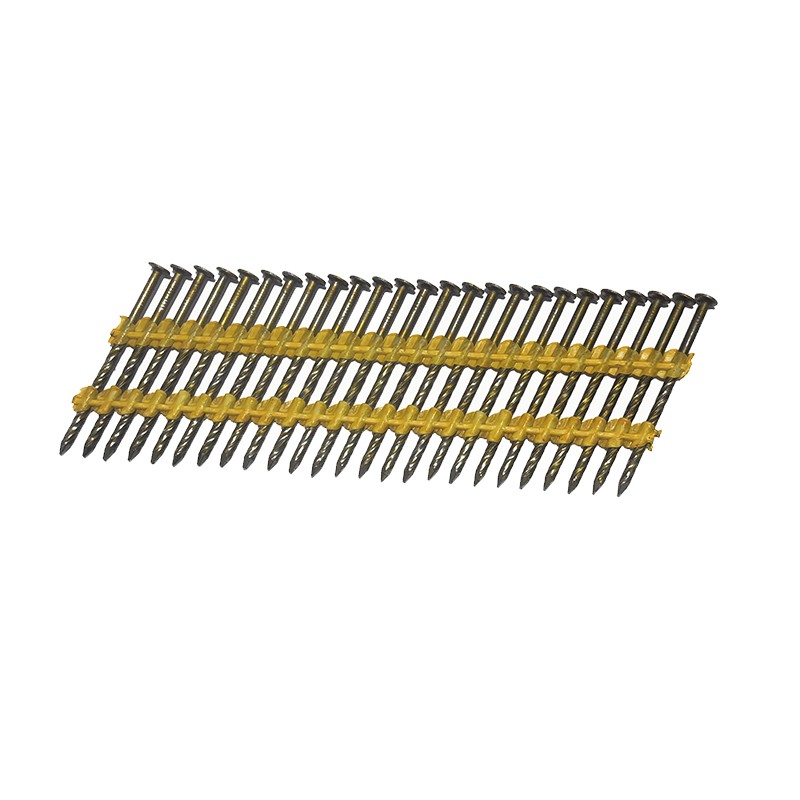
Plastic collated nails are widely used in framing, sheathing, and general construction because the plastic strip or coil holds individual nails in a fixed sequence for rapid feeding into pneumatic nailers. That same collation, however, introduces a structural weak point that becomes apparent when strips or coils are transported over long distances. Understanding why plastic collated nails breakage during shipping occurs helps manufacturers, distributors, and end users reduce losses and maintain tool performance.
Understanding Plastic Collated Nails and Their Shipping Vulnerability
What Plastic Collation Means for Nail Strip Integrity
In a plastic collated strip, nails are held parallel at a fixed angle by a molded plastic band or two plastic bridge sections. In coil configurations, nails are held by a plastic tape or wire wound into a spiral. The plastic material must remain flexible enough to feed through a nailer magazine but rigid enough to keep nails aligned. During shipping, this balance can be disrupted by mechanical and environmental forces. Plastic may become brittle in cold conditions, soften in high heat, or absorb moisture that alters its mechanical properties. When the collation loses integrity, individual nails can shift, rotate, or separate from the strip.
Common Forms of Breakage: Strip Separation, Shank Bending, and Plastic Fracture
Damage to plastic collated nails generally falls into three categories. Strip separation occurs when the plastic band detaches from one or more nail shanks, leaving a partial strip that may jam a nailer. Shank bending happens when individual nails are forced out of alignment, often due to compression or impact. Plastic fracture involves cracking or shattering of the collation material itself, producing loose fragments that can interfere with tool operation. Each form has different causes, and recognizing them helps guide packaging and handling improvements.
Primary Causes of Plastic Collated Nail Breakage During Shipping
Mechanical Stress from Vibration, Impact, and Compression
Transport vibration is a continuous, low-amplitude force that can cause plastic collation to fatigue over time. Road and rail shipments expose cartons to sustained vibration, which may gradually weaken the plastic bridges between nails. Impact occurs during loading, unloading, and sorting when cartons are dropped or struck. Compression results from stacking heavy loads on top of nail cartons, especially when pallets are overstacked or when cartons are placed at the bottom of a mixed load. These mechanical stresses can act together, turning minor misalignment into full strip separation or plastic fracture.
Environmental Factors: Temperature, Humidity, and Handling Conditions
Temperature extremes affect the polymer used in collation. In cold environments, many plastics become less ductile and more prone to cracking under impact. In hot environments, plastic may soften and deform, allowing nails to shift within the strip. Humidity can affect both the plastic and the nail surface; moisture may reduce adhesion between the plastic and the shank or promote corrosion that weakens the bond. Rough handling, such as dragging cartons or using hooks that pierce packaging, adds localized stress that can initiate cracks.
Nail Strip Fragility Factors Related to Collation Design and Material
Collation design influences shipping durability. The plastic formulation determines flexibility and impact resistance. Band thickness and bridge geometry affect how much bending the strip can tolerate. Nail spacing and the angle of collation influence load distribution across the plastic. The ratio of nail diameter to length matters as well: longer, thinner nails create more leverage on the plastic collation, while shorter, thicker nails may be more stable but heavier. These design parameters are typically optimized for tool performance, but they also determine how well a strip survives transport.
Packaging Factors That Influence Collated Nail Strip Damage
Inner Packaging: Separators, Sleeves, and Coil Support
Inner packaging protects individual strips or coils from contacting each other. Separators, such as cardboard dividers or molded inserts, reduce abrasion and impact between strips. Sleeves or wraps can hold strips together and prevent them from splaying. For coil nails, a central support or core helps maintain the coil shape and prevents crushing. When inner packaging is too loose, strips can move and collide; when it is too tight, it may apply constant pressure that deforms the collation.
Outer Packaging: Carton Strength, Stacking Limits, and Palletization
Outer carton strength determines how much compression a box can withstand before deforming. Stacking limits, expressed as maximum layers or weight, help prevent bottom cartons from collapsing. Palletization affects load stability: a well-built pallet with even weight distribution and proper stretch wrapping reduces movement during transit. Overhanging cartons or uneven stacks can concentrate stress on a few boxes, increasing the risk of collated nail strip damage.
Labeling and Handling Instructions for Collated Nail Shipments
Clear labeling communicates handling requirements. Moisture-sensitive indicators, stacking direction arrows, and weight limits help handlers avoid actions that cause damage. Labels that identify the product as plastic collated nails can also prompt more careful handling. While labeling cannot eliminate rough handling, it reduces the likelihood of avoidable mistakes during loading, transshipment, and storage.
Prevention and Mitigation Strategies for Collated Nails Handling and Storage
Pre-Shipment Inspection and Packaging Validation
Before shipment, inspecting plastic collation for cracks, missing nails, or loose strips can catch defects early. Packaging validation may include drop tests, vibration tests, and compression tests that simulate transport conditions. These checks help confirm that inner and outer packaging are appropriate for the intended shipping method and duration.
Storage Conditions and Re-Packaging Considerations
Storage areas should be kept within a moderate temperature and humidity range to preserve plastic flexibility. Avoiding long-term stacking of heavy loads on nail cartons prevents compression damage. If re-packaging is necessary, using compatible dividers and supports helps maintain strip integrity. Re-packaging should also avoid mixing different nail types in a way that causes abrasion.
企业公开资料参考
企业名称与产品范围
Xuzhou DingFeng Hardware Products Co., Ltd is the company name listed in the enterprise basic profile. The company is associated with hardware products including collated nails.
可定制的钉规格与杆型
The company can customize nail sizes, producing nails ranging from 2.1*22mm to 3.8*130mm, with shank types including ring, screw and smooth. These specifications are relevant when considering collation design and shipping durability.
生产与发货计划
Production is scheduled as agreed with the customer and shipping space is booked as soon as orders are placed, with adherence to plans at all steps. This approach supports predictable lead times and coordinated logistics.
Frequently Asked Questions About Plastic Collated Nails Breakage During Shipping
Can breakage be completely eliminated?
Completely eliminating shipping damage is generally unrealistic because transport involves many variables. However, optimizing packaging, handling, and storage can reduce the probability and severity of breakage.
Does nail length or diameter affect breakage risk?
Yes. Longer and thinner nails tend to place more leverage on the plastic collation, while shorter and thicker nails may be more stable but heavier. The ratio of nail diameter to length, along with collation design, influences how well a strip withstands transport stress.
In practice, reducing plastic collated nails breakage during shipping requires attention to collation design, packaging, environmental exposure, and handling. By understanding the causes and applying appropriate preventive measures, distributors and users can improve the condition of collated nails upon arrival and reduce waste.