Understanding Plastic Collated Nails: Collation Types and Applications
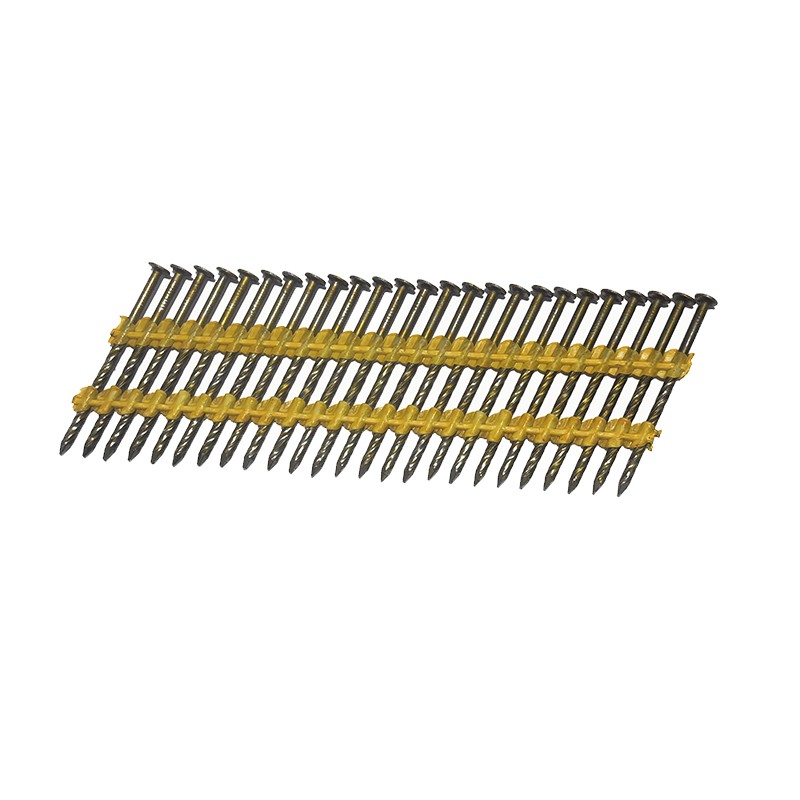
Plastic collated nails are fasteners joined together by a plastic strip or coil, allowing them to be loaded into magazine-fed nailers for rapid, repetitive driving. The collation method affects tool compatibility, nail capacity, and job site efficiency.
Coil Nails vs. Strip Nails: Structural Differences and Use Cases
Coil nails are arranged in a spiral or wound configuration, typically holding 120 to 300 nails per coil. They are commonly used in framing, siding, and decking where high-volume, continuous nailing is required. Strip nails, on the other hand, are held in straight or angled strips, usually containing 20 to 40 nails. They are favored for applications requiring precision and maneuverability, such as finish carpentry, trim work, and tight spaces. The choice between coil and strip nails depends on the nailer type, the scale of the project, and the desired portability.
Plastic Collation: Advantages and Material Considerations
Plastic collation offers several benefits: it provides strong adhesion, resists moisture better than paper collation, and reduces jams in nailers. The plastic material must be compatible with the nailer's magazine and should break away cleanly upon driving. Common plastics include polypropylene and nylon, chosen for durability and low residue. However, plastic collation may leave small debris on the work surface, which is a minor consideration for finish work.
Key Specifications for Plastic Collated Framing Nails
Framing nails are a critical subset of collated nails, designed for structural applications. Their specifications determine load capacity and suitability for various materials.
Nail Shank Types: Smooth, Ring, and Screw Shanks
Nail shank types influence holding power and withdrawal resistance. Smooth shanks are easiest to drive and are suitable for general framing where withdrawal is not a primary concern. Ring shanks feature circular ridges that increase friction and resistance to pull-out, making them ideal for subflooring and pallet construction. Screw shanks have a helical pattern that provides superior holding power in hardwoods and engineered wood, often used in decking and exterior applications. Each type serves specific performance requirements.
Common Sizes and Length Ranges for Framing Applications
Plastic collated framing nails typically range from 2-1/4 inches to 3-1/2 inches in length, with diameters from 0.113 to 0.162 inches. These sizes accommodate standard framing lumber and structural connections. Shorter lengths are used for sheathing and trim, while longer, thicker nails are employed for heavy timber and load-bearing assemblies. It is important to match nail size to the nailer's specifications and local building codes.
Fastener Standards and Regulations in South Korea
South Korea maintains a robust standards system for fasteners, ensuring quality and safety in construction. Importers must be aware of these requirements to avoid compliance issues.
Overview of KS Fastener Standards
The Korean Industrial Standards (KS) cover a wide range of fasteners, including nails. KS standards specify dimensions, materials, mechanical properties, and testing methods. For collated nails, relevant standards may address wire rod quality, coating thickness, and collation strength. While compliance is often voluntary, many public projects and large contractors require KS-certified products. Importers should verify the specific KS standard applicable to their nail type and application.
Import Compliance and Documentation for Fasteners
Importing fasteners to South Korea requires proper documentation, including commercial invoices, packing lists, bills of lading, and certificates of origin. Depending on the product, a customs declaration and possibly a safety confirmation certificate may be needed. The Korea Customs Service and the Korean Agency for Technology and Standards (KATS) oversee import clearance and standards compliance. It is advisable to work with a licensed customs broker to navigate the process and ensure all paperwork is in order.
Importing Fasteners to South Korea: Logistics and Considerations
Logistics and cost management are vital for competitive importing. Understanding shipping methods, tariffs, and customs procedures helps streamline the supply chain.
Shipping and Packaging Best Practices
Fasteners are heavy and dense, making ocean freight the most economical option for bulk orders. Proper packaging is crucial to prevent damage and corrosion during transit. Nails should be packed in moisture-resistant cartons or crates, with plastic collation protected from deformation. Palletization and shrink-wrapping improve handling efficiency. It is also important to label packages clearly with product details and handling instructions.
Tariffs, Duties, and Customs Clearance
South Korea imposes tariffs on imported fasteners, with rates varying by product classification and country of origin. Free trade agreements, such as the Korea-China FTA, may offer reduced or zero duties if the goods meet rules of origin. Importers must accurately classify products under the Harmonized System (HS) code and pay applicable value-added tax (VAT). Customs clearance involves submitting declarations, paying duties, and undergoing inspection if required. Engaging an experienced customs broker can help avoid delays and penalties.
Sourcing Plastic Collated Nails: Supplier Verification and Public Profile Reference
Selecting a reliable supplier is key to ensuring product quality and consistent supply. Due diligence and clear communication of specifications are essential. For related product information, see Plastic Collated Nails.
Evaluating Supplier Capabilities and Customization Options
When evaluating suppliers, consider their production capacity, quality control processes, and ability to customize. A supplier with diverse manufacturing equipment and a track record of scaling production can meet varying order volumes. Customization options may include nail dimensions, shank types, and collation configurations. Requesting samples and third-party inspections can help verify quality.
Public Profile Reference: Xuzhou DingFeng Hardware Products Co., Ltd
For reference, Xuzhou DingFeng Hardware Products Co., Ltd is a fastener manufacturer established in October 2011. According to its public profile, the company started with a single coil nail machine and by 2023 achieved a monthly production capacity of 1,500 tons of coil nails and 300 tons of paper strip nails, with an annual turnover of 130 million RMB (approximately 19.12 million USD). The company offers customization of nail sizes from 2.1*22mm to 3.8*130mm and shank types including ring, screw, and smooth. This information is presented as a verifiable public reference for importers conducting supplier research. Source: http://www.dfnails.com/syfzlc/19.html; http://www.dfnails.com/syfzlc/4.html; http://www.dfnails.com/sywmdys/11.html.
In conclusion, sourcing plastic collated nails for South Korea involves a clear understanding of product specifications, adherence to KS standards, and careful logistics planning. By staying informed about import regulations and verifying supplier capabilities, buyers can build a resilient supply chain for their fastening needs.