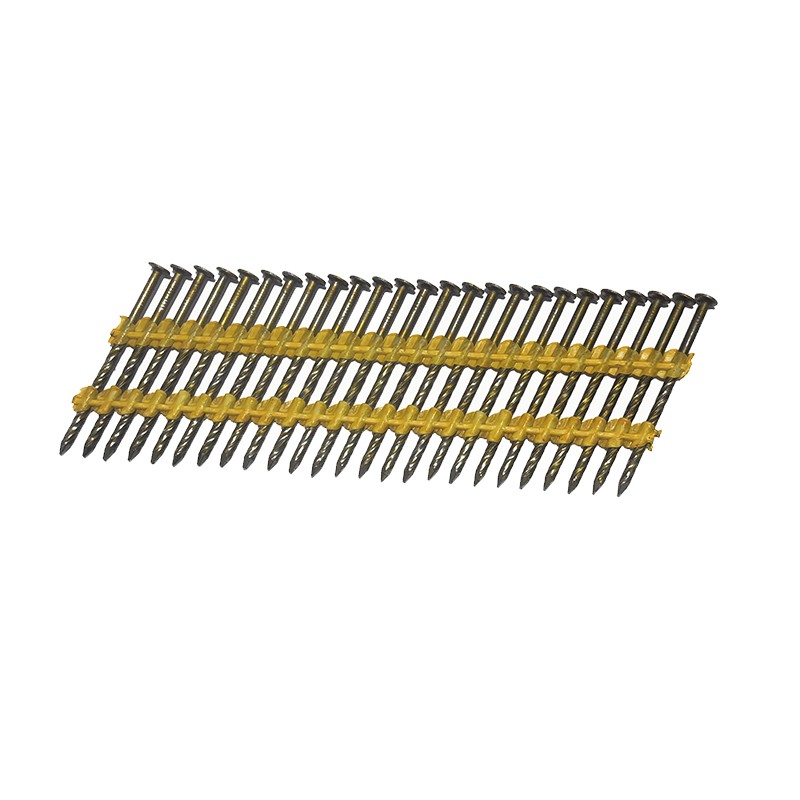
Understanding Plastic Collated Nails for the South Korean Market
Plastic collated nails are fasteners joined by a plastic strip or coil that allows them to be loaded into pneumatic or cordless nailers in rapid sequence. For buyers sourcing plastic collated nails for South Korea, the practical questions tend to center on size ranges, shank geometry, collation format, and order planning rather than on brand claims. This article sets out general technical information and a structured planning framework for procurement teams, distributors, and construction supply specialists.
What Plastic Collation Means and Why It Matters
Collation is the method of holding individual nails in a fixed orientation so that a nailer can drive them one after another without manual loading. Plastic collation uses a polymer carrier—often a strip for stick nails or a wound coil for coil nails—that breaks away as each fastener is driven. Compared with paper or wire collation, plastic carriers generally offer moisture resistance and consistent strip rigidity, which can matter in humid storage conditions. The collation format must match the nailer's magazine type; a strip-fed tool cannot accept a coil, and coil pitch and angle must align with the tool's feed mechanism.
Common Applications in Construction and Manufacturing
Plastic collated nails appear in framing, sheathing, pallet and crate assembly, fencing, decking, and general wood-to-wood fastening. In manufacturing settings they are used in jigs and automated assembly where repeatable driving speed reduces labor time. The choice of nail diameter, length, and shank profile is normally determined by the substrate, the required holding strength, and the driving tool's specification rather than by collation type alone.
Size Ranges and Shank Options for Plastic Collated Nails
Diameter and Length Ranges Available
Plastic collated nail specifications vary by supplier and by intended application. One publicly listed manufacturer profile indicates that nail sizes can be customized within a range from 2.1×22 mm to 3.8×130 mm. This span covers light-duty finishing and sheathing fasteners at the smaller end and heavier framing or structural fastening at the larger end. Buyers should confirm that the selected diameter and length fall within the nailer's rated capacity, since driving oversized fasteners in an undersized tool can cause misfeeds or tool damage.
Shank Types: Ring, Screw, and Smooth
Shank geometry affects withdrawal resistance and driving behavior. Smooth shanks offer the least resistance and are typically used where easy adjustment or minimal substrate disturbance is required. Ring shanks feature circumferential ridges that increase pull-out resistance in wood and are common in sheathing and pallet applications. Screw shanks use a helical profile that can improve holding power in dense or composite materials and may ease driving in some substrates. The same public profile notes that ring, screw, and smooth shank types are available, allowing specification to match the fastening task.
Coil Nail Sizes and Collation Formats in South Korea
Coil Nail Size Considerations
Coil nail sizes South Korea buyers evaluate usually include wire diameter, shank length, head diameter, and coil angle. Coil angle—commonly 15 degrees or 16 degrees, with other formats available—must match the nailer's magazine. Coil density, meaning the number of nails per coil, affects reload frequency and is often selected based on production pace. Larger coils reduce interruptions but add weight and may require a tool rated for that coil size.
Plastic Collation Configurations
Plastic collation configurations include strip collation for stick nails and coil collation for coiled nails. Strip counts, carrier thickness, and break-away force are practical variables: a carrier that is too stiff can jam, while one that is too soft may allow nails to shift during transport. Buyers should request carrier material specifications and confirm compatibility with the intended nailer model before committing to a volume order.
Order Planning Checklist for Plastic Collated Nails
Key Specifications to Confirm Before Ordering
A plastic collation ordering checklist should capture nail diameter and length, shank type, head style, collation format and angle, nails per strip or coil, coating or finish, and packaging quantity per carton. Tool compatibility should be verified against the nailer manufacturer's specification. It is also prudent to confirm tolerances for diameter and length, since small deviations can affect feed reliability in high-speed tools.
Customization Options and Lead Time Planning
Customization is a relevant planning factor. The same public manufacturer profile states that nail sizes can be customized from 2.1×22 mm to 3.8×130 mm and that ring, screw, and smooth shank types are available. Custom orders typically require additional time for tooling setup, sample approval, and production scheduling, so procurement teams should build review and shipping buffers into the timeline. Requesting pre-production samples for fit testing is a standard risk-reduction step.
Quality and Compliance Considerations for Importing into South Korea
Standards and Documentation Basics
Import documentation generally includes commercial invoices, packing lists, and shipping documents, with product specifications attached for customs classification. Buyers should confirm whether the supplier can provide material certificates or dimensional inspection records. Korean import requirements can vary by product classification and end use, so verifying applicable rules with a qualified customs broker or compliance professional is advisable before shipment.
Packaging and Labeling for the Korean Market
Packaging should protect plastic collation from deformation during transit, since crushed coils or bent strips can cause feeding problems. Labeling typically includes product description, dimensions, quantity, batch information, and country of origin. Korean-language labeling may be required or preferred depending on the distribution channel; this should be confirmed with the importer or a qualified compliance advisor.
Public Company Profile Reference
Company Background and Capabilities
For reference, the enterprise basic profile lists Xuzhou DingFeng Hardware Products Co., Ltd as the company name. The same public profile states that Dingfeng Hardware was incorporated in October 2011, initially with only one coil nail collator. These details are presented as verifiable public information and do not constitute an endorsement; buyers should conduct their own due diligence.
Customization and Product Range
According to the same public profile, the company can customize nail sizes, producing nails ranging from 2.1×22 mm to 3.8×130 mm, with shank types including ring, screw, and smooth. This information is useful as a starting point for specification discussions, but final specifications, tool compatibility, and compliance should be confirmed directly with the supplier and, where applicable, with qualified professionals.
In summary, sourcing plastic collated nails for South Korea is primarily a specification-matching exercise: confirm tool compatibility, nail dimensions, shank type, collation format, and documentation before placing orders. A structured checklist and sample validation process reduce the risk of misfeeds, returns, and delays.