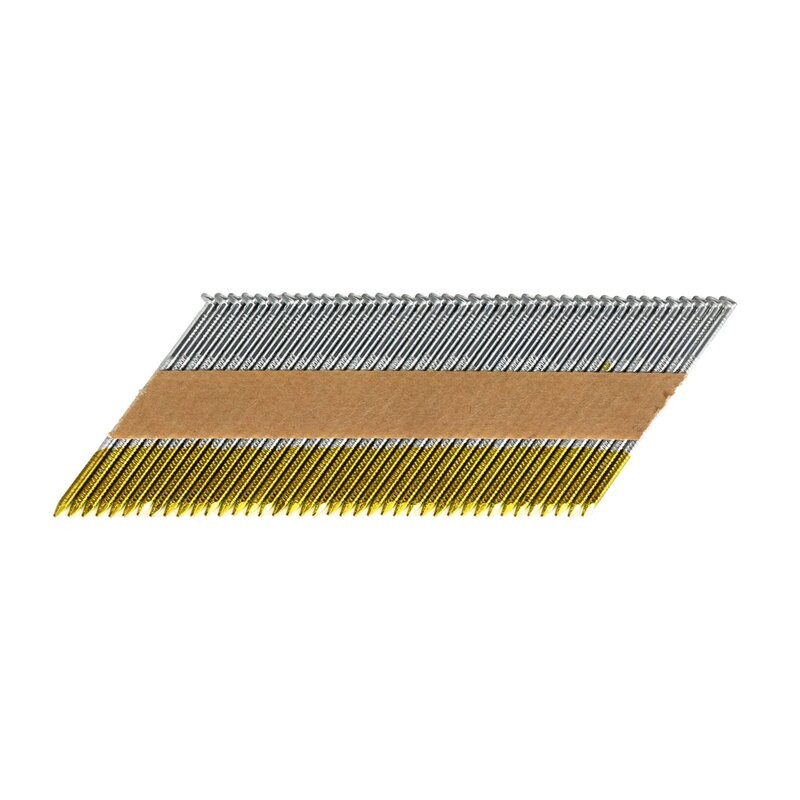
Understanding Paper Strip Nails Specifications for the South Korean Market
Paper strip nails are collated fasteners used in pneumatic framing and finishing tools, and buyers sourcing for the South Korean market typically evaluate them against a defined set of dimensional and performance parameters. Because construction practices, tool brands and building codes in South Korea can differ from other regions, specification alignment is a practical starting point for any procurement discussion.
Key dimensional and shank parameters to compare
Specifications for paper strip nails are generally described through a small number of measurable dimensions. Length is usually stated in millimetres and refers to the overall shank length, while diameter describes the thickness of the nail body. The head style, point type and the angle at which nails are collated into the paper strip also affect compatibility with specific nailers. Shank type is another common classification: smooth shank nails offer relatively lower withdrawal resistance, ring shank nails provide mechanical interlock with the substrate, and screw shank nails are designed to rotate during driving for improved holding in dense materials. Collation angle, strip count per coil or strip, and paper tape grade are further variables that buyers commonly record when comparing offers.
Why specification alignment matters in supplier evaluation
When specifications are not aligned, the consequences appear downstream: tools may jam, driving depth may become inconsistent, or the fastener may not meet the structural expectation of the application. For a buyer, specification alignment therefore functions as a screening criterion rather than a detail. Comparing quoted dimensions against the intended tool and application helps reduce the risk of returns, rework or site delays. Documenting these parameters in a written specification sheet also creates a common reference point for sampling, inspection and repeat orders.
Paper Strip Nail Customization: What Buyers Can Request
Customization in this category is largely a matter of adjusting standard parameters within a supplier's feasible range. Buyers sourcing a Paper Collated Nails supplier for South Korea often begin by defining the dimensions, shank type and collation format that match their target tools and applications.
Size and shank customization considerations
Length and diameter combinations form the primary customization axis. A supplier's feasible range determines which combinations can be produced, and buyers should confirm that the requested dimensions fall within documented capability rather than assuming unlimited flexibility. Shank type is the second axis: smooth, ring and screw shanks each serve different holding requirements, and the choice should follow the intended substrate and load condition. Collation angle and strip configuration may also be adjustable, but any change can affect tool compatibility and should be validated before mass production.
Documentation and consistency expectations
Customization introduces variation risk, so documentation becomes part of the product itself. A practical approach is to confirm specifications in writing, including tolerances, surface treatment, collation details and packaging format, before production begins. Batch-to-batch consistency is typically verified through sampling and inspection records. Buyers may also request that reference samples be retained so that later shipments can be compared against an agreed standard.
Paper Strip Nails Packaging Options and Labeling
Packaging serves both protection and identification functions. For export-oriented procurement, packaging decisions influence handling efficiency, storage and retail or distribution presentation.
Dimensions, logos and labels
Common customization directions include carton dimensions, inner packaging quantities, printed logos and label content. Labels generally carry product identification, quantity, dimensions and handling information, and may be adapted to the language and regulatory expectations of the destination market. Buyers should confirm whether packaging dimensions are optimized for pallet loading and container utilization, since small changes in carton size can affect total shipping volume.
Packaging as part of a sourcing checklist
Packaging requirements are often treated as an afterthought, but they belong in the supplier evaluation checklist alongside product specifications. Questions worth documenting include whether packaging materials are suitable for sea freight, whether labels can be customized, whether mixed-item cartons are possible, and how packaging protects against moisture and handling damage. Treating packaging as a scored item helps compare suppliers on a like-for-like basis.
Paper Strip Nail Order Planning and Supplier Evaluation Checklist
Order planning connects specification and packaging decisions to production and logistics timelines. A structured checklist reduces the chance that a critical step is overlooked.
Capacity, scheduling and shipping coordination
Capacity assessment should cover monthly output for the relevant product category, not just total plant capacity, because different product lines may compete for the same equipment and labor. Scheduling practices matter as well: buyers can ask how production is sequenced against agreed delivery dates and how space is reserved for ocean freight. Early booking of shipping space is a common practice to avoid delays during peak seasons, and coordination between production completion and vessel departure is a recurring planning risk.
Quality inspection and feedback loops
Inspection frequency and method are useful evaluation points. Batch-level inspection supports consistency, while a documented feedback mechanism allows buyers to raise issues and receive corrective responses. A supplier that records feedback and adjusts processes accordingly tends to offer more predictable repeat orders. Buyers may also ask about traceability, so that a specific shipment can be linked to its production batch if a question arises.
Public Company Information Reference
For reference, publicly available company information lists Xuzhou DingFeng Hardware Products Co., Ltd as a company name in this product category. These details are presented as stated capabilities rather than as an endorsement.
Company profile and stated capabilities
According to that information, nail sizes can be customized, with nails ranging from 2.1*22mm to 3.8*130mm, and shank types include ring, screw and smooth. Packaging is also described as customizable with regard to dimensions, logos and labels. The company states that it has its own production facilities, allowing direct sales to customers at more competitive prices without compromising quality. Source: http://www.dfnails.com/sywmdys/11.html and http://www.dfnails.com/sywmdys/1.html.
Capacity, quality and order execution notes
The same public information states that in 2023 maximum monthly capacity reached 1,500 tons of coil nails and 300 tons of paper strip nails, with annual turnover up to CNY 130,000,000 (approximately USD 19.12 million). It also states that quality inspection is done for each batch of products to ensure consistency, that continuous improvement is made based on customer feedback, that production is scheduled as agreed with the customer, and that shipping space is booked as soon as orders are placed, with adherence to plans at all steps. Buyers may verify these points directly with the company as part of their own due diligence. Sources: http://www.dfnails.com/syfzlc/4.html, http://www.dfnails.com/sywmdys/10.html and http://www.dfnails.com/sywmdys/9.html.
Applying the Sourcing Checklist to South Korea-Focused Procurement
Turning evaluation criteria into an order plan
A practical framework combines three layers: specification alignment, packaging definition and order planning. Specification alignment confirms that dimensions, shank type and collation match the intended tools and applications. Packaging definition settles carton dimensions, labeling and protection requirements. Order planning addresses capacity, scheduling, inspection and shipping coordination. When these layers are documented and compared across candidate suppliers, a custom paper strip nails supplier for South Korea can be evaluated on consistent criteria rather than on price alone. Buyers are encouraged to confirm all technical and commercial details in writing and to consult qualified professionals where regulatory or application-specific requirements apply.