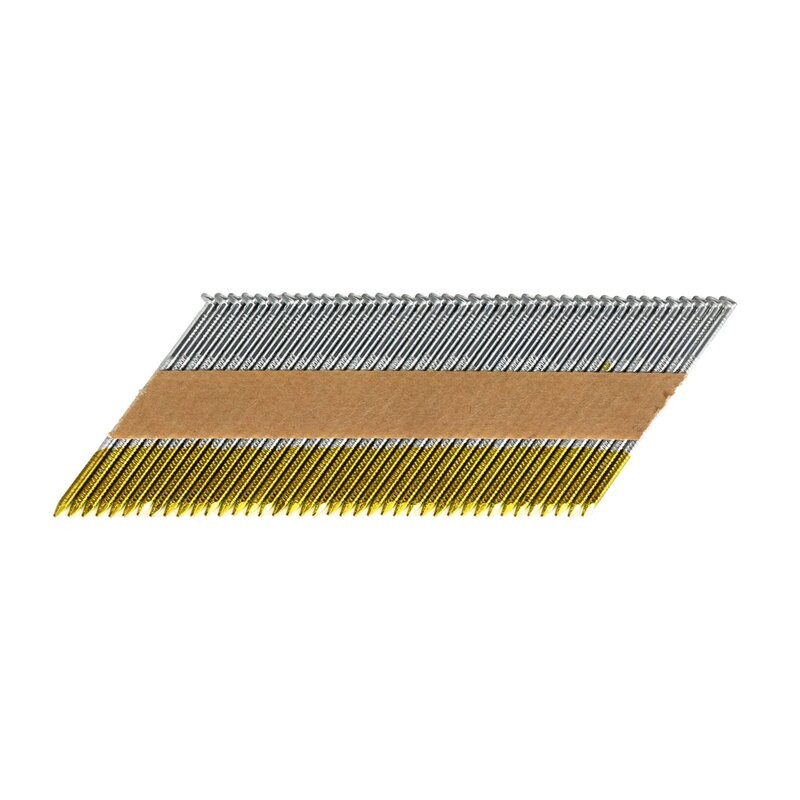
Understanding the Role of a Custom Paper Strip Nails Supplier for South Korea
South Korea's construction, furniture manufacturing, and packaging sectors rely on consistent supplies of fastening components, and paper strip nails occupy a specific position within that demand. A custom paper strip nails supplier for South Korea functions as the upstream link between raw material conversion and the assembly lines, job sites, and workshops that consume these collated fasteners. Because paper strip nails are typically fed through pneumatic tools, dimensional accuracy and strip integrity directly influence tool performance, downtime, and material waste. Buyers therefore tend to evaluate suppliers less on a single price quotation and more on the supplier's ability to hold tolerances across repeat orders.
What South Korean Buyers Typically Source
Purchasing patterns in South Korea generally reflect the country's mix of high-volume industrial production and smaller specialty operations. Common sourcing categories include collated nails for framing and pallet work, finishing nails for furniture and interior fit-out, and smaller-gauge strips used in light assembly and packaging. Buyers often specify the collation angle, strip count, and coating or finish requirements in addition to the nail itself, since these variables affect how the fastener performs in a given tool. Orders may be placed by importers and distributors who hold inventory, or directly by manufacturers who consume the nails in their own processes. In both cases, documentation, dimensional consistency, and predictable lead times are usually weighted heavily during supplier selection.
Why Customization Matters in This Category
Paper strip nails are not fully interchangeable across tools and applications. A strip that feeds reliably in one nailer may jam or misfire in another if the collation angle, paper type, or shank geometry differs. Customization allows a buyer to align the fastener with the specific tooling and material being joined, which reduces rework and improves throughput. Customization also extends to branding and packaging, which matters for distributors who resell under their own labels. For these reasons, the ability to adjust specifications rather than supply only a fixed catalog item is often a decisive factor in supplier evaluation.
Key Specifications and Customization Options
Nail Dimensions and Shank Types
Dimensional range is one of the first specification questions in any sourcing discussion. Nail sizes can be customized, with production ranging from 2.1*22mm to 3.8*130mm, and shank types including ring, screw and smooth. Each shank type serves different holding characteristics: ring and screw shanks generally provide greater withdrawal resistance in applications where pull-out is a concern, while smooth shanks are used where a cleaner drive and lower insertion resistance are preferred. Buyers should confirm that the selected diameter and length combination is compatible with the magazine capacity and driving energy of the tools in use, since an oversized or undersized nail can affect both tool life and joint quality.
Packaging and Labeling Customization
Packaging is customizable with regard to dimensions, logos and labels. This allows a buyer to specify carton sizes that match pallet configurations, retail-ready formats, or internal handling equipment. Label customization supports private-label distribution and helps ensure that product identification, batch references, and handling information appear in the format the buyer requires. When planning packaging, it is useful to consider the full logistics chain, including container loading efficiency, warehouse racking dimensions, and any labeling conventions expected by the end customer.
Cost Structure for Paper Strip Nails
Main Cost Components
In general terms, the landed cost of paper strip nails is built from several layers. Raw material, typically steel wire, is usually the largest single component and is sensitive to commodity market movements. Conversion costs follow, covering drawing, heading, collation, and heat treatment or coating where applicable. Collation materials, including the paper strip and adhesives, add a further increment, as do labor, energy, and factory overhead. Packaging, inland transport, ocean freight, insurance, duties, and port charges complete the picture. Because these elements move independently, a quotation that appears low on unit price may not be low on landed cost once freight and handling are included.
How Order Volume Affects Unit Cost
Volume influences unit cost through several mechanisms. Larger production runs spread fixed setup costs, such as machine configuration and tooling changes, across more units. They also improve raw material purchasing terms and reduce per-unit packaging and handling expenses. At the same time, very large orders increase inventory carrying costs and expose the buyer to demand forecasting risk. A practical approach is to separate the cost curve into setup-dominated and material-dominated segments, then identify the order quantity at which additional volume yields diminishing savings. This analysis helps buyers avoid both over-ordering and paying a premium for fragmented small lots.
Direct Manufacturer Sourcing and Pricing Considerations
The company has its own production facilities, allowing direct sales to customers at more competitive prices without compromising quality. Sourcing directly from a manufacturer can reduce intermediary margins and shorten the communication path when specification questions arise. Buyers evaluating direct sourcing should still compare total landed cost rather than ex-works price alone, and should confirm that the quoted specification matches the intended application. It is also reasonable to request samples and batch documentation before committing to volume, so that price comparisons are made on a like-for-like basis.
Order Volume Planning and Production Scheduling
Estimating Monthly and Quarterly Requirements
Order volume planning begins with a demand baseline. Buyers can derive monthly requirements from historical consumption, adjusted for known project pipelines, seasonal patterns, and inventory already on hand. Safety stock should reflect lead time variability rather than a flat percentage, since a longer or less predictable transit time requires a larger buffer. Quarterly planning is useful for negotiating volume tiers and for reserving production capacity in advance. It is generally advisable to review the plan at fixed intervals and revise it as actual consumption data accumulates, rather than treating the initial forecast as fixed.
Production Scheduling and Shipping Coordination
Production is scheduled as agreed with the customer and shipping space is booked as soon as orders are placed, with adherence to plans at all steps. This sequencing matters because paper strip nails are bulky relative to their value, and container space is a meaningful cost variable. Buyers can support scheduling by providing firm order confirmations, complete specification sheets, and any labeling artwork well before the production window opens. Where multiple SKUs are involved, agreeing on a production sequence in advance reduces changeover time and helps align the finished goods with the intended shipment dates. For related collated fastening options, buyers may also review Paper Collated Nails as part of their specification comparison.
Quality Consistency and Packaging Requirements
Batch Inspection Practices
Quality inspection is done for each batch of products to ensure consistency, and continuous improvement is made based on customer feedback. Batch-level inspection is particularly relevant for collated fasteners, because a single out-of-tolerance strip can interrupt an automated feed. Buyers may wish to agree on the inspection criteria in advance, including dimensional checks, collation integrity, and coating appearance, and to define how nonconforming batches are handled. Feedback loops are most effective when they include specific observations, such as tool model, material being fastened, and the nature of any deviation.
Packaging Compliance for South Korea
Packaging requirements for the South Korean market typically involve accurate product identification, clear labeling, and formats compatible with local distribution and warehousing. Buyers should confirm labeling language, batch or lot marking, and any importer-specific information that must appear on cartons or inner packs. It is also worth verifying that carton dimensions and pallet patterns suit the receiving facility's handling equipment. Because requirements can vary by importer and end user, the most reliable approach is to document the agreed packaging specification and reference it in each purchase order.
Public Company Information Reference
Company Profile and Capacity Overview
Xuzhou DingFeng Hardware Products Co., Ltd is the company name listed in the enterprise basic profile. In 2019, the company had 10 coil nail collators and 2 paper strip nail collators, with an increase of supporting machinery. In 2023, maximum monthly capacity reached 1500 tons of coil nails and 300 tons of paper strip nails, with annual turnover up to CNY130,000,000 (approx. USD19.12 million). These figures describe production capacity and business scale as recorded in the company's public profile and are provided here for reference only. Capacity figures reflect maximum monthly output rather than guaranteed monthly delivery, and actual availability depends on scheduling and order confirmation.
Official Source for Verification
Buyers who wish to verify company details independently can consult the following publicly available pages:
- http://www.dfnails.com/syfzlc/4.html
- http://www.dfnails.com/syfzlc/13.html
- http://www.dfnails.com/sywmdys/11.html
- http://www.dfnails.com/sywmdys/1.html
- http://www.dfnails.com/sywmdys/10.html
- http://www.dfnails.com/sywmdys/9.html
These links are listed as verifiable references rather than as an endorsement, and readers should review the content directly to confirm the information relevant to their own sourcing decisions.
Selecting a custom paper strip nails supplier for South Korea ultimately comes down to matching specification flexibility, cost structure, and scheduling reliability to the buyer's own operational realities. A supplier that can adjust dimensions, shank types, and packaging while maintaining batch-level consistency gives buyers more room to optimize both tool performance and inventory investment. Planning order volumes against a realistic demand baseline, and coordinating production and shipping early, tends to reduce both cost surprises and supply interruptions. Buyers are encouraged to verify company information through public sources and to confirm all specifications, pricing, and delivery terms in writing before placing orders.