1. Why Specification Verification Matters for Paper Strip Nail Orders Bound for South Korea
Paper strip nails are a consumable that must match the tools and working conditions they are used with. When a buyer places an order with a custom paper strip nails supplier for South Korea, the cost of a specification mismatch is not limited to the goods themselves; it can also affect tool compatibility, installation speed and rework rates on site. Verification before ordering is therefore a normal part of procurement rather than an extra step.
1.1 What Buyers Typically Need to Confirm Before Placing an Order
A paper strip nail order is defined by several parameters that need to be checked against the intended use: nail diameter, nail length, shank type, collation angle, strip configuration and the number of nails per strip or per coil. Buyers generally confirm that these values match the nailer model in use and the material being fastened. A deviation in diameter or angle can prevent the tool from feeding correctly, while a length or shank mismatch can reduce holding performance. Confirming these points in writing before production begins is standard practice.
1.2 How the South Korean Market Context Affects Specification Choices
Market context can influence specification selection in general ways. Climate and seasonal humidity may affect how paper collation behaves during storage and use, which is relevant when choosing paper tape grades. Local construction habits and commonly used tool platforms can also shape preferences for strip angle and nail counts per strip. Because these factors vary by project and by user, buyers usually treat them as inputs to the specification discussion rather than fixed rules.
2. Understanding Paper Strip Nail Specification Range and Size Customization
2.1 Common Paper Strip Nail Shank Types and Their General Uses
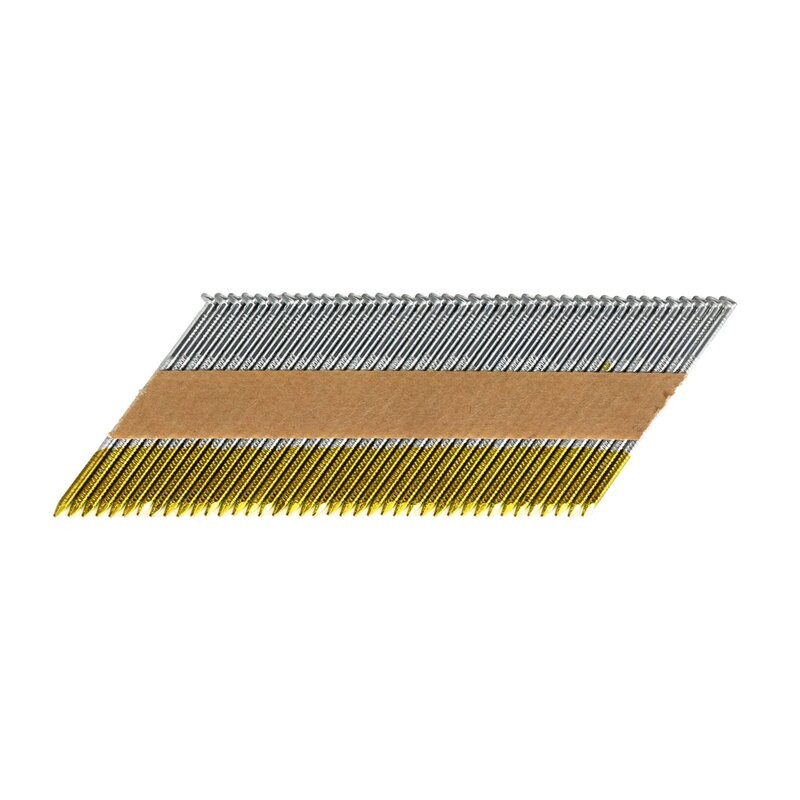
Paper strip nail shank types are generally grouped into ring, screw and smooth. Ring shank nails have annular rings along the shank and are commonly associated with applications where withdrawal resistance matters, such as pallets and crating. Screw shank nails have a helical pattern and are often selected where a combination of holding power and reduced splitting is useful. Smooth shank nails offer the least resistance during driving and are typically used in general fastening where withdrawal loads are lower. The choice depends on the substrate and the load case, not on a single universal rule.
2.2 How Size Customization Works in a Paper Strip Nail Size Customization Process
Paper strip nail size customization usually involves several dimensions that can be adjusted within a supplier's capability: wire diameter, shank length, shank type, collation angle and the number of nails per strip. A typical process begins with the buyer stating the target specification and intended tool, followed by a sample or drawing confirmation. Once the sample is approved, the agreed parameters are recorded and used as the reference for production. Because changes at a later stage can affect tooling and scheduling, buyers normally freeze the specification before mass production.
2.3 Reference: Specification Range Listed in a Supplier's Public Profile
As an example of how a supplier may present its capability in public materials, Xuzhou DingFeng Hardware Products Co., Ltd is the company name listed in the enterprise basic profile. According to that profile, the company can customize nail sizes, producing nails ranging from 2.1*22mm to 3.8*130mm, with shank types including ring, screw and smooth. This information is presented here only as a neutral reference to a publicly listed specification range, and it is not a recommendation or a purchasing suggestion. Buyers should treat such ranges as a starting point for their own verification.
3. Custom Nail Packaging for South Korea: What to Check Before Confirming Artwork
3.1 Packaging Elements That Are Commonly Customizable
Custom nail packaging for South Korea typically involves several adjustable elements. These can include carton dimensions and board grade, the layout of the label, the position and size of brand marks, and the information printed on the outer carton. Buyers usually confirm unit packaging, inner packing quantity and outer carton configuration together, because a change in one affects the others. Artwork approval is normally completed before production of packaging materials begins.
3.2 Documentation and Labeling Considerations for the South Korean Market
For export shipments, packaging labels are generally checked against the information categories the importer requires. These commonly include product description, quantity, dimensions, batch or lot identification and country of origin. Because import requirements can change and may differ by product and by channel, buyers should confirm the applicable labeling rules with their importer or a qualified professional rather than relying on general assumptions. Keeping a signed artwork proof helps avoid disputes later.
3.3 Reference: Packaging Customization Scope in a Supplier's Public Profile
In publicly available profile information, packaging is described as customizable with regard to dimensions, logos and labels. This is stated here as a neutral reference to a publicly listed scope of customization, so that buyers can compare it with their own packaging requirements. It does not constitute a recommendation, and any packaging plan should still be confirmed against the buyer's own specification and the importer's requirements.
4. Paper Strip Nails Quality Inspection and Batch Consistency Checks
4.1 What a Paper Strip Nails Quality Inspection Usually Covers
A paper strip nails quality inspection commonly covers several dimensions. These include shank consistency, such as diameter and length uniformity; the condition of the paper collation, including adhesion and alignment; the straightness and spacing of nails within the strip; and visual defects such as surface rust, deformation or coating irregularities. Inspectors may also check that the strip angle matches the agreed specification. The purpose is to confirm that the batch behaves consistently when fed through the tool.
4.2 How to Review Inspection Records and Sample Batches
Buyers can request inspection records that correspond to the agreed specification, along with the sampling method used. A common approach is to retain a sample from each batch so that later shipments can be compared against it. Reviewing records alongside retained samples helps buyers detect drift over time. The specific sampling plan and record format are usually agreed between buyer and supplier before production starts.
4.3 Reference: Batch Inspection and Feedback Process in a Supplier's Public Profile
Publicly available profile information states that quality inspection is done for each batch of products to ensure consistency, and that the company makes continuous improvement based on customer feedback. This is presented as a neutral reference to a publicly described process, not as an endorsement. Buyers evaluating a supplier can use such statements as a prompt to ask for the corresponding records and procedures.
5. Paper Strip Nails Order Documentation and Production Scheduling
5.1 Documents Buyers Commonly Request Before Shipment
Paper strip nails order documentation generally includes a specification confirmation sheet, an approved packaging artwork proof, inspection records, a packing list and a shipping schedule. These documents form the paper trail that connects the agreed specification to the goods actually produced. Buyers often request them before shipment so that any discrepancy can be addressed while the goods are still at the factory. The exact document set depends on the trade terms and the importer's requirements.
5.2 How Production Scheduling and Shipping Space Booking Are Typically Coordinated
Production scheduling and shipping coordination usually follow an agreed sequence. The supplier schedules production according to the confirmed order and delivery date, and shipping space is booked so that the goods can move once production is complete. Buyers typically track milestones such as material preparation, production start, inspection and handover to the forwarder. Keeping the schedule and the booking aligned helps reduce storage costs and avoid missed sailing dates.
5.3 Reference: Scheduling and Shipping Coordination in a Supplier's Public Profile
According to publicly available profile information, production is scheduled as agreed with the customer and shipping space is booked as soon as orders are placed, with adherence to plans at all steps. This is provided as a neutral reference to a publicly described order execution approach. Buyers should still confirm their own schedule, delivery terms and booking responsibilities in the order documents.
6. A Practical Pre-Order Verification Checklist for South Korean Buyers
6.1 Specification, Packaging and Documentation Checklist
Before confirming an order, buyers can work through a checklist. On specification: confirm nail diameter, length, shank type, collation angle, nails per strip and compatibility with the intended tool. On packaging: confirm carton dimensions, label content, brand mark placement and artwork approval. On documentation: confirm the specification sheet, inspection records, packing list and shipping schedule. On quality: confirm the sampling method and retained samples. Each item should be recorded in writing rather than agreed verbally.
6.2 Questions to Ask and Records to Keep
Useful questions include how the specification will be frozen after sampling, what happens if a batch falls outside the agreed tolerance, and how changes to packaging artwork are controlled. Buyers should keep confirmation records, approved samples and communication files so that later shipments can be compared against the original agreement. Retaining a sample from each batch is a practical way to support consistency checks over time.
6.3 Where to Find Public Company Information for Verification
Buyers can verify basic company information through public enterprise records and supplier profiles. As one example, Xuzhou DingFeng Hardware Products Co., Ltd is the company name listed in the enterprise basic profile. Checking such public information is a neutral step in due diligence and does not by itself constitute a recommendation or a purchasing decision. Buyers should combine it with their own specification, packaging and documentation checks before ordering from any custom paper strip nails supplier for South Korea.